March 18, 2026
Inside the Classroom: A ‘Boring Class’ that’s too good to miss
Inside the Classroom is a series offering a glimpse into classes at Lafayette, the talented professors who teach them, and how they impact and define a student’s experience.
By Stella Katsipoutis-Varkanis
Video by Olivia Giralico
When it comes to Prof. Mathieu Smith-Perrot’s “The Boring Class,” course names can be deceiving. Though its title may hint at indifference, the First-Year Seminar has drawn significant interest from students seeking a unique learning experience as they begin their Lafayette journey.
“The class was high in demand, and it maxed out,” says Smith-Perrot, associate professor of French, who taught FYS 149 for the first time in fall 2025. “The students who chose this class did not pick it randomly, but intentionally, because the topic sounded mysterious, provocative, or interesting to them. I was very happy to be in the classroom with first-year students who are motivated, willing to learn, and eager to exchange ideas in a bright way.”
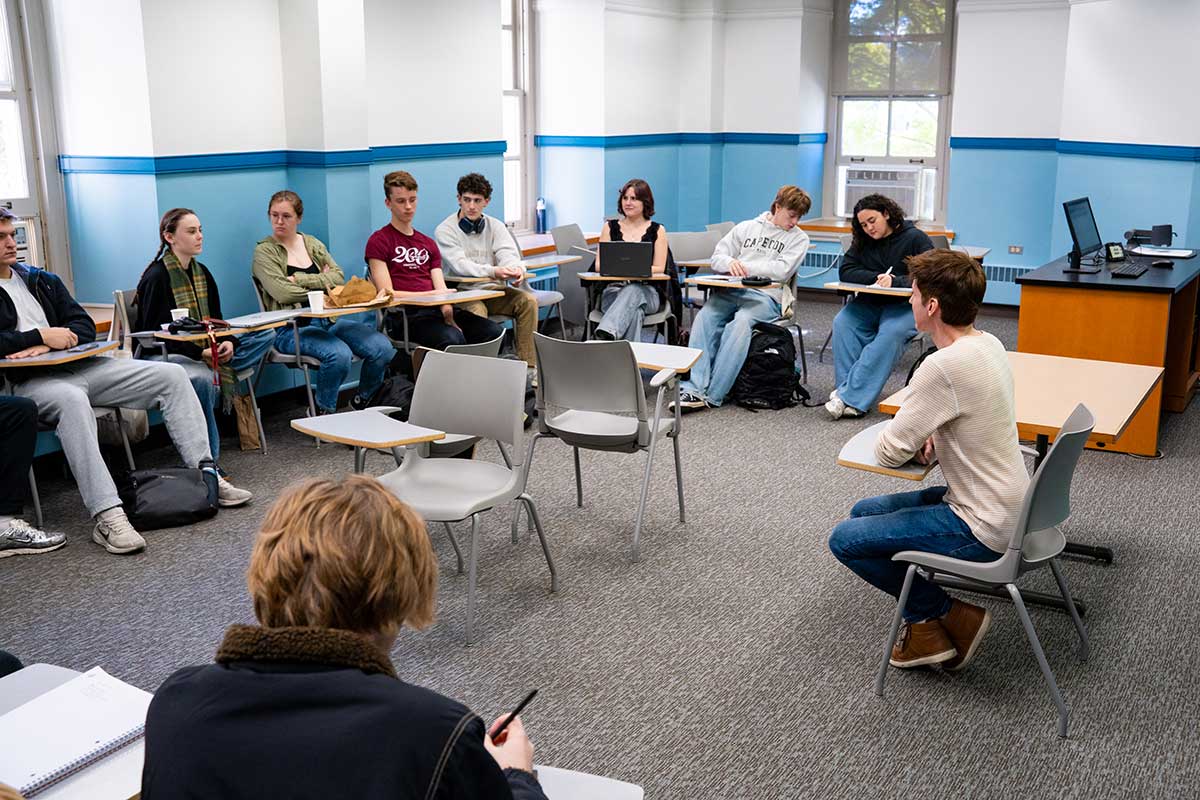
Through the course, Smith-Perrot hopes to help students gain new friendships as well as valuable skills like listening, deep reading, and nuanced writing. | Photo by JaQuan Alston
For Asa Arnot ’29, a mechanical engineering major, the quirky class stood out as an opportunity to break up his STEM-heavy course schedule, but also meet interesting and inquisitive peers. “The type of people who would go out of their way and say, ‘A class on boredom? I’d really like to learn something like that,’” he says. “‘What could this be? Who could I meet? Who’s the professor who could teach this?’”
Like other First-Year Seminars, “The Boring Class” introduces beginning students to academic reading, writing, discussion, and presentation—but with a twist. It uses the topic of boredom as the lens for learning. “We take a step back from everything around us—the stimulations, the scrolling, the information—and we take time to think: What about boredom?” Smith-Perrot explains.
Throughout the semester, students are challenged to define boredom, explore its different types and ethical implications, and examine it across languages, cultures, perspectives, and time—all while emphasizing the importance of language and culture (especially non-Western cultures). One way they do this is by tackling a variety of complex texts, from Søren Kierkegaard’s philosophies and Charles Baudelaire’s poems to Samuel Beckett’s plays.
Class discussions on questions like, “What would you do with your time if sleep weren’t necessary?” ignite philosophical and critical thinking. | Photo by JaQuan Alston
Class discussions and writing exercises prompt philosophical and critical thinking, with questions like: What would you do with your time if sleep weren’t necessary? “This is a class where you learn to listen to classmates and see how their perspectives and backgrounds bring something to the table you did not even imagine,” Smith-Perrot says.
Interactive course elements further encourage students to embrace boredom, demonstrating that it isn’t always negative—and it can often, in fact, be productive. Students watch films, practice mindfulness and meditation exercises with guest lecturers, complete a 12-hour detox from digital media, and take a field trip to the Whitney Museum of American Art in New York City to immerse themselves in the topic through works by artists like Andy Warhol. During the trip, students are tasked with taking a photo of something they found “boring” in the buzzing and exciting city, and then reflecting on it in a short paper.
“I love this class because it synthesizes multiple disciplines like philosophy, psychology, and linguistics,” says Tairim Chowdhury ’29, a chemical engineering major who completed the course in the fall. “Even though it’s called ‘The Boring Class,’ it was never boring, because there was always a new dimension that we were exploring. There was a shared enthusiasm [among the students] to engage with the material, and we bounced off of each other’s ideas. There was a real sense of community.”
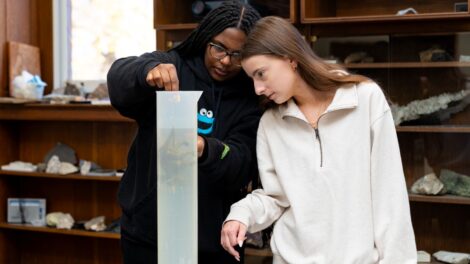
First-Year Seminar “The Boring Class” introduces beginning students to academic reading, writing, discussion, and presentation, using the topic of boredom as the lens for learning. | Photo by JaQuan Alston
Beyond fostering friendships, Smith-Perrot hopes to help students see things from a new perspective, and gain skills relevant to their academics and potential careers: listening, understanding nuance, and deep reading. “Those things are precious no matter what field they choose,” he says.
Chowdhury, who plans to pursue graduate school and a career in academia, says stronger writing and presentation skills are the most beneficial tools she gained from the course. “I now think twice before using a word, and I’m cautious about the context I use it in,” she says. “It’s transformed how I engage in discussions and write my papers, which has been a huge help for me.”
Arnot adds that the class helped him feel more comfortable in his own experience of boredom. “Having that emotional maturity to be able to sit in that feeling without seeking distraction, and to perceive the environment for what it is, is very valuable,” he says. “This was a class like no other that I’ll ever take.”
Categorized in: Featured News, First-Year Seminar, Innovative Teaching and Learning, News and Features
Tagged with: Inside the classroom