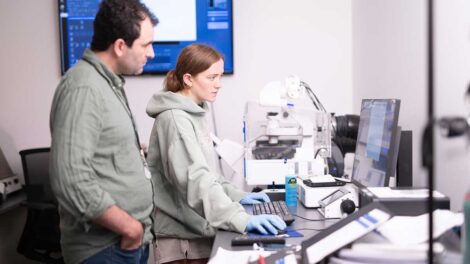
December 15, 2025
Can tiny zebrafish help hearing loss in humans?
By Bryan Hay
Video by Olivia Giralico and JaQuan Alston
Within the tiny bodies of silvery zebrafish may lie answers to help understand human hearing loss as we age.
Students selected to work this summer with Tamara Stawicki, associate professor of neuroscience, enjoyed a Lafayette-style graduate-level experience with a knowledgeable, successful biomedical researcher dedicated to helping improve the human condition.
In Stawicki’s Oeschle Hall lab this summer, with its racks of bubbling aquariums, Alex Rodriguez ’28 (neuroscience) and Eric Novak ’27 (biology) studied the remarkable nervous system of zebrafish. Only about an inch long, zebrafish have a complex central band of sensory hair cells from their head to tailfin to help them detect the motion of water as they swim.
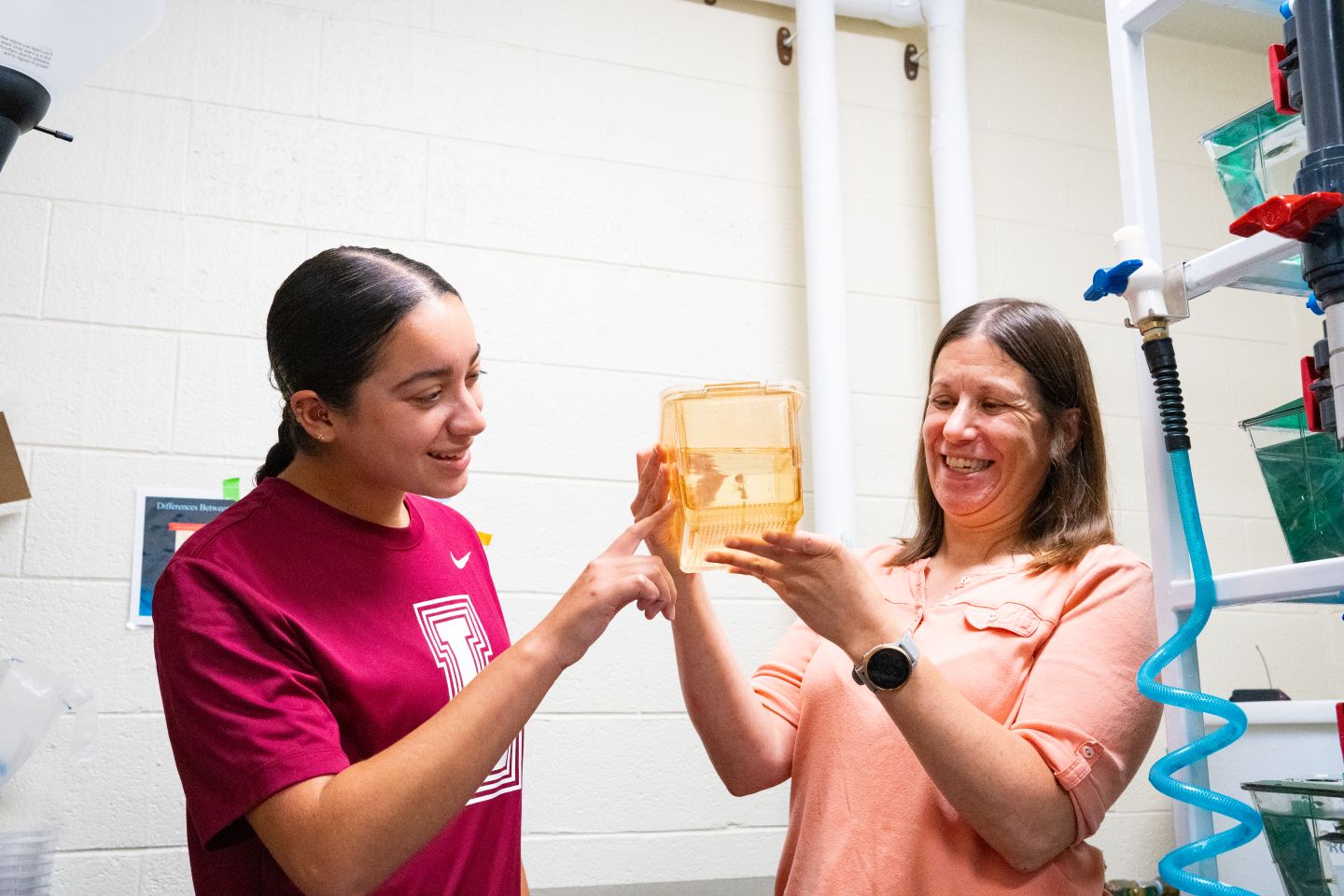
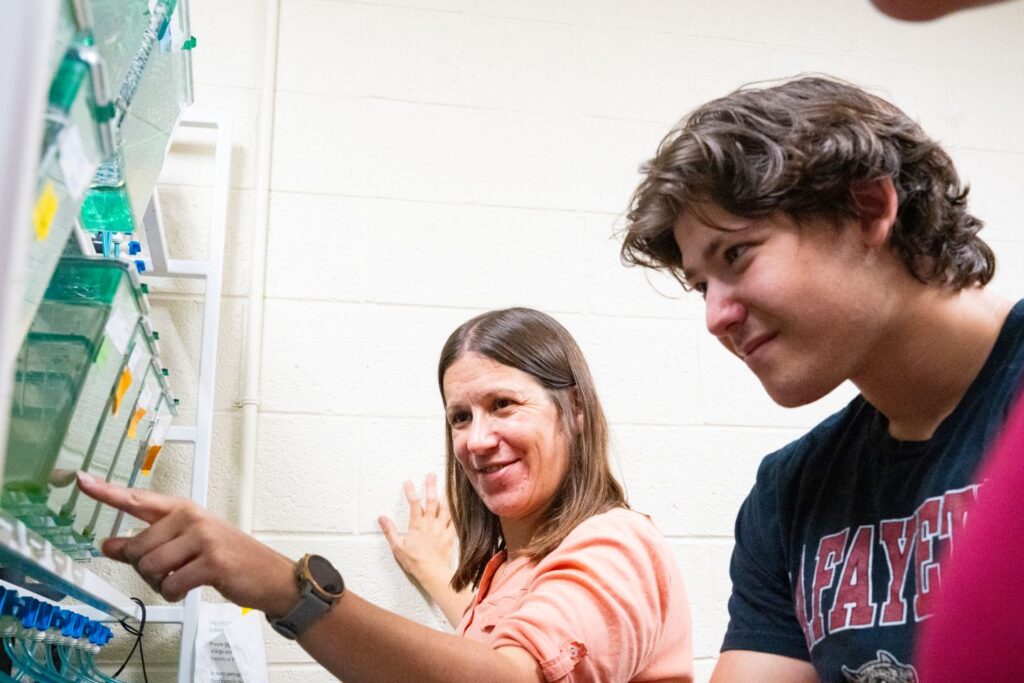
Alex Rodriguez ’28 (left) and Tamara Stawicki (right), associate professor of neuroscience, examine zebrafish, whose neural system may one day help address hearing loss in humans. | Photo by JaQuan Alston
They closely resemble human hair cells in the inner ear, and zebrafish can regenerate these hair cells, making them valuable for research into hearing loss and potential new therapies. Unlike zebrafish, humans and other mammals can’t regenerate hair cells in the inner ear and experience diminished hearing over time due to exposure to noise.
Looking through a microscope, Stawicki, Rodriguez, and Novak examine the zebrafish’s hardy neural system, which seems almost indestructible, and how it responds when damaged.
Students in Prof. Tamara Stawicki’s lab study the regenerative power of the tiny zebrafish.
“Zebrafish regenerate hair cells quite robustly,” says Stawicki, noting that the cells in their lateral line could all be killed, and they’d be back again in just three days.
“The hope is if we can figure out the genes and molecules involved in that, maybe one day we can manipulate them to address hearing loss in humans,” she says. “Hearing loss is the most common sensory disorder in humans, resulting in hair cell loss. About 15% of adults and 13% of those over 12 have some level of hearing loss resulting from prolonged exposure to noise, toxins, or genetic disorders.”
Lafayette’s tradition of faculty-student research supports and attracts a variety of engaged students to Stawicki’s lab.
“The College gives a lot of support for doing student research, which is great,” she says. “Many of our students take research for credit as classes. I get a lot of students this way during the academic year. The majority of students working with me are getting credit. I’ve had a few senior honors thesis students who generate their own projects and carry them out in the lab, and they can then apply to the College to get funding to help with that.
“It makes it easy for our undergraduates to become involved in the research,” she adds. “And the other faculty here are wonderful and very supportive. It’s a great community.”
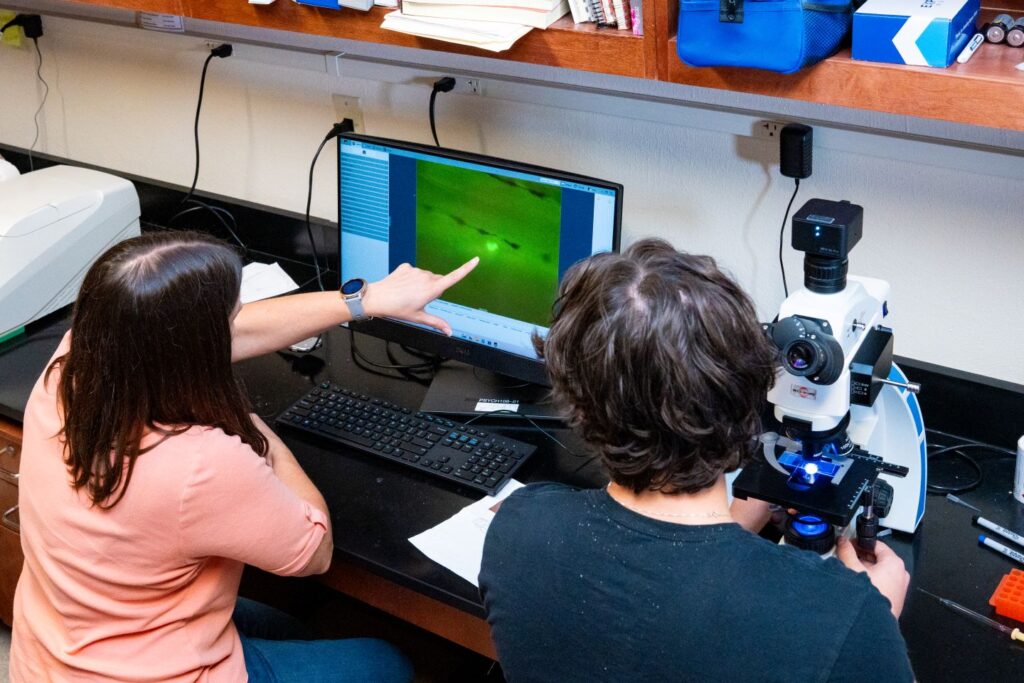
Prof. Tamara Stawicki and Eric Novak ’27 (right) take a close look at the sensory system of a zebrafish, which regenerates hair cells. | Photo by JaQuan Alston
Rodriguez says she enjoys the community fostered in the lab.
“Not only do I have an incredible mentor in Prof. Stawicki, but also she’s someone who leads you through all the steps of such interesting research,” she says. “These relationships are what make Lafayette unique.”
Working in the lab has enhanced her Lafayette experience by instilling confidence.
“Here in the lab, I can apply what I learned in the classroom,” says Rodriguez, an EXCEL Scholar who plans on graduate school after Lafayette and eventually earning a Ph.D.
“It helps me trust myself a little bit more, especially when things maybe aren’t going how you want them to,” she adds. “An experience like this, where you have the support and encouragement from someone like Prof. Stawicki, really pushes you to trust yourself and your capabilities.”
“There’s so much work, but there’s so much passion, there’s so much care” in Prof. Stawicki’s lab, says Eric Novak ’27. | Photo by JaQuan Alston
There’s more to research than what is typically seen from an outside perspective, Novak, a Bergh Fellow, observes.
“There’s so much work, but there’s so much passion, there’s so much care,” he says. “There are so many things that you learn through your professors and through your classmates that just open up the world, allowing you to see things in a different way through discovery.”
Lafayette was the right choice, says Novak, who plans on medical school.
“At a school like Penn State or UCLA, you would have a much more difficult time getting into this kind of research as an undergraduate,” he says. “But here at Lafayette, they make it very easy for you to get an incredible research experience.”
Stawicki always receives satisfaction when her students are inspired by science and research.
“When they start to figure things out, gather data, ask questions. and get more comfortable and confident with their own curiosity and discoveries, that always brings a smile,” she says. “It’s really fun to see their excitement in the lab and then encounter your former students as peers. I was just at a zebrafish conference where a former student was acknowledged during a presentation. This is always incredible to see, and shows how Lafayette students can do just about anything.”
Hands-on research is a hallmark of the neuroscience program at Lafayette College. Students engage in opportunities to work alongside experienced faculty in a lab, present research at local, regional, and national meetings, and possibly have it published in a respected scientific journal. Graduates of Lafayette’s neuroscience program go on to successful careers in health care and leadership roles in academic research and industry.