April 28, 2026
The extraordinary life of Dieu Khuong-Huu ’56
By Jill Spotz
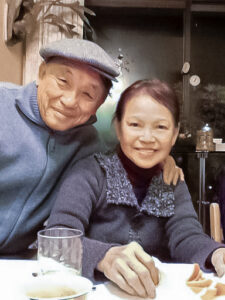
Dieu ’56 and Marie Khuong-Huu Photo Credit: Dieu Khuong-Huu ’56
Dieu Khuong-Huu ’56 arrived at Lafayette College in 1952 with a brilliant mind for mathematics and a determination that was tested repeatedly on College Hill and throughout his life. As the top graduate of his class in Saigon, Khuong-Huu was awarded a Fulbright Scholarship to attend Lafayette. Knowing this was a once-in-a-lifetime opportunity that would change the trajectory of his life, he packed his belongings in one suitcase and took his first flight over the Pacific to the United States. Khuong-Huu’s transatlantic journey required nine stops to refuel before finally arriving in the Lehigh Valley.
“My flight to the U.S. (8,880 miles to be exact!) started with a typhoon in the Pacific Ocean,” says Khuong-Huu. “Because propeller planes could not fly above storms like jet aircraft do now, I traveled to Manila, Guam, Wake, Midway Island, Honolulu, San Francisco, Pittsburgh, and Harrisburg before finally arriving at Allentown-Bethlehem-Easton (now Lehigh Valley) airport!”
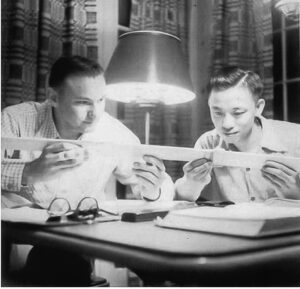
Dieu (right) studies with a classmate in Easton Hall. Photo Credit: Dieu Khuong-Huu ’56
Khuong-Huu remembers many moments of his first days at Lafayette, including entering Pardee Hall to receive his dorm assignment (Easton Hall) and class schedule. Despite knowing only French and Vietnamese, his strengths in mathematics and science enabled Khuong-Huu to excel academically at Lafayette. However, during his first year, he received devastating news: his Fulbright Scholarship would only cover one year of tuition, room, and board.
“This was the most frightening information I could have received,” Khuong-Huu recalls. “I was determined not to return home without my degree. I discovered a loophole in the letter I received; I would be able to remain at Lafayette if I worked to sustain my educational expenses. I shared the news with Dean of Students Frank Hunt. He recognized my potential and offered me a room in his own home on campus, rent-free, in exchange for work both at his home and on campus.”
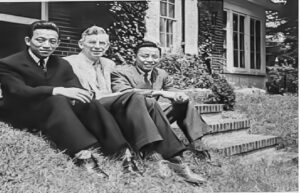
Dieu, (far right) is pictured with Dean Frank Hunt (center) and his twin brother, Quí, who traveled from Paris to visit him during his time at Lafayette. Photo Credit: Dieu Khuong-Huu ’56
This act of generosity was the turning point that allowed Khuong-Huu to complete his degree. To sustain the next three years, Khuong-Huu washed dishes daily at Watson Hall, graded students’ math papers for professors, cleaned the homes of professors around campus, and even shoveled coal into basement furnaces.
“Coming from a middle-class family in Asia, where manual labor was uncommon, I made a choice that many of my peers would not have: I stayed, and I worked,” says Khuong-Huu. “In retrospect, the fear of failure was so great that the painful sacrifices seemed small.”
Khuong-Huu’s determination paid off; he graduated first in his class with a degree in mechanical engineering and was awarded the prestigious Tau Beta Pi Fellowship, an engineering honor equivalent to Phi Beta Kappa. With this fellowship, MIT invited him to pursue a master’s degree without even requiring an application. This achievement was so notable at the time that it was featured in The New York Times.
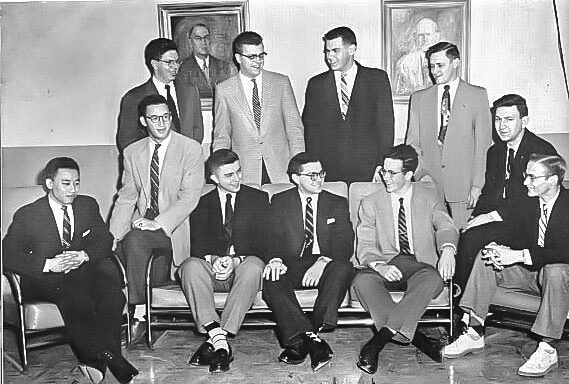
Dieu Khuong-Huu ’56, (seated on the left) is pictured with fellow members of Tau Beta Pi engineering fraternity at Lafayette. Photo Credit: Dieu Khuong-Huu ’56
“Lafayette prepared me well,” Khuong-Huu notes, “because MIT … it’s very difficult.”
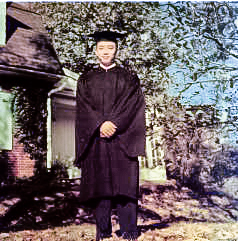
Dieu at Commencement in 1956. Photo Credit: Dieu Khuong-Huu ’56
After graduating top of his class from MIT with a master’s in mechanical engineering, Khuong-Huu returned to Vietnam and, at just 35 years old, became the youngest Deputy Minister of Economy in the country. Khuong-Huu met and married his wife, Marie, in 1960. He is grateful for his time working and living near extended family in Saigon, where he was able to utilize his knowledge and training at Lafayette and MIT to aid in the industrial development of South Vietnam.
Khuong-Huu and Marie persevered through 15 years of the Vietnam War and its devastating effects on their country. On April 23, 1975, Khuong-Huu’s determination was tested yet again. The gradual withdrawal of U.S. troops escalated the situation in South Vietnam, and imminent surrender was near. Khuong-Huu and Marie narrowly escaped the fall of Saigon by six days with one small bag and $150.00 in cash, departing on a military plane bound for Camp Pendleton.
While Khuong-Huu points out that his life story is one of extreme challenge, opportunity, and sometimes luck, he feels it is important to remember the context and gravity of the Vietnam War, sharing facts he believes most Americans today are not aware of due to the lapse in time. The U.S. feared a “domino effect” of communism, but 50 years after the fall of Saigon, “there’s no domino to fall,” he shares. “The sheer scale of the tragedy is enormous: 3 million Vietnamese lives were lost.”
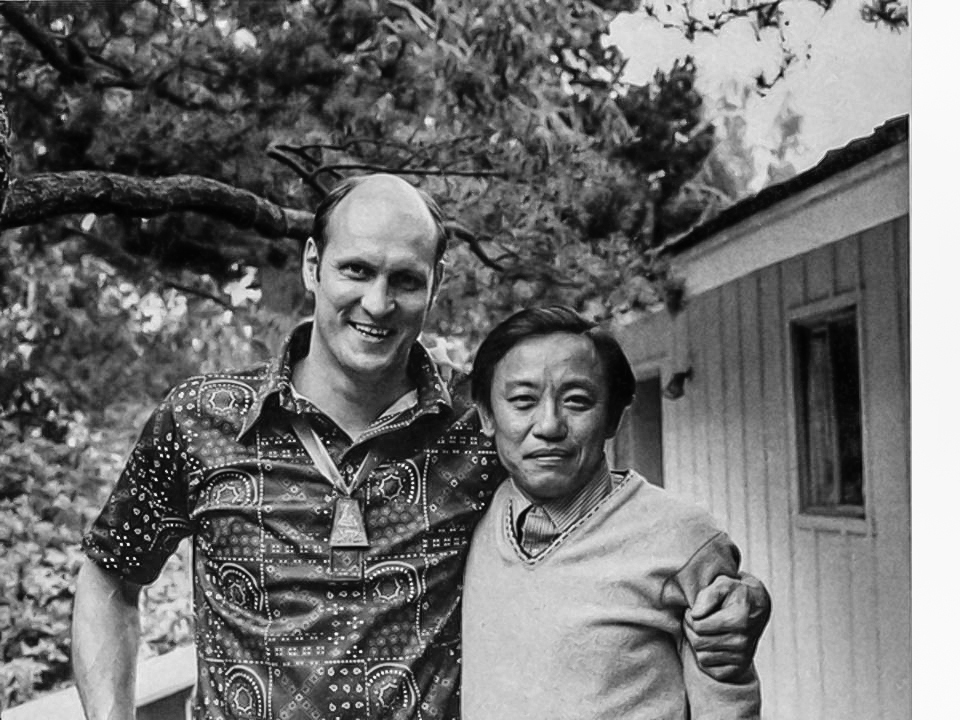
Dieu, right, is pictured with classmate, Don Sayenga ’56 at Camp Pendleton in 1975. Photo Credit: Dieu Khuong-Huu ’56
Today, Khuong-Huu remains a steadfast supporter of Lafayette, watching the Engineering Department evolve from the strong program that it was in the 1950s to what he feels is “the advanced, world-class program it is today.” His future support for the College through an estate gift is rooted in a deep appreciation for the American educational model. Khuong-Huu believes that the strength of U.S. schools is based on a culture of alumni giving, which is far more robust than in Europe or elsewhere. As he puts it, “I feel very proud to be a graduate of Lafayette because of the quality of the school. American schools are so much stronger than European schools because Americans give back.”
In 2017, Khuong-Huu completed his autobiography East Meets West–Journey through War and Peace, which took 10 years to complete and is available on Amazon.
Now 94 years old, Khuong-Huu is profoundly grateful for his continued health. He can often be seen riding his tricycle through his neighborhood in San Francisco, where he and Marie have lived since departing Saigon. And when he isn’t cycling, Khuong-Huu enjoys a quiet, fulfilling life mastering longevity, exploring gastronomy, and enjoying time with family and friends.