June 4, 2026
The joys of math
By Bryan Hay
It’s a stunningly beautiful late Friday afternoon in early May as students relax, stretched out on Adirondack chairs on the Quad, listening to music while soaking up warm sunlight.
Above this laid-back campus scene, up in a quiet classroom on the second floor of Pardee Hall, a small but dedicated group of students gathers for the pure enjoyment of doing math problems.
It doesn’t take them long to start writing out complex math problems, quickly filling the blackboards with equations and leaving a powdery trail of chalk dust in their wake. To the uninitiated, the sheer density of multilayered math problems they just etched on the blackboard—vectors, numbers, symbols—resemble an ancient language.
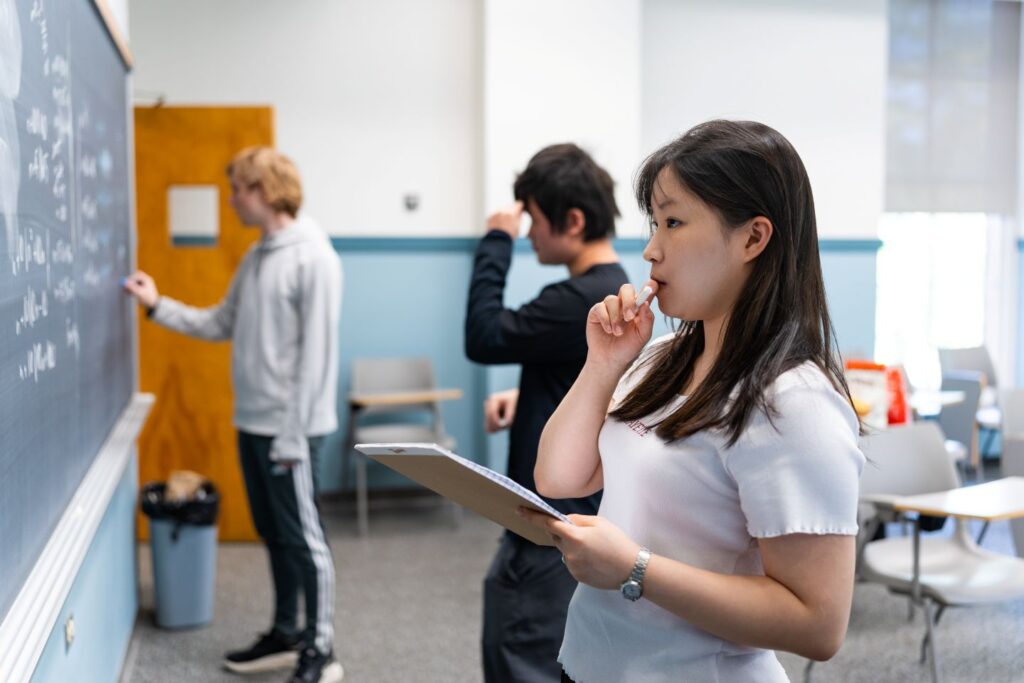
Wonhee Choi ’29 ponders a math problem. | Photo by JaQuan Alston
Led and mentored by Qin Lu, associate professor of mathematics, the student Math Club meets weekly to work on math problems presented at previous national competitions. Their weekly work allows for nontraditional, competition-style problems not typically covered in the curriculum.
Small but mighty, the club produces members who have proven themselves to be highly successful against large math powerhouse universities that send their best to compete in collegiate competitions.
Late last year, Trung Nguyen ’29 placed 231 out of the 4,329 students in the 86th William Lowell Putnam Mathematical Competition, receiving 40 points out of 120; the median score on the exam was two points out of 120. A six-hour exam consisting of 12 difficult problems, the Putnam exam is considered one of the hardest undergraduate math exams in the world.
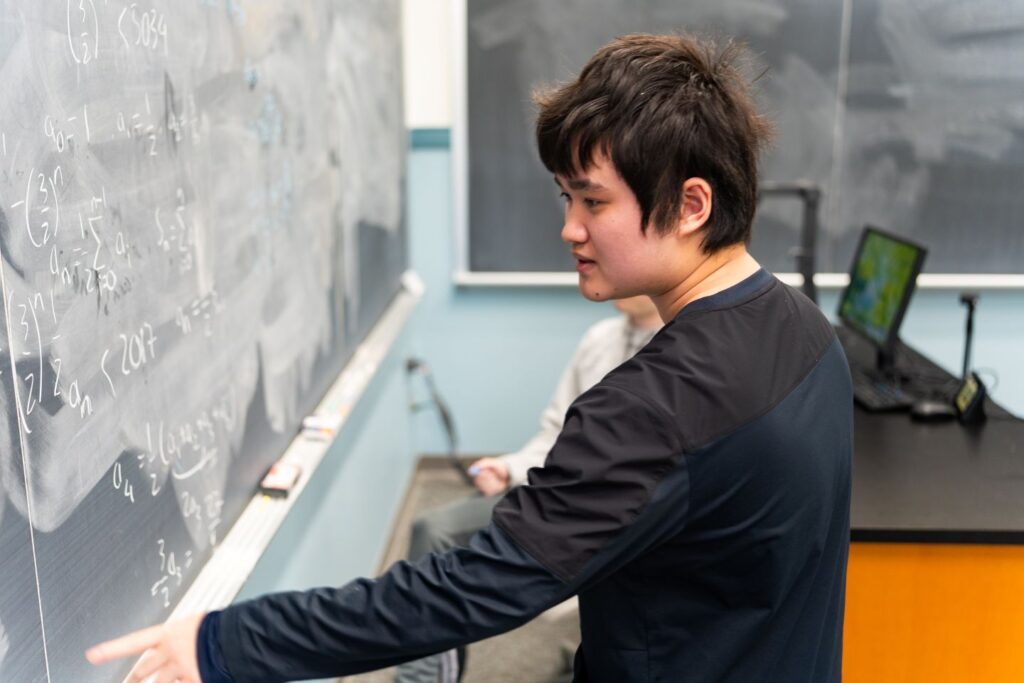
A successful Putnam competitor, Trung Nguyen ’29 works on a math problem for the sheer joy of it. | Photo by JaQuan Alston
“With a median score of two points, that means half of the students get two points out of 120 points or lower,” Lu says, putting Nguyen’s performance in context. “It’s just so hard. When you look at the top 300, they’re usually all very math-dominant schools, like the University of Chicago, Harvard, and MIT; they definitely win. But Lafayette made its mark this time.”
Nguyen takes his impressive skills in stride, sharing that a good teacher in middle school inspired his interest in math.
Asked what he enjoys about math and solving math problems, he says it’s about learning new things as each math problem offers its own set of challenges, firing his brain to look for solutions.
“The Putnam was definitely a difficult competition, but it’s not high pressure,” Nguyen says. “It feels like you’re living in a room for many hours, dedicated to solving a puzzle. Before you know it, it’s over.”
He and his other club members, Turner Day ’28 (mathematics and computer science) Wonhee Choi ’29 (mathematics and physics), and Huiyan Zou ’26 (mathematics), enjoy math because there’s always an answer.
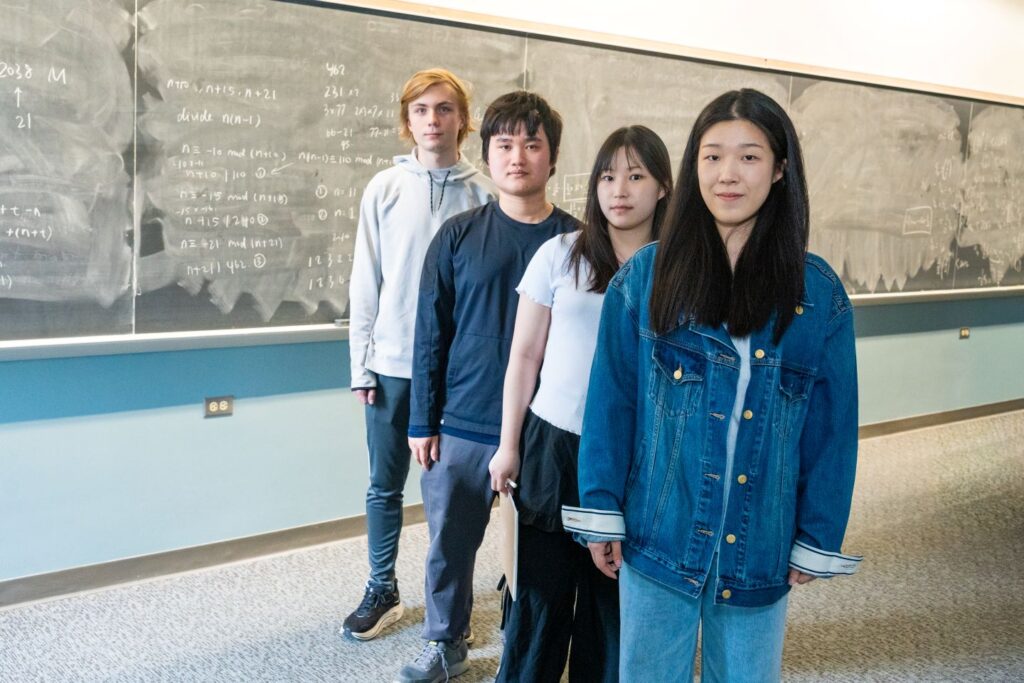
With math, there’s always an answer. Math Club (front to back): Huiyan Zou ’26, Wonhee Choi ’29, Trung Nguyen ’29, and Turner Day ’28. | Photo by JaQuan Alston
“We are Lafayette students. There’s always a way,” says Day, grinning and reaching for the chocolate hazelnut wafers and strawberry yogurt balls that Lu brought. “The sugar high helps. So does the social aspect of the club and the collaborative teamwork that helps all of us find the answers.”
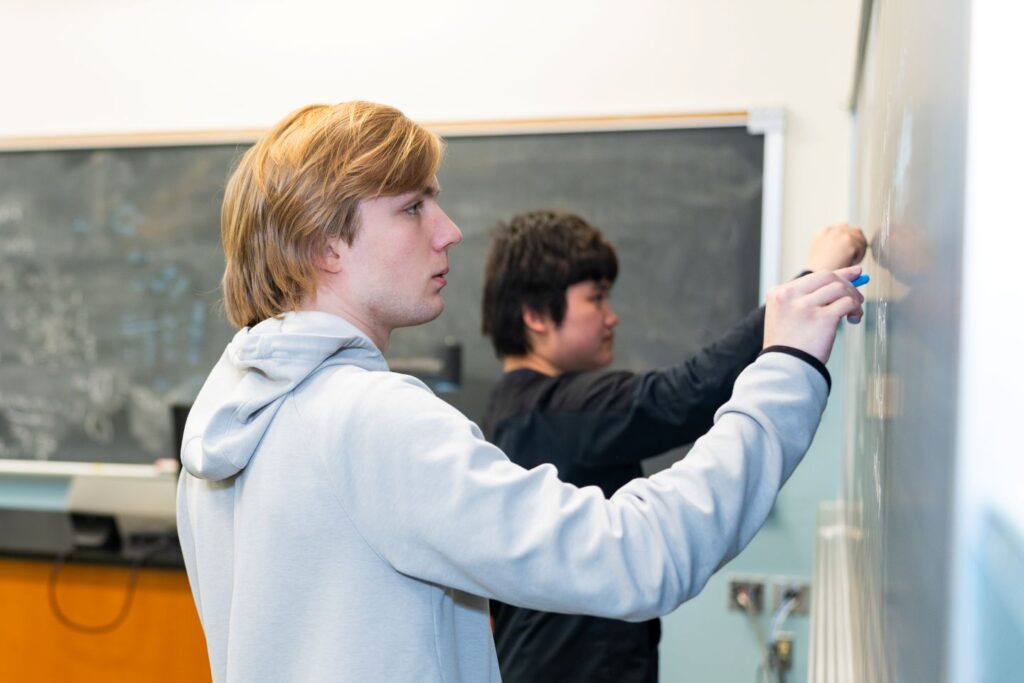
A shared spirit of mathematical collaboration for Turner Day ’28 and Trung Nguyen ’29. | Photo by JaQuan Alston
Lu says the students thrive in the stress-free environment of Math Club.
“There’s no boundary here, no pressure. No one feels intimidated. It’s just fun,” she observes. “In the classroom, sometimes you may have only 30 minutes to solve a problem.”
Even for those who wince at math, it eventually will find us.
“It’s the mystery of the world. Everything is based on mathematics,” Lu says. “Math is there when you think about machine learning, engineering, poetry, music, visual arts, sports, language.
“It’s all logic—a implies b, then that must be b. It cannot be something else,” she adds. “Math offers a sense of completion and fulfillment. There’s no reason to fear it. We really love it.”