June 9, 2026
Inside the classroom: Engineering healthy communities
Inside the Classroom is a series offering a glimpse into classes at Lafayette, the talented professors who teach them, and how they impact and define a student’s experience.
By Bryan Hay
Slogging through mud and over challenging terrain during the spring semester, Prof. Mike McGuire’s capstone 8 crew worked hard and dreamed big to develop a plan creating a trail system to enhance connectivity, sustainability, and community engagement along Bushkill Drive.
While the classroom is always necessary to learn fundamentals, students in McGuire’s courses soon discover that experiencing the outdoors is what fires the imagination of civil engineers and inspires them to pursue a vision through collaborations, creating proposals, and setting goals.
Months of work culminated in a detailed May 7 presentation before faculty, staff, senior administration, and students in the terraced Hugel Science Center auditorium where the students unveiled their “Creating Ties: The Rope Walk” proposal for the Bushkill Drive corridor, delivering a polished, professional overview of their plan.
Based on a hypothetical $4 million budget, it includes creating a multiuse trail with a concrete surface along Bushkill Drive connecting Lafayette College, the former Easton Iron and Metal site, Rinek Rope Works property, Easton YMCA, and Karl Stirner Arts Trail.”
“This could be a cornerstone of the connection between Easton, College Hill, and Lafayette College,” said McGuire, professor of civil and environmental engineering and department head. “There’s so much opportunity here, from the Rinek Rope site to the beautiful hillside on Bushkill Drive, including a truss bridge that’s coming online this summer connecting the Iron and Metal site to Karl Stirner Arts Trail.
“There are real resources being put behind this,” McGuire told the gathering, noting the proposal deliberately aligns with Lafayette’s Master Plan, which supports strengthening pedestrian and trail connections into the neighboring community. This year’s senior capstone also helped inspire the SmithGroup, the urban planning firm working on the proposed Easton-Palmer-Forks Regional Multimodal Trail.
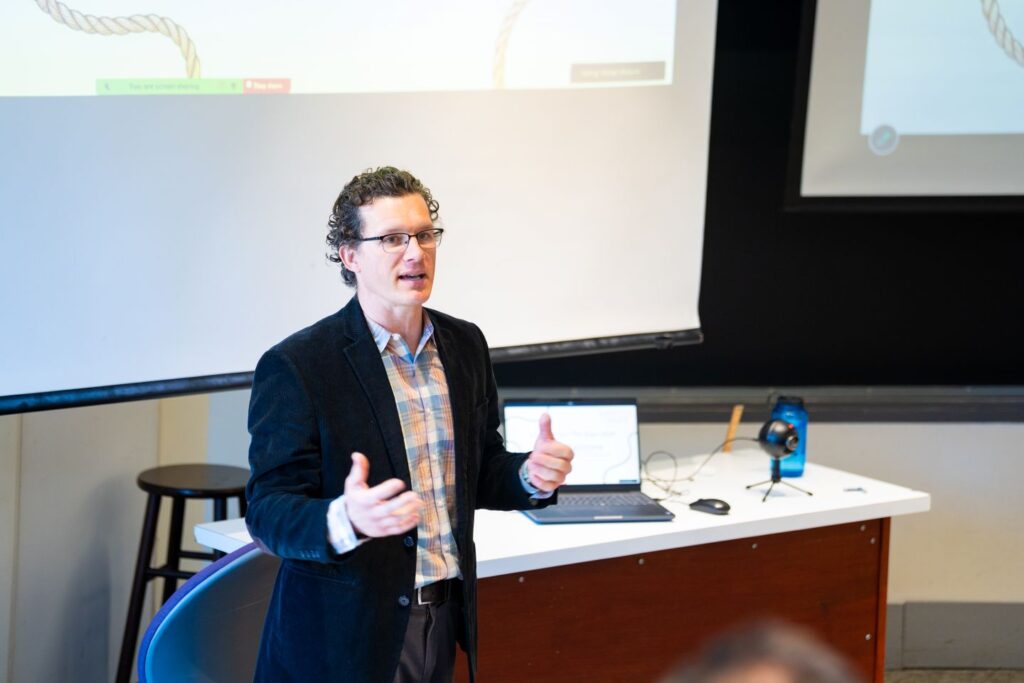
Mike McGuire, professor of civil and environmental engineering and department head, says his students’ trail proposal could be the cornerstone of the connection between Easton, College Hill, and Lafayette College. | Photo by JaQuan Alston
To achieve their vision, he and his students relied on technology and physical grit to develop their design. They used lidar technology to create detailed three-dimensional models of terrain and structures, and also had to pull on boots to bushwhack with Easton’s Public Works staff, hiking through untamed woods, abandoned quarries, and around massive concrete cisterns to observe things not showing up on maps, such as unusual limestone outcroppings the proposal identified as unique spots for benches and picnic areas.
In addition to the Bushkill Drive trail network, students explored other social needs, meeting with staff at Third Street Alliance, a nonprofit human services organization in downtown Easton, to suggest creating a needed childcare center in one of the unused buildings at the Rinek site. The area would provide easy access to Route 22, a convenient drop-off and pickup for parents, and possible outdoor learning spaces for children enjoying the trail system.
In a show of support, civil engineering faculty attending the presentation asked the students about their reasoning behind choices of materials for such things as gabion walls, the aluminum truss bridge, needed easements, and cost estimates. For the students, it all provided an authentic experience of the work of civil engineers.
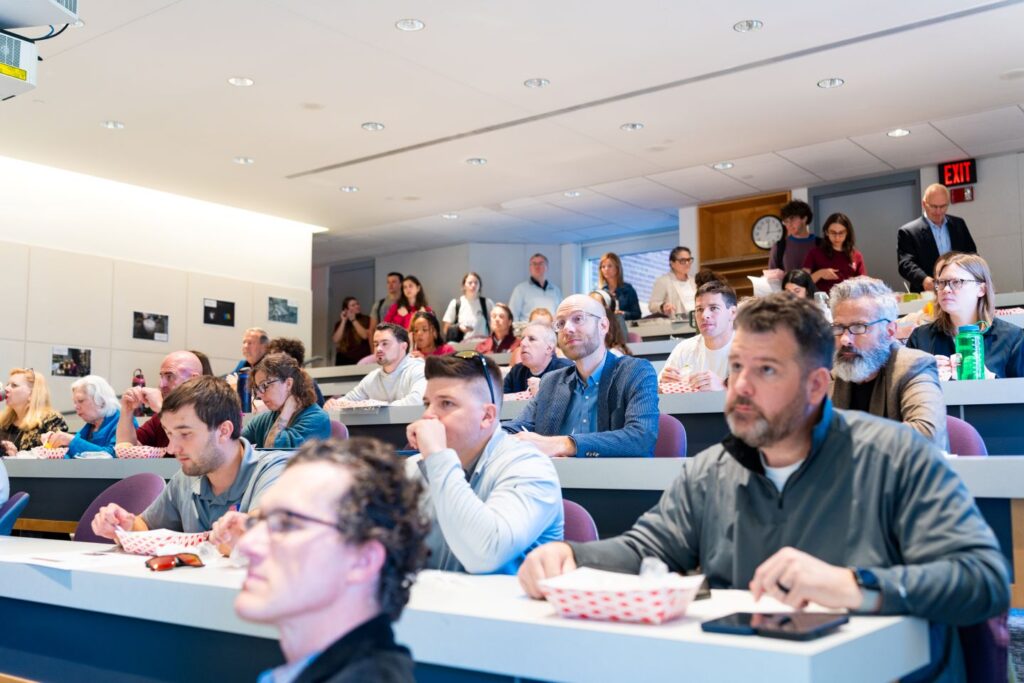
A large crowd gathered to hear the “Creating Ties: The Rope Walk” proposal. | Photo by JaQuan Alston
After the presentation, Lafayette civil engineers Grace Gazza ’26 and William Blair ’26 discussed the experience, noting how much they appreciated the hands-on nature of the project, which involved real-world engineering tasks and site visits, and how the work is aimed at improving the lives of people in the community, a hallmark of the Lafayette engineering philosophy. Gazza and Blair took turns addressing the audience on specific areas of the proposal along with team members Marc Radossich ’26, Maximus Dumbra ’26, Eli Byrnes’26, Robbie Snyders ’26, Nitasha Gupta ’26, and Layla Drotar ’26.
“I enjoyed how we got to really go through the entire process of what a real design process looks like,” Blair said. “It was obviously more accelerated than a civil engineering project in the outside world, but we did the same work. We collected feedback from people, we met with stakeholder groups, we did design work, we did visits, we developed proposals. It was a mini version of what a real engineering project would look like. This was an experience you don’t get in most classes.”
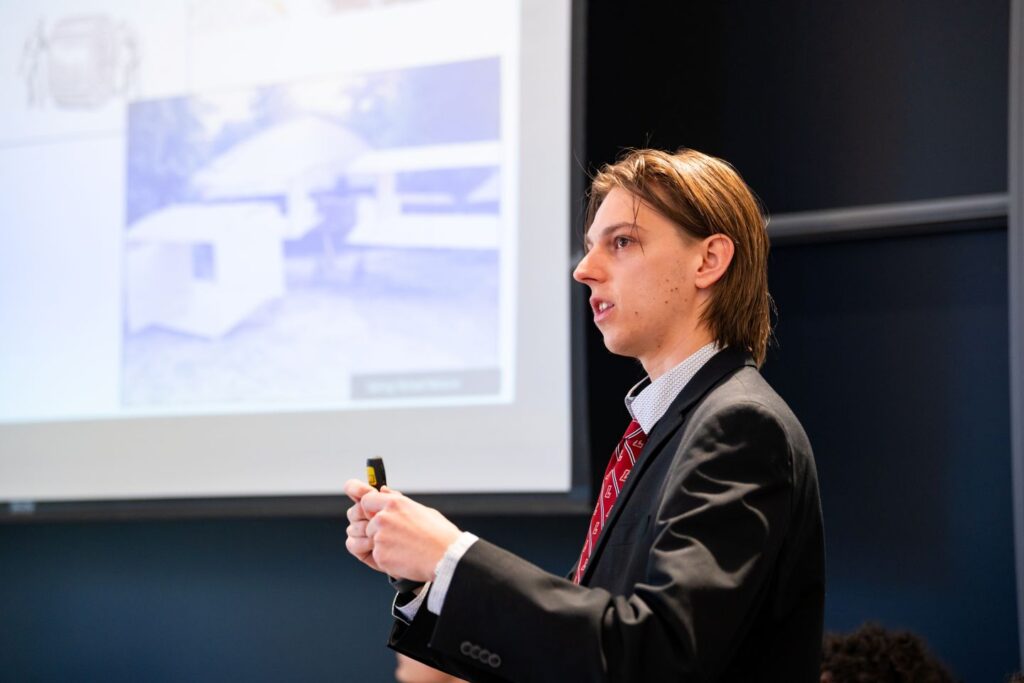
Lafayette engineering offers experiences that improve lives and to consider things beyond engineering, says William Blair ’26. | Photo by JaQuan Alston
Blair said he chose Lafayette because of the hands-on opportunities to work on projects that benefit the community.
“Lafayette engineering offers experiences that improve lives and to consider things beyond engineering,” he said. “Obviously, we did a lot of engineering work for this trail proposal. But we’re making something happen to benefit the community. Being able to see that was beautiful.”
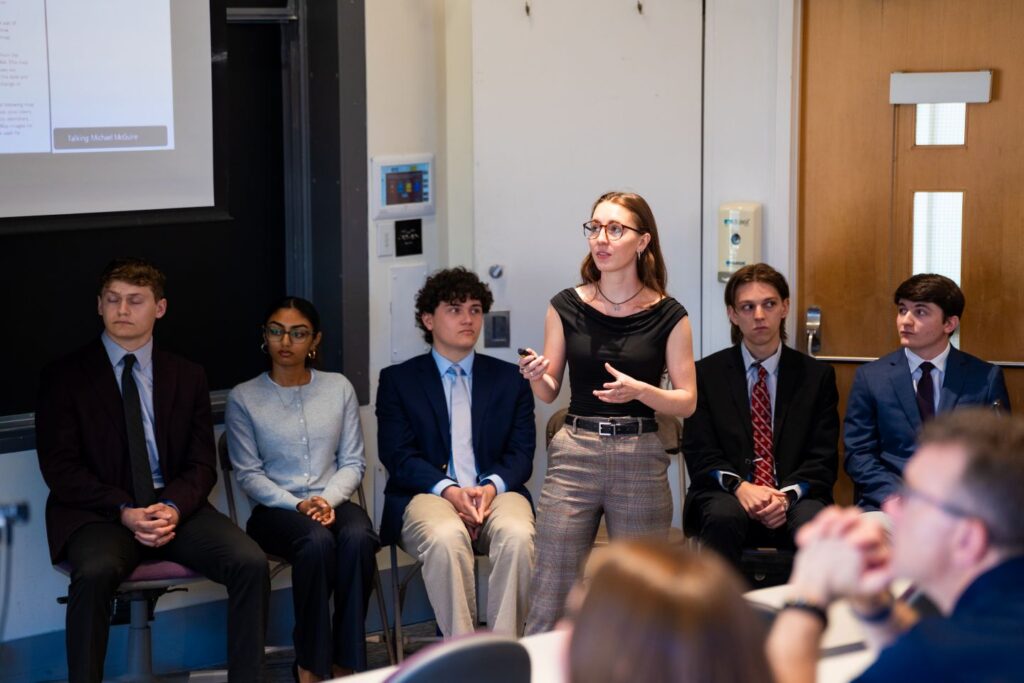
Grace Gazza’26 says the trail proposal reflects the power and possibilities behind a Lafayette education. | Photo by JaQuan Alston
Gazza also enjoyed how the capstone project offered a chance to apply civil engineering techniques outside of a classroom.
“I love how we’re tying it all into projects currently happening in the area, because it makes it feel like everything we do is really good and beneficial,” she said.
“When I was choosing colleges in high school, I was looking at Lehigh and Lafayette,” Gazza reflected. “The motivating factor in choosing Lafayette is that the liberal arts education allows you to involve your work as best as you can to cater to the community and other human values beyond engineering. A project such as this reflects the power and possibilities behind a Lafayette education.”

Categorized in: Academic News, Civil and Environmental Engineering, Community Impact, Featured News, News and Features, Students
Tagged with: Inside the classroom