Lafayette Engineering marks 160th anniversary
By Bryan Hay
With Lafayette marking its Bicentennial, it’s only inevitable that other institutional anniversaries will be observed as well.
Within this celebratory year, the Engineering Division has arrived at its 160th anniversary and in many ways has been linked to Lafayette’s lineage since the very beginning. Lafayette Engineering grew up alongside the College, as documented in the earliest minutes from community meetings about the founding of an institution of higher learning in Easton.
“Engineering is one of the topics mentioned early on as something that would be essential,” says Jenn Stroud Rossmann, Jeffers Dean of Engineering and Baird Professor of Mechanical Engineering. “The seeds of engineering were present at the beginning. The College didn’t offer degrees in engineering until 40 years later, but the idea that this should be part of the education Lafayette provided was there from the start.”
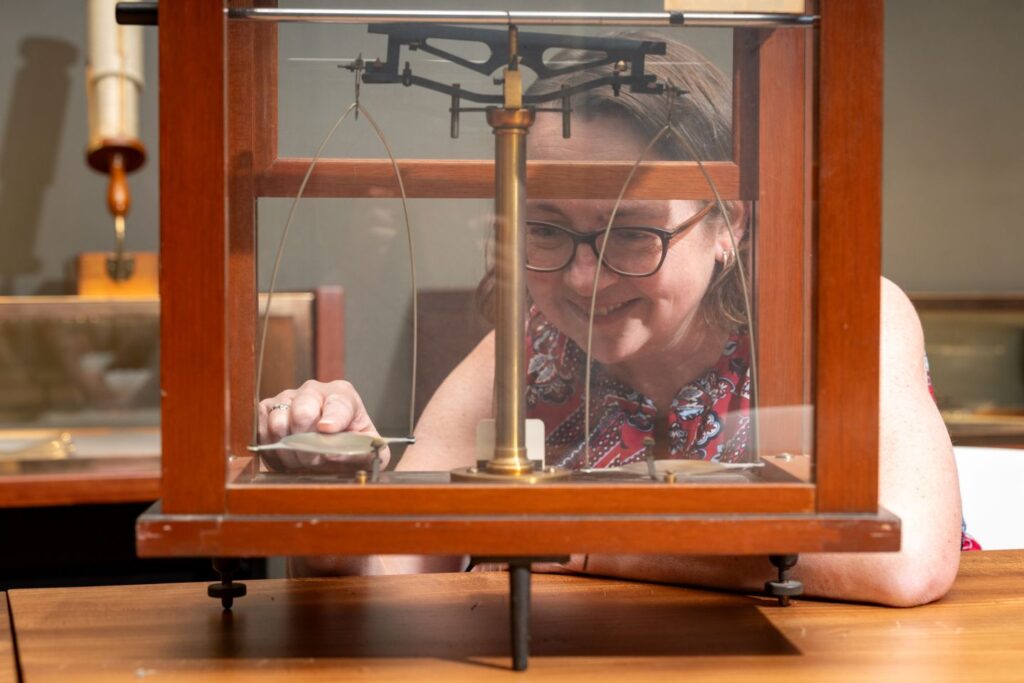
Jenn Stroud Rossmann inspects a vintage mass balance, part of Engineering Artifacts: Past, Present, & Future exhibit at Kirby Art Study Center, Room 109 in Williams Center for the Arts. (Photo | JaQuan Alston)
Lafayette engineering was established in 1866, when industrialist Ario Pardee gave a $100,000 gift that included the establishment of a curriculum for civil and mining engineering, as well as chemistry. An 1866 report from the Lafayette Board of Trustees “set the goal of educating not just the engineer” but the whole person “who is able to meet the challenges of a world in which scientific, technological, and human needs have steadily become more complex.” The endowment established a curriculum for civil and mining engineering, as well as chemistry, and an additional $200,000 gift brought about Pardee Hall, which housed the departments until 1927.
With Pardee’s gifts, Lafayette became a school of arts, science, and engineering. This sentiment was articulated in an 1866 report from the Board of Trustees.
“Lafayette himself, who our founders were honoring, was, of course, a military leader, but also a world builder, which is what engineering can do,” Rossmann adds. “It can dream up and imagine the world we might live in in the future, and then hopefully work toward those futures and improve the human condition.”
In the 10 years since its 150th anniversary, the Engineering Division, which now offers six degree programs as well as a dual degree with international studies, has seen significant growth in its facilities and curriculum. Highlights include:
Creating an Inclusive Culture
The establishment of the Clare Boothe Luce program coming out of the 150th anniversary year has been a transformative initiative that has been reshaping the landscape of undergraduate research at Lafayette. The program, providing women engineering students with faculty-mentored research opportunities, blossomed into a powerhouse of inclusivity. The professional development workshops developed for CBL scholars and allies have grown into a program for students involved in summer research throughout the College.
Rossmann credits Prof. Scott Hummel, who served for 10 years as the William A. Jeffers Director of the Engineering Division, for backing initiatives to promote an inclusive culture in the Engineering Division. In addition to the Clare Boothe Luce Research Scholars program, he helped reinstate National Society of Black Engineers (NSBE) and establish Society of Hispanic Professional Engineers (SHPE) chapters on campus, and coordinated events with the Office of Admissions and Society of Women Engineers.
Curriculum Expansion
In 2019, the ABET-accredited Integrative Engineering program was launched, increasing opportunities for students to cross the boundaries of traditional engineering degrees. In the Integrative Engineering program, developed by engineering faculty through a process led by former Jeffers Dean of Engineering Lauren Anderson and Hummel, students are engaged in a transformative educational experience bridging the liberal arts, engineering, and interdisciplinary study. Students develop “systems” thinking, which enables them to address complex problems at the intersection of and across a variety of disciplines.
Acopian Renovations
Hummel led a $25 million fundraising effort for major renovations at Acopian Engineering Center, a multiphase project and fifth-floor expansion started in 2019 and concluded in 2022–2024.
The project modernized 15% of the existing 98,000-square-foot facility, adding a fifth floor and the Walter Scott Pavilion, remodeling labs, and adding study spaces while reducing bottlenecks and widening tight corridors, a ground-level corridor physically linking Acopian to the Rockwell Integrated Sciences Center, and energy-efficient LED lighting, updated furnishings, and new audio-visual presentation equipment.
Acopian’s renovations reflected deep and deliberate thinking, facilitated by the Engineering Division’s partnership with the Hanson Center for Inclusive STEM Education and Center for the Integration of Teaching, Learning, and Scholarship, about how to make the learning environment more inclusive and dynamic.
“Through our partnership with the Hanson Center and CITLS, our faculty have learned new ways of approaching course design, delivery, and assessment,” Rossmann notes. “The partnership with the Hanson Center also includes a peer mentoring program, climate studies, and an understanding of the student experience, trying to improve it for all students so everybody can flourish. In engineering, there has been intentional thought about making both our spaces, our processes, and our products all more inclusive.”
The Future
For the next 10 years and beyond, Rossmann hopes to see more students minoring in engineering programs and a continued growth of the engineering studies program, which she describes as “a natural hub for the kinds of engineering plus liberal arts thinking that distinguishes Lafayette graduates in a really cool way.”
A minor in engineering studies is on her wish list to draw even more students into Acopian to engage in interdisciplinary thinking and doing, along with expanding staff in the machine shop to support maker spaces to create experiences blending topics such as anthropology and infrastructure.
“Our two pillars, interdisciplinarity and inclusivity, have definitely been leading the changes that have occurred,” Rossmann says. “And I can see this growing more and more in the years ahead.”
Engineering Faculty and Students, Always Curious
Asked to describe the qualities of Lafayette engineering faculty and students, Rossmann says it comes down to a single word: curiosity.
“In their teaching and in their research, faculty share a common enthusiasm for discovery and satisfying a natural curiosity that rises from every engineering field. There’s an interest in trying things thoughtfully,” she adds. “Their Cur Non-ness is real and infectious.”
In the corridors of Acopian, you’ll hear engineering faculty exchanging ideas about teaching techniques and sharing an eagerness to know how students responded to a new concept.
“There’s porosity of borders in this building, and that’s something I really appreciate,” Rossmann notes, adding faculty bring not only expertise in their academic and research areas but also a rich trove of other outside interests — music, writing, theater, community service — perspectives to enrich their classrooms and relationships with students.
“The fact that engineering faculty here have lots of interests, many of which are outside engineering, helps us appreciate more fully the range of experiences our students are able to have,” Rossmann observes. “If a student is sitting in our office and lamenting there’s no time for theater, which they enjoyed in high school, an engineering faculty member is likely to lean forward and say, ‘No, you really need to make time for theater, and here’s why.’”
Celebrations and Events
In observation of the College’s Bicentennial and Engineering’s 160th anniversary, an exhibit, Engineering Artifacts: Past, Present, & Future, will be presented at Kirby Art Study Center, Room 109 in Williams Center for the Arts. It opens Sept. 9 and runs through Dec. 4.
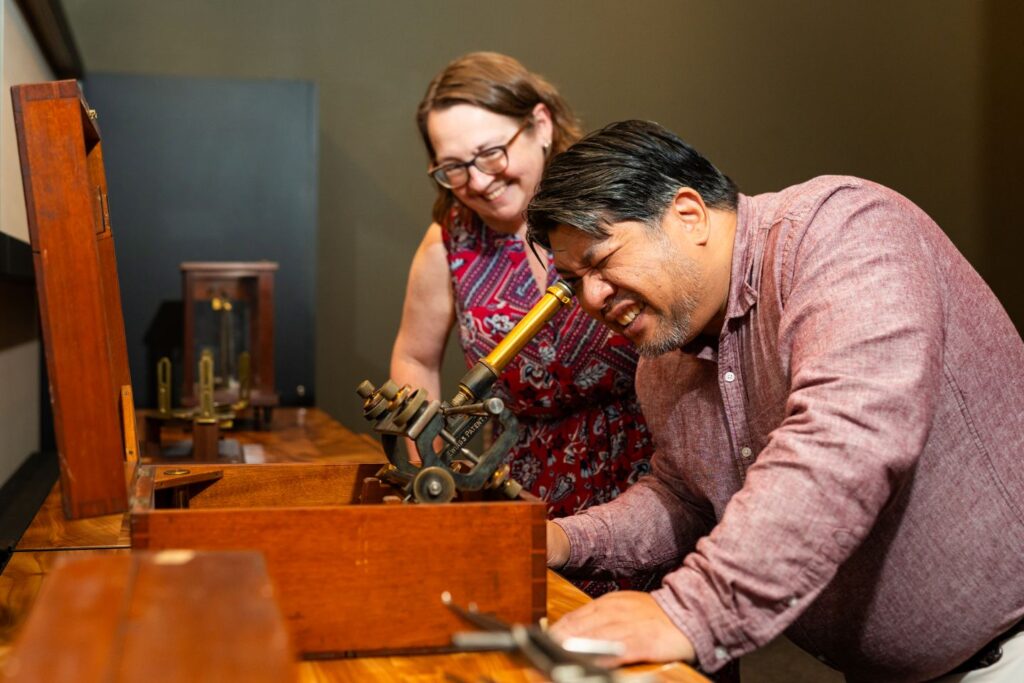
Rico Reyes, director of art galleries and curator of art collections, and Jenn Stroud Rossmann, Jeffers Dean of Engineering and Baird Professor of Mechanical Engineering, collaborated on Engineering Artifacts: Past, Present, & Future exhibit, which runs through Dec. 4. (Photo | JaQuan Alston)
The exhibit will showcase how the tools engineers use to design, build, and connect our world have evolved. Among the 20 pieces is coal mining equipment collected over the years by Frank Shema, engineering technician in the machine shop and manufacturing labs, including vintage tools — an auger, gas mask, gas-sensing lamp, a cap with lantern — that miners used to extract the coal to make industry possible in Easton.
Visitors also will enjoy seeing finely etched brass protractors, compasses, surveying and drafting tools, and slide rules, some in leather and dovetailed wooden cases with rich patinas from use. There’s a “portable” mechanical Marchant calculator juxtaposed with a Texas Instruments calculator, on loan from Rossmann’s personal collection, and a 1930s-era guide to Lafayette’s Mining Engineering Hall, now Markle Hall, by John Markle, Class of 1880, a coal executive who funded the building’s construction. Visitors are encouraged to handle and examine some of the equipment on display.
The exhibit will be open as part of the Bicentennial Symposium Sept. 9, and prior to a lecture on engineering history Sept. 17, 6-7:30 p.m.
Rossmann says the exhibit will offer visitors a window into how early engineers customized their equipment, revealing their expertise in designing and making better tools to perform essential tasks. It also provides a platform to think about how industries transformed the landscape, perhaps not always for the best, and the way labor was exploited, and considerations of workplace safety and how it evolved over the years.
Alumni Presentations
Michael Bennett ’17, a Ph.D. student in civil engineering with a geotechnical focus at Virginia Tech and a licensed professional engineer in Pennsylvania and New Jersey, will give a talk about some of the core values of Lafayette engineering Sept. 17 at 7:30 p.m. in Oeschle Hall 224.

Michael Bennett ’17 | contributed photo
“My remarks will touch on how Lafayette gives students room to embrace their idiosyncrasies, emphasizing the different considerations that go into engineering work and faculty who are wonderful instructors and mentors,” he says.
Bennett will illustrate these values with case histories from the Engineering Division’s rich heritage, including some of his own, but mostly from and about his peers and other Lafayette engineering alums.
“The program’s strength is its continued adherence over 160 years to these abiding principles, even as it ably adapts and changes to meet the engineering needs of the moment,” Bennett says. “From my perspective, these position the program very well as the College enters its third century.”
Hank Cauley ’77 will deliver the Resnik Memorial Lecture at 7:30 p.m. Oct. 27 in Colton Chapel.
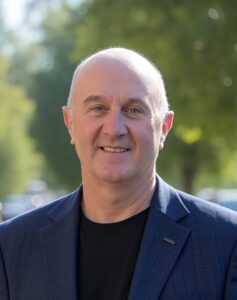
Hank Cauley ’77 | contributed photo
From managing refugee programs in Somalia to steering multimillion-dollar global sustainability initiatives, Cauley has been driving change at the intersection of conservation, business, and capital for more than four decades. An institutional builder and board-level leader, he holds a B.S. degree in chemical engineering from Lafayette, an M.S. degree in chemical engineering from University of Arizona, and an MBA from Harvard Business School, a combination that underpins his practical, data-driven approach to environmental oversight.
“I have had an eclectic career built on an engineering foundation, and Lafayette is at the heart of it,” Cauley says.
He is co-founder and former CEO of Nature for Justice, guiding mission-driven efforts to leverage nature-based solutions for climate resilience and community empowerment. Previously, he co-built and managed the $12 million Wild Australia program at The Pew Charitable Trusts, contributing to current outcomes of 25% of the continent’s lands protected and 26% on the oceans (in highly protected marine sanctuaries).
Cauley served as senior vice president at Conservation International, managing a 30-person team and influencing over $150 million in sustainability partnerships across agriculture, extractives, and consumer goods.
He also reorganized the U.S. Forest Stewardship Council as its president, raising nearly $20 million and strengthening its position as the leading global certification standard for sustainable forestry, and he advised and served on founding boards for pioneer impact organizations, including the Aquaculture Stewardship Council and Root Capital.
“My Lafayette ChemE degree gave me two things: a way of breaking problems into manageable pieces and the confidence to take anything on,” Cauley says. “That foundation carried me from refugee camps, to boardrooms, to co-founding a social justice organization from scratch.”
Rossmann says the sentiments expressed by Cauley and Bennett are reflected in the thousands of Lafayette-trained engineers working in academia, research, industry, and the nonprofit sector across the globe.
“There are so many ways that engineers, particularly Lafayette engineers, use their imaginations to create new knowledge,” she says. “We get to create new things and improve upon processes, inspire engineering students, and contribute to the education of non-engineering students, to help them approach challenges and opportunities differently.
“Over time, it seems that our mindset as faculty here at Lafayette has been ever more interdisciplinary, ever more appreciative of the connections we can make both across different kinds of engineering and also with the wider campus and community,” Rossmann adds. “It’s exciting to deploy our knowledge and our mindsets in new ways in new partnerships. That’s been our legacy for 160 years and our compass for the years ahead.”