December 12, 2025
Inside the classroom: ‘Not a regular English class’
Inside the Classroom is a new series offering a glimpse into classes at Lafayette, the talented professors who teach them, and how they impact and define a student’s experience.
By Selma O’Malley ’25

Prof. Gabrielle Kelenyi (standing) teachs Writing & Community Engagement, a course focused on writing for social change. | Photo by JaQuan Alston
ENG 357: Writing & Community Engagement is less about reading books and writing essays than it is about enacting real, tangible change at the College and in Easton communities.
“What are the best practices for using writing to create social change and create meaningful change with other people?” Prof. Gabrielle Kelenyi says about the course’s central question.
An assistant professor of English, community engagement and literacy are Kelenyi’s research expertise, so she sought to create a course based on these themes and offered it for the first time in spring 2024.
“We think a lot about how writing can create change in journalism; how writing can create change because maybe you’re convincing someone of something,” she explains. “But how do we use writing alongside communities to achieve what they want?”
Writing relating to community engagement is very broad, but “that’s what makes the class fun and different every time I offer it,” Kelenyi says. Instead of essays and explications, this can include social media campaigns, flyers, internal documents, research, and more.
“It goes against the purpose of the class if we’re doing it just to do it,” Kelenyi says. “I think the difference for ENG 357 is that it’s really practical and applicable.”
These types of projects are what Kelenyi’s students work to accomplish through the course of the semester with a selected community partner. The professor works with the Landis Center for Community Engagement to reach the local Easton community and on-campus partners who could use the help of a small group of English students.
“I had that mindset of coming in and it being like an English course, where you have essays, writing a lot,” English major Goodness Obadofin ’26 says. “[But] it’s not a regular English class.”

Goodness Obadofin ’26 is working with the Easton Neighborhood Center through his coursework. | Photo by JaQuan Alston
Obadofin’s group of five worked with the Easton Area Neighborhood Center to create a digital pamphlet educating volunteers and employees on asset-based framing—a rhetorical technique used to describe people based on what they have instead of what they lack—for their patrons.
Since finishing the pamphlet in early November, the group has been working on an infographic for the Neighborhood Center to use to present itself and its services.
Obadofin called being able to work with the Center a “privilege.” His group was able to visit the Center earlier in the semester to explore its site and resources.
“It just makes me feel like I’m doing something really meaningful, other than just studying for a grade,” he says. “I can contribute to the cause in Easton, and that’s something I can take with me wherever I go.”
Benjamin White ’27 and his group are working on campus to improve the College Writing Program website after soliciting feedback from the community. The students are working on increasing the website’s visual appeal and streamlining its organization.
“I would say I am very used to the routine of paper–project–presentation, so to do something that is not that feels out of the ordinary,” he says. “It’s just not what I’m used to, so it’s outside of my comfort zone.”
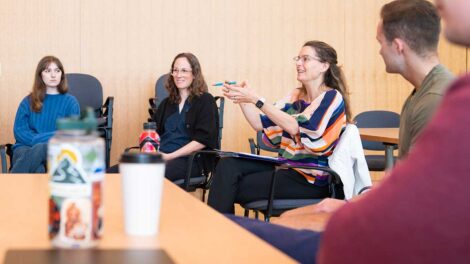
Classes are divided during the week into discussion days and “lab days.” Students are assigned readings that exemplify community engagement in Writing Studies, and its impact, touching on themes such as reciprocity and co-design on projects.

Students engage in discussions and work in the community during their course. | Photo by JaQuan Alston
Kelenyi also invites speakers who work in different fields to speak to the class. On lab days, students have time to meet outside of the classroom to connect with their community partners and work on their projects.
“[Prof. Kelenyi’s] done a really good job of creating a classroom where there are people giving each other productive and constructive feedback, and there are people who are actually working together on these projects,” White says.
“I am always surprised and impressed by the deliverables at the end of the semester,” Kelenyi says. “Lafayette students are determined and talented, and by this time of the semester, they have built a really deep relationship with their community partners.”
This relationship is what Kelenyi believes motivates students to accomplish what needs to be completed in time for the end of the semester.
“It’s just really heartwarming,” she says. “Part of community engagement is this ethic of care, and Lafayette students have it. That’s what comes out in their final deliverables.”
Tagged with: Inside the classroom