January 9, 2026
Prof. Casey Schmidt earns Kaufman research grant
Prof. Casey Schmidt has won a 2025 Kaufman Integrated Research-Education grant, which will help advance her study of histones, important proteins for normal cellular function, and open opportunities for her students to engage in authentic lab experiences and attend conferences.
Schmidt, assistant professor of biology, the first Lafayette faculty member to ever receive this Kaufman grant, will use the $100,000 award to support her research, “Harnessing the Power of Students to Discover and Characterize New Regulators of Histone Gene Expression.”
“I came to Lafayette so that I could work closely with students as both an instructor and a research mentor,” she says. “This grant is helping me achieve my goals.”
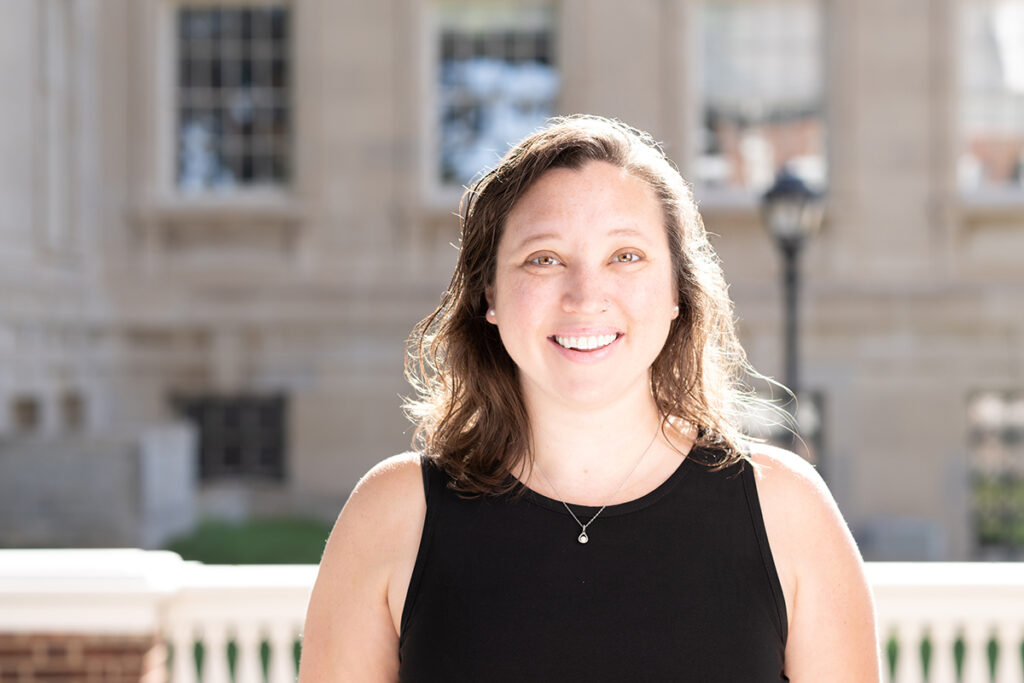
Casey Schmidt, assistant professor of biology | Photo by Adam Atkinson
It will provide funds for reagents, allowing her and her students to conduct experiments in both the classroom and her laboratory. The grant will also provide funding for travel to conferences, so students can present their findings to a wider scientific audience.
Schmidt studies a molecular factory called the histone locus body (HLB), which is involved in the production of histone proteins. Histones are crucial components of cells because they serve as a spool for DNA to wrap around.
“This wrapping of DNA around histones is important to both compact DNA, so it fits into the small nucleus, and to keep DNA organized and accessible,” she explains. “If there are errors in histone production, there are many dire consequences at the cell and organism levels; thus, it is important to understand this fundamental cellular process.”
Schmidt likes to think about the HLB as if it’s an actual factory, one that we don’t know a lot about.
“For example, imagine that this factory is in a valley, and we are viewing it from a hillside. Because the factory is far away, we can’t see it in its entirety,” she says. “Some of the buildings aren’t fully visible, and we can’t see workers traveling between the buildings. This is the current state of knowledge of the HLB: We don’t know what all its components are, and we don’t know how they work together.”
Her proposed research involves three directions. First, students in Schmidt’s Molecular Genetics course will use a bioinformatics approach to search for new HLB members, akin to revealing new potential buildings in the factory. Second, students in her Cell Biology course will experimentally validate those findings, ensuring that the new buildings are indeed part of the factory. Third, summer researchers in her laboratory will perform follow-up experiments on the new HLB members to determine their exact role in the production of histones, and how they work together with other HLB members.
“This grant demonstrates Lafayette’s commitment to faculty scholarship and student research,” Schmidt says. “It opens up many more doors for me and my students. I can bring research into the classroom at a larger scale, and I can support more student researchers in my laboratory.”
“This grant gives students in my courses the opportunity to participate in a novel, authentic research project. They may discover something that was previously not known,” she says. “In addition, the funds from the grant will support student travel to conferences. Presenting at a national conference is a transformative experience: Students get the opportunity to share and get feedback on their work, network with potential employers, and meet fellow scientists, sometimes including Nobel Prize winners!”
About the Kaufman grant program
The Charles E. Kaufman Foundation, a supporting organization of the Pittsburgh Foundation, helps fund fundamental scientific research in chemistry, biology, and physics at institutions throughout Pennsylvania.
The grant program was established by chemical engineer, entrepreneur, philanthropist, and longtime Pittsburgh resident Charles E. Kaufman, who recognized the importance of supporting early- and mid-career scientists and to “promote a better and fairer world by supporting those who can make a difference with science.” The foundation granted its first award in 2008.


Categorized in: Academic News, Biology, Faculty and Staff, Faculty Research, Featured News, News and Features