January 12, 2026
Inside the classroom: Time traveling through geology
Inside the Classroom is a new series offering a glimpse into classes at Lafayette, the talented professors who teach them, and how they impact and define a student’s experience.
By Bryan Hay
Eager to delve into the question of whether a Tyrannosaurus rex could catch and snatch a Jeep Wrangler, Prof. Dave Sunderlin opened his lab by showing a classic scene from the original Jurassic Park.
“There’s no way a T. rex could catch a Jeep Wrangler in third gear, but we’ll see,” he says a bit incredulously under his breath in his Dino Lab for his Geology 130 students. “Here, we use the present to understand the past. After today, we’ll know for certain if that scene is accurate or not.”
In this popular introductory geology course, first- and second-year students experience field trips and tactile learning to discover the vast epochs of time before humans and how both gradual and rapid global shifts shaped the planet and ultimately civilization itself.
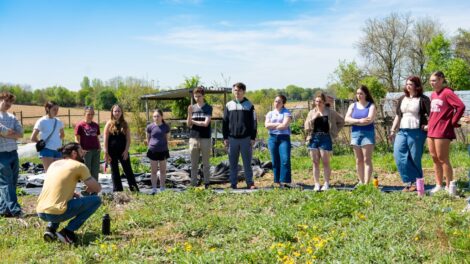
The Dino Lab is a key part of Geology 130, providing Lafayette-style hands-on learning to unlock a deeper understanding of geologic time. Sunderlin, John H. Markle Professor of Geology and department head, and other geology faculty who teach the course also include field trips to such places as Ringing Rocks Park in Upper Black Eddy, Pa., about 15 miles south of Easton, where students can see sedimentary, metamorphic, and igneous rocks all in the same area, a rarity in the geologic world.
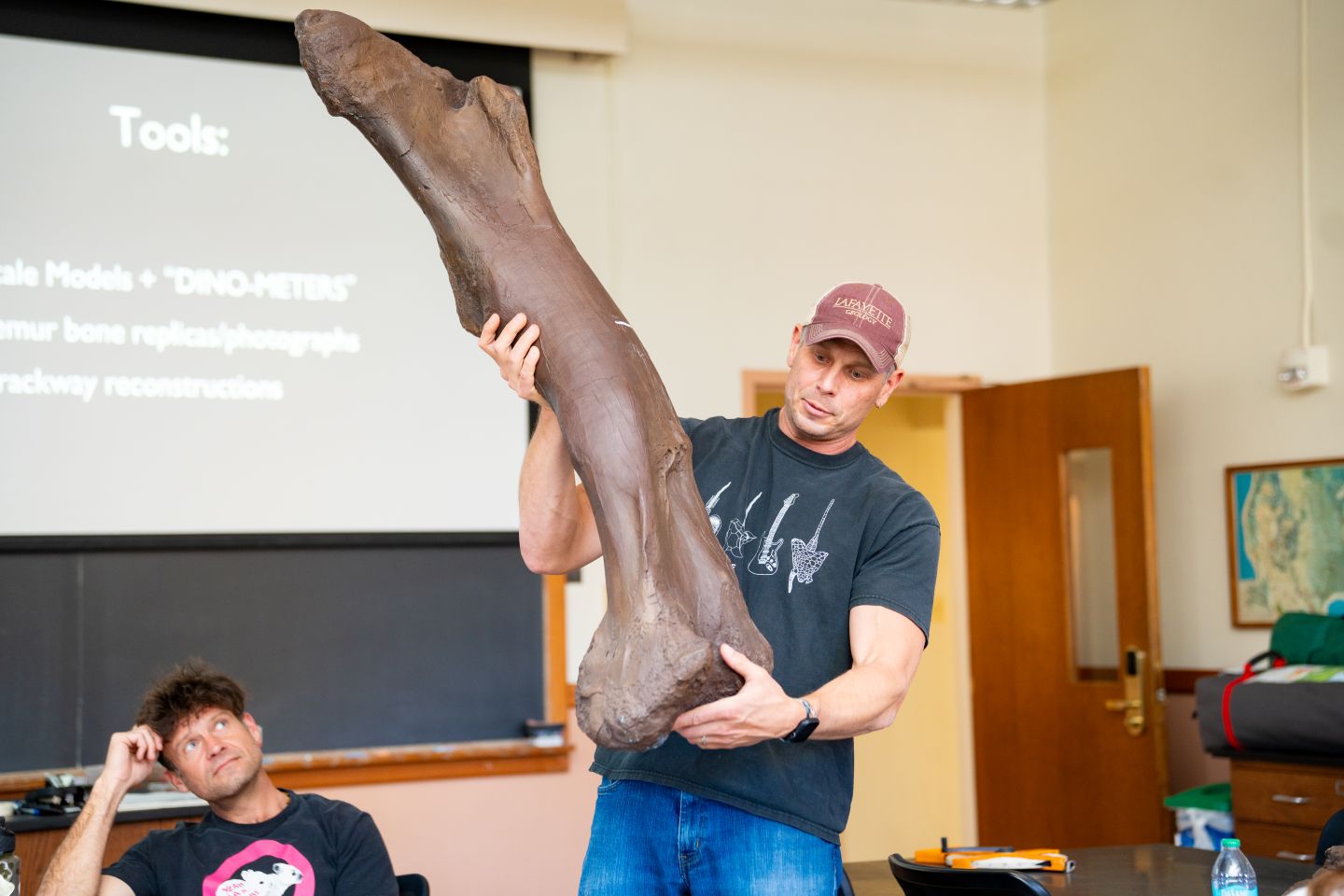
Femur fact-finding: Prof. Dave Sunderlin uses full-size casts of dinosaur femurs to help students envision the Cretaceous and Jurassic periods | Photo by JaQuan Alston
Back in the Dino Lab, Sunderlin and his class delve into biomechanical modeling, taking a close look at Triceratops, T. rex, and Apatosaurus. Using scale models of the dinosaurs dipped into columns of water to gauge mass and handling full-size casts of their femurs, students see the Cretaceous and Jurassic periods come back to life.
At one point, Sunderlin hopped onto a lab counter to demonstrate how a quadruped walks and how measuring stride, speed, and agility can help determine whether a pursuing T. rex will have you for lunch. Outside Van Wickle Hall, students measured their own stride lengths to see if they might be able to outrun a dinosaur.
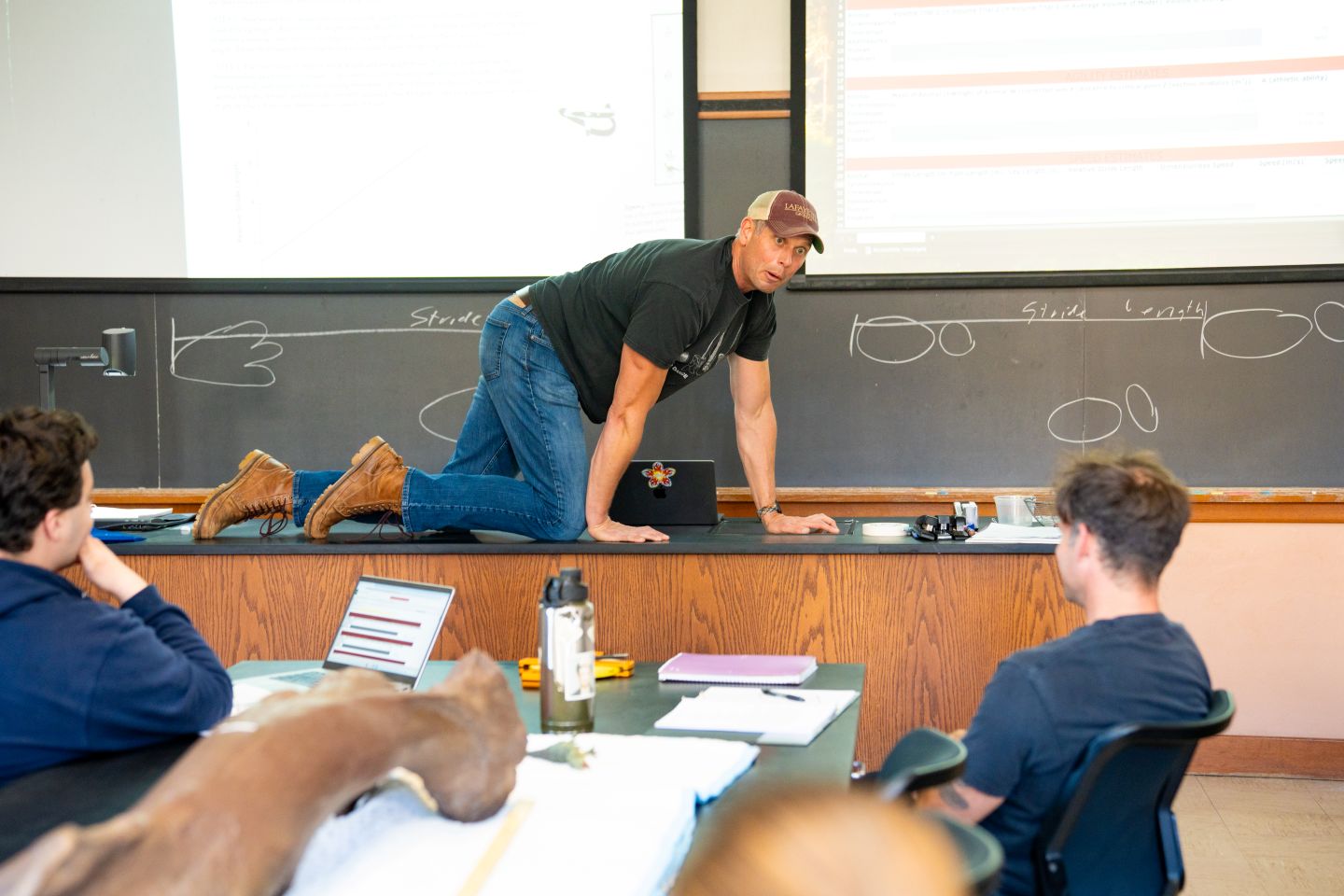
To help understand the importance of measuring stride, speed, and agility, Prof. Dave Sunderlin demonstrates how a quadruped walks. | Photo by JaQuan Alston
Sunderlin, who’s taught Geology 130 for every year of his 20 years at Lafayette, loves observing the engagement and widening curiosity of his students.
“It’s the surprise people feel when they see how geology and natural history come together, that’s what I love seeing,” he says. “It’s way more than what objects are. It’s the stories they tell, their origin, the dynamic history of the planet. What I commonly go back to is that the present processes leave records in objects and shapes and landscapes. If we know how present processes work, then we can reconstruct what ancient processes were by seeing the products that are in the rock record, like dinosaurs. They tell us fascinating and interesting things.”
Sunderlin’s goal is to make the course accessible to all students, whether they’re pursuing a geology degree, a Common Course of Study credit, or just exploring an interest in the subject.
“I try to make the content relatable to everyone,” Sunderlin says. “Sometimes there’s a childhood interest in geology from a family vacation or a curiosity about natural surroundings from just walking around the Quad. As humans, we have a natural curiosity about how things came to be.”
Jadey Mercedes ’28, who plans to major in English, was drawn to Geology 130 on recommendations from other students and has enjoyed Sunderlin’s animated style. It’s her second geology class as she considers geology as a minor.
“The first time you take a geology class, there’s a lot of information that can be a little bit confusing,” she says. “But once you take another one, and the same information is presented in a different manner by a different professor, it definitely helps solidify the ideas that you learned from the first class you took. For me, when it came to rock types and rock formations and plate tectonics, it all came together.”
Her experiences confirmed for her that Lafayette was the right choice.
“I took this discipline because I needed a science course with a lab,” Mercedes says. “I wasn’t expecting I would enjoy it as much as I did. That’s the great part about Lafayette: the freedom to explore so many disciplines. And I had so much fun that I’m going to pursue a minor in geology.”
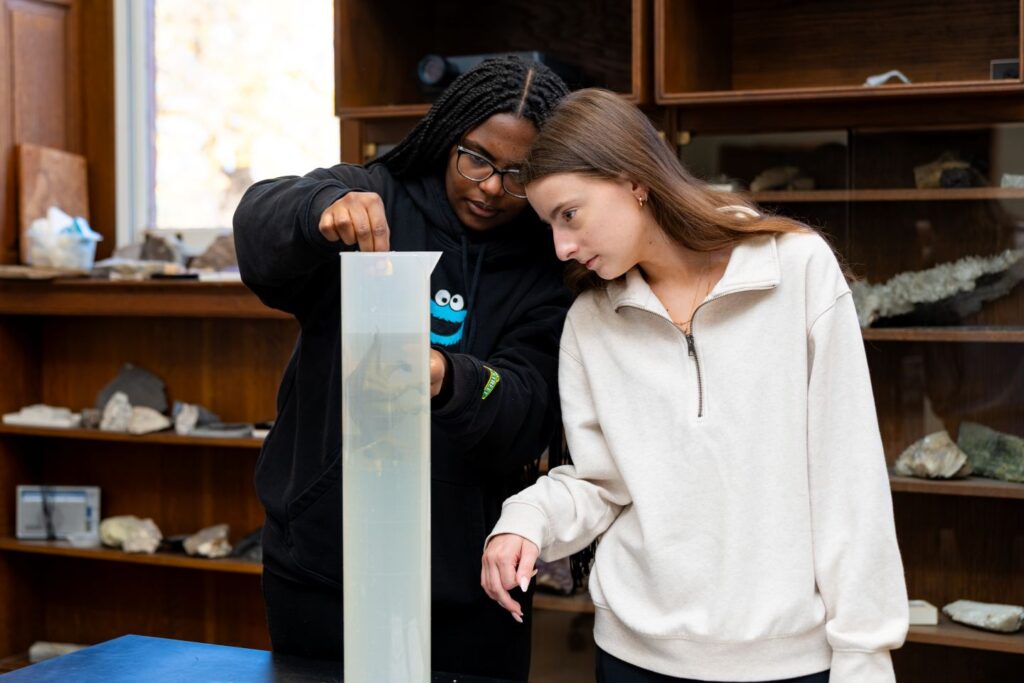
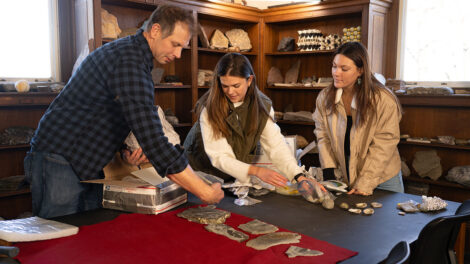
For Jadey Mercedes ’28 (left) and Emily Gelewski ’28, GEOL 130 has helped them branch out. | Photo by JaQuan Alston
Eric Doyle, a nontraditional student who works as the chemical storeroom manager in the Department of Chemistry, is catching up and fulfilling his interest in geology.
“The college I attended didn’t have a geology department,” he says. “It’s nice to have an opportunity to take some classes and learn from great professors and work alongside students. It keeps you young.”
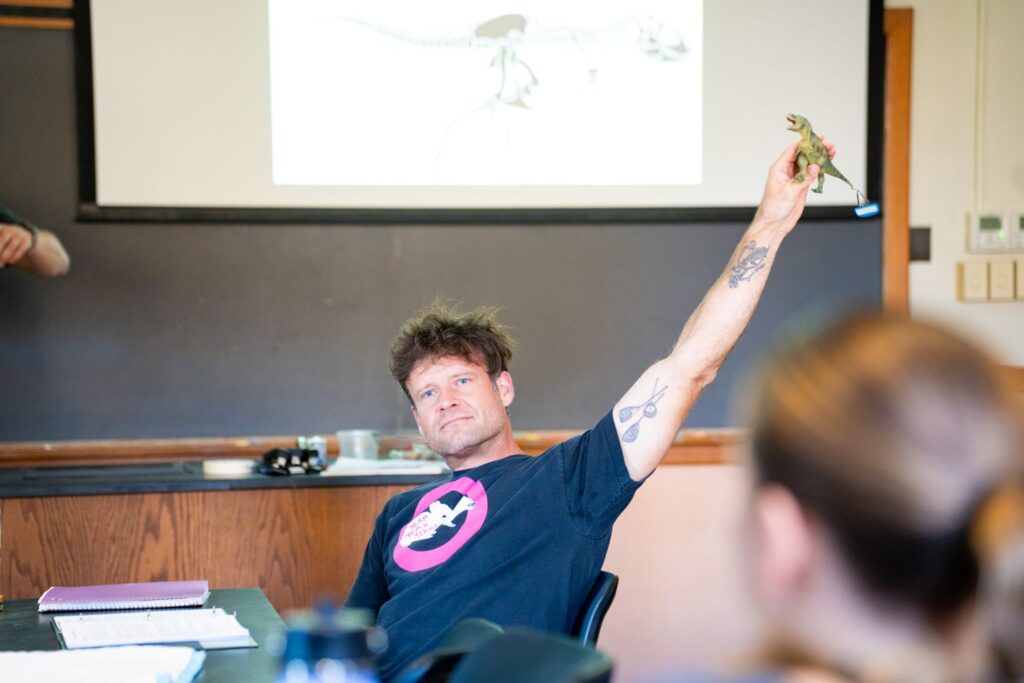
A dino discovery, as Eric Doyle enjoys pursuing a long-held interest in geology. | Photo by JaQuan Alston
Doyle says his exposure to geology has helped him with his work in the Chemistry Department.
“Taking part in the labs helps me see how I can help out the chemistry professors a little more with setting up their labs,” he says, adding that he has observed how geology faculty and students use chemicals, acids in particular, in their work.
Like Mercedes, Emily Gelewski ’28 (government and law and economics), took the course after hearing “really great things” about Prof. Sunderlin.
“I was really nervous to take a lab, because I’m not much of a science person,” she says. “But I had heard he really cares a lot about his students and that the labs were fun. It’s not just rocks, it’s rocks, dinosaurs, and an appreciation of the depth of time. I’m really happy I chose this course.”
With interest in policy issues, Gelewski appreciates learning about climate change and how science can inform politicians and influence the economy.
“This course really solidified my choice for coming to Lafayette,” she says. “Prof. Sunderlin knows that people come here with a wide variety of interests, and specifically, during the field trips and the labs, he encourages participation and discussions. He definitely tries to make sure everyone gets a chance to get their questions answered in the most creative, thoughtful ways.”
As the afternoon lab wrapped up and the large femurs continued to be passed around and studied, Sunderlin continued to challenge his students. Is T. rex the terrifying predator depicted in movies?
Sunderlin left plenty of intriguing questions for them to ponder until their next gathering.
“What have we learned today from what is left behind in the rocks? How might what we’ve seen and measured help us have a more realistic view of what it would have been like back then in time? How scared would we be, with or without a Jeep Wrangler?”