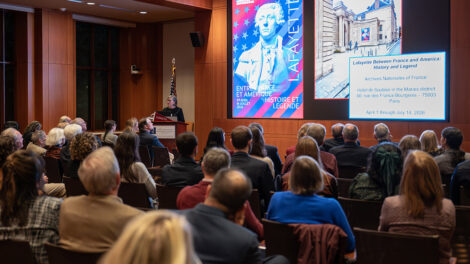
February 4, 2026
Largest known collection of Lafayette/Washington letters now available digitally
By Bryan Hay
After years of meticulous work, Special Collections & College Archives has completed the digitization of 201 letters written by the Marquis de Lafayette to George Washington between 1777 and 1792, one of the most important quill-pal relationships from early America. The digital collection can now be accessed through the Library’s website.
For more than 80 years, Lafayette College has held and preserved the largest single repository of letters written and sent by Lafayette to Washington, from the earliest ones written as a young officer from Valley Forge in 1777 and other military encampments during the American Revolution, to the 1790 letter from his restive homeland that included the key to the Bastille.
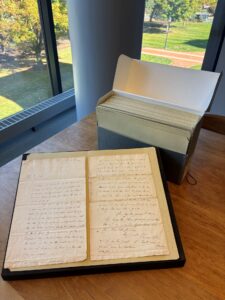
Lafayette College has the largest single repository of letters written and sent by the Marquis de Lafayette to George Washington, reflecting the special bond they shared. | Photo courtesy of Special Collections and College Archives
Inspired by the College’s Bicentennial, the digitization project makes this unique, insightful correspondence more accessible globally to historians, researchers, students, and history enthusiasts.
Donated to the College in 1943 by New York philanthropist Helen Fahnestock Hubbard, all of the letters are written in English, with approximately half sent from battlefields in America and half from France; 81 of them are docketed in Washington’s hand, usually on the reverse of the last sheet, with the note “From Marq. de la Fayette,” and the date of the letter.
“Lafayette College holds one of the most distinguished collections relating to the Marquis de Lafayette in the United States, and some might say, even in the world—manuscripts, artifacts, artworks, and rare books that document his life as a participant in both the American and French revolutions, and also as a symbol of liberty during and long after his lifetime,” says Elaine Stomber ’89, P’17,’21, co-director of Special Collections and College Archives and College Archivist.
“The Hubbard collection is really a star of this collection,” she notes. “It seemed like a wonderful opportunity, in honor of the Bicentennial, to digitize that collection and make it more widely available.”
In an 1811 letter to Washington’s nephew, Bushrod Washington, Lafayette requested that the letters be returned to him. Moved by Lafayette’s persuasive words lamenting his separation from the letters as he endured “the revolutionary storms of Europe,” Bushrod packaged up the letters, kept at Mount Vernon after his uncle’s death in 1799, and sent them to France.
The letters remained at Lafayette’s home outside Paris, LaGrange, for about 100 years until after World War I, when they were sold to Hubbard, who had an interest in the Marquis de Lafayette and early American history. Along with the letters, the College still has the original leather valise bearing Lafayette’s name that contained the letters when they arrived on campus.
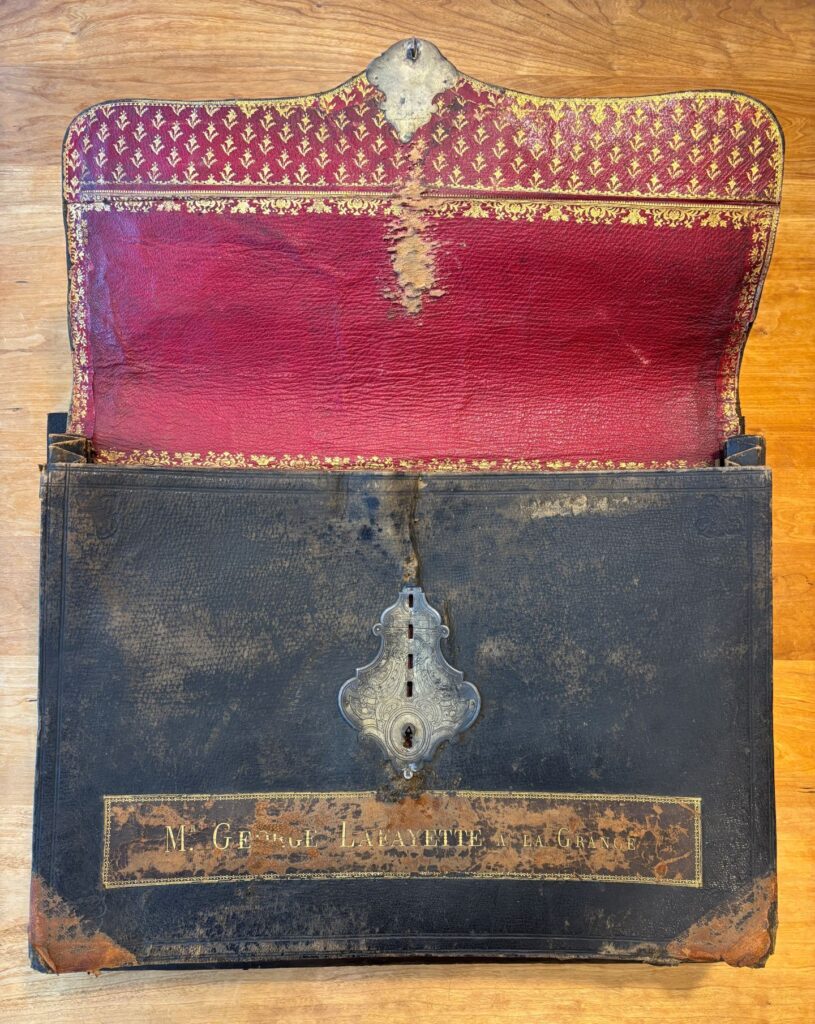
Original leather valise bearing Lafayette’s name that held the letters when they arrived on campus. | Photo courtesy of Special Collections and College Archives
Hubbard received an honorary degree from Lafayette College at the 1943 commencement in conjunction with the donation of the collection. Her generous gift came during an era when the College was becoming a hub for the study and preservation of Marquis de Lafayette materials, advanced by the American Friends of Lafayette, which was founded on this campus in 1932. Members of the organization regularly donated their personal collections to the College.
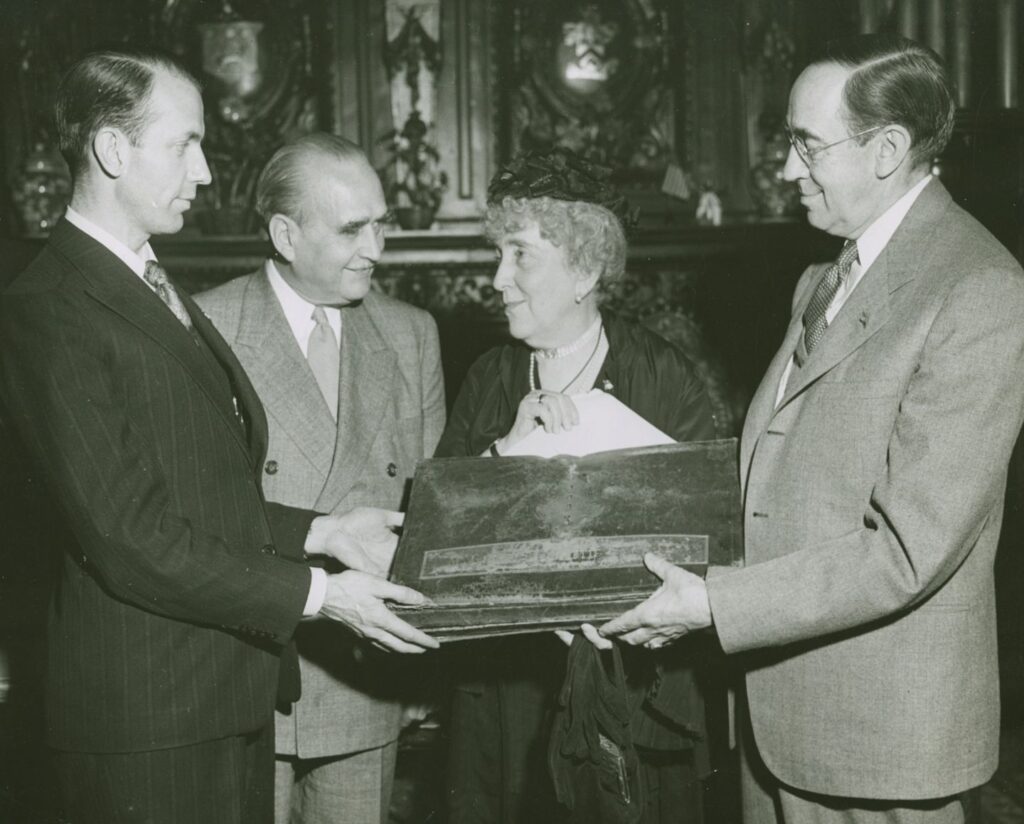
Helen Fahnestock Hubbard presented her collection of letters to Lafayette College in 1943. Pictured during the ceremony, left to right: the Count de Chambrun, great-great-grandson of the Marquis de Lafayette, Messmore Kendall, founder and president of the American Friends of Lafayette, Helen Fahnestock Hubbard, and Dr. William Mather Lewis, Lafayette College president, 1927-1945. | Photo courtesy of Special Collections and College Archives
Stomber credits her colleague Nora Zimmerman, digital archivist and head of repository strategies, as the mastermind behind the letter project, which was carried out using an overhead camera by faculty, librarians, archivists, professional staff, and student workers from fall 2023 through summer 2025. Their work is part of a broader Bicentennial project that includes the digitizing of other documents such as yearbooks, commencement programs, and audio files of notable figures who have been on campus over the years, including Dwight Eisenhower, who visited Lafayette on Founders’ Day in 1946.
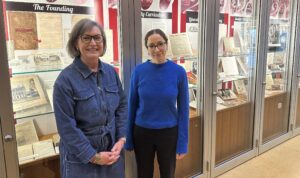
“Lafayette grows up over the course of this correspondence,” says Nora Zimmerman, digital archivist & head of repository strategies (right), with Elaine Stomber, co-director of Special Collections and College Archives and College Archivist. | Contributed photo
Through a high-resolution, zoomable viewer in Lafayette’s Digital Repository, details of the letters come alive. You can even see the broken wax seals on the envelopes and where Washington signed Lafayette’s letters, acknowledging their receipt, as was his custom. Images are also downloadable in multiple sizes, resolutions, and file types.
“It’s as if you’re using a magnifying glass in our reading room, but without putting the physical materials at risk for wear and tear,” Zimmerman says. “And what’s really exciting to share is that the letters are all transcribed into plain text, so the contents are searchable on the site. If your 18th-century handwriting reading skills are a little rusty, you can read the full text of the letters easily in the transcriptions right next to the images.”
The canon of correspondence reveals how Lafayette’s life unfolded, starting in November 1777, the year he turned 20 and just a few months after his arrival in North America, to the 1790s, when he entered the most heated years of the French Revolution.
His improving command of English is also shown over the course of the 20-year correspondence, as the content of his letters evolves from brief dispatches written with expediency from battlefield bivouacs to richer, more philosophical tomes to Washington later in life. Regardless of the message or where it was written, all are penned in iron gall ink on high-quality linen paper, a reflection of Lafayette’s personal wealth.
“One could say that Lafayette grows up over the course of this correspondence from being a hot shot, idealistic young nobleman, eager to earn his laurels, as he repeatedly writes in his letters during the American Revolution, to a 34-year-old man entering early midlife and facing a turbulent revolution at home in France,” Zimmerman observes.
Lafayette’s skills in spy craft are also displayed in seven letters written during the Revolutionary War that contain deciphering of Lafayette’s military code in Washington’s hand. Lafayette indicates locations of military forces using a coded numbering system, and Washington’s deciphering of the code appears above each number within the manuscripts.
In middle age, even as he confronts political unrest in France, Lafayette departs from his messages about liberty and the condition of humanity, asking Washington for seeds.
“There are some letters where he’s asking Washington to send him seeds of different American crop varietals for planting,” Zimmerman says, noting Lafayette’s awareness of the many varieties of crops Washington grew at Mount Vernon. “He’s asking for different things that he wants to plant on his properties.”
Taken together, the letters show the genuine, intimate nature of the relationship between Washington and Lafayette.
“I would describe it as one of fierce loyalty and deep affection, growing out of their shared experiences together navigating not only the Revolutionary War battlefields, but also the political minefields and intrigues of the Continental Congress and Continental Army and events in France and Europe,” Zimmerman says.
“The artifactual and material qualities of the letters, which are visible in the digital collection, make the history they document a lot more accessible and emotionally impactful,” she adds. “You can see Lafayette self-editing, crossing things out, underlining, and also Washington’s own annotations of the letters. It all adds a special quality to their interpretation that you don’t get from just reading the published text.”