February 10, 2026
A mentorship that builds more than bridges
From its earliest days, Lafayette College has inspired lifelong relationships and friendships between faculty and students/alumni, collaborations that have often resulted in inspired research and advancements in science and the humanities.
During the Bicentennial, we celebrate Lafayette mentorships and their teacher-scholar legacy that continues to nourish an endless passion for learning and exploration.
By Bryan Hay
To his legions of loyal students and alumni, he’s known as Kurtz. Not Prof. Kurtz. Not Dr. Kurtz. Just Kurtz.
Given freely as a gesture of mutual respect, the informality is symbolic of the instant relationship Steve Kurtz, associate professor of civil and environmental engineering, establishes with everyone who’s in or has come through his classroom or served on his highly competitive, award-winning steel bridge teams.

Steve Kurtz, associate professor of civil and environmental engineering | Photo by Adam Atkinson
“Prof. Kurtz, rather Kurtz, is one of my favorite professors I’ve ever had. He really cares about his students and about teaching,” says Kathryn Wright ’25, who received a civil engineering degree from Lafayette and was active with the steel bridge team that placed third and second, respectively, nationally during her junior and senior years. She’s now pursuing a graduate degree in structural engineering at Georgia Tech.
“He’s always available. He leaves his office door open. Even when it’s not during office hours, you can get a hold of him, and his commitment to the steel bridge team is even more memorable,” she says. “He’s a true Lafayette mentor in so many ways.”
Found working at the height of summer in his dimly lit office, a converted utility closet across the hall from the steel bridge lab in the basement of Acopian Engineering Center, Kurtz stays in close touch with students and alums. He’s even been known to intern for companies managed by his former students.
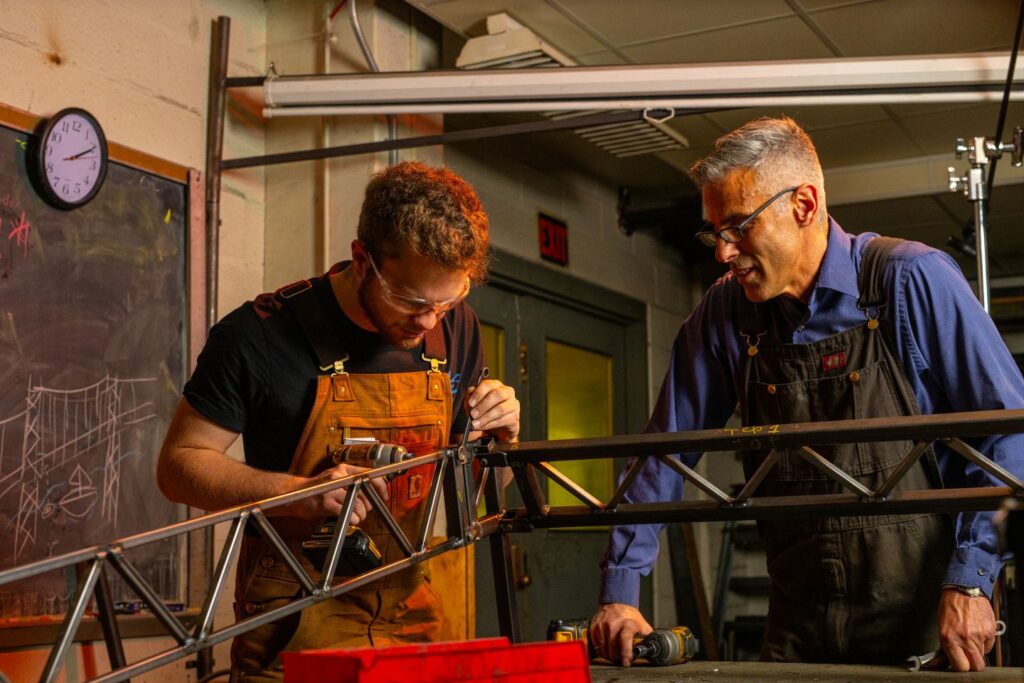
A familiar scene as Prof. Steve Kurtz oversees welding work in the steel bridge lab. | Photo by Adam Atkinson
“He’s there for you when you need him,” Wright says. “He’s one of those professors who has all of his students’ respect. But it feels like he’s your friend as well. It’s a really hard line to walk to have your students’ respect and also have them really enjoy you as a person.”
Recalling her parents’ surprise on hearing the informal reference to a revered Lafayette professor, Wright remembers explaining how it’s hardly an expression of disrespect.
“My parents would ask, ‘Shouldn’t it be Prof. Kurtz?’ But I would always remind them about how he says everyone in his life calls him Kurtz,” she says. “It’s a reflection of that personal relationship he has with all of his students.”
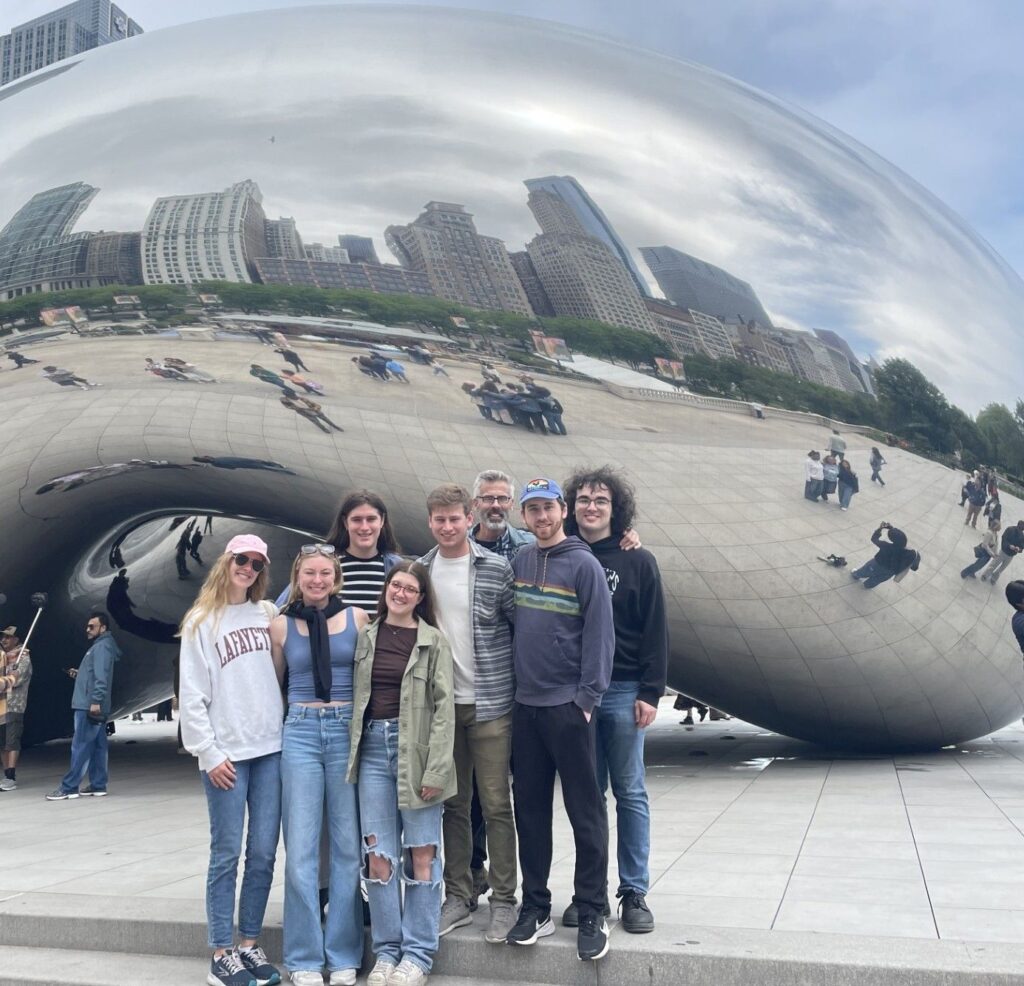
A sightseeing stop in Chicago for Lafayette’s steel team on the way to the 2025 national competetion in Iowa. Prof. Steve Kurtz is “a true Lafayette mentor in so many ways,” says Kathryn Wright ’25, pictured at left in the Lafayette sweatshirt. | Contributed photo
Because of Kurtz’s example, mentorships thrive in his civil engineering community, and Wright and others like her have benefited from Lafayette’s multilayered mentor legacy.
As a first-year student, Wright was hired as an intern by Dan Kucz ’07, associate vice president and structures department manager at HNTB Corp., one of the largest bridge design companies in the U.S., and one of Kurtz’s many successful bridge building alums. She has interned each year at HNTB since then and plans to return there full time after completing her graduate degree.
Wright met Kucz at a civil engineering career fair during her first year at Lafayette. Most of the companies represented at the event were not interested in hiring freshman interns, but she struck up a conversation with Kucz.
“After I reached back to him, he set me up with a job at HNTB and helped to curate a position for a student like me who wouldn’t have really much of any civil engineering knowledge,” Wright recalls. “I interned there after my freshman year and for the past four summers, and it’s allowed me to grow a lot. I’ve worked in the same office as Dan every summer, and I always write him a note at the end of the summer saying thank you so much for taking a chance on me, because I have gotten to grow so much. I’m so grateful for this mentorship.”
Kucz follows the Steve Kurtz model for being an effective mentor.
“The first thing for any mentor-mentee relationship is for the mentee to be able to relate to them and connect with them on a personal level, one of the many things I learned from Kurtz,” Kucz says. “You need to show empathy and demonstrate that you’re truly listening. Because if you don’t have a relationship established with them, it may as well just be a conversation with a stranger at that point.”
Even though Wright didn’t yet have any core courses under her belt, Kucz saw something in her and took a chance.
“She’s a superstar, for sure,” he says. “I was impressed by her. You could just tell, with her personality, that she’d be successful.”
“Relationships are built on trust, listening, respect, influence, and care,” Kucz adds. “Those are the five areas I always zoom in on, and I try to have all those with Kathryn [Wright]. It’s the solid basis of our relationship. She listens to what I say, which is awesome, but I respect what she has to say just as much. She probably looks up to me. But you learn a lot from your mentee as well.”
Like his mentee, Kucz has been interested in bridges all his life, ever since seeing railroad bridges with his dad in the coal fields around his native Scranton, Pa.
He’s currently working on the Virginia Passenger Rail Authority’s Long Bridge Project near Washington, D.C., a major rail improvement over the Potomac River that will relieve one of the biggest rail bottlenecks on the East Coast.
In every project, he carries out Kurtz’s load-bearing creed that the noble work of civil engineer bridge builders must always center on the safety of the public.
“Kurtz is on my shoulder guiding me, and it’s been that way from the very first time we met,” Kucz says. “I’ll never forget my first year and how he broke through that nervousness I had. He just pulled me aside and started talking about the similarity of our last names and family history.”
“He talked to me like I was his friend. As you get older, you realize you’re really not that far apart in age or development,” he reflects. “That gap starts to get closer and closer. After a while, you start to become friends with those whom you learn so much from back in school.”
Kucz and Kurtz reunite every year the day before the Lafayette-Lehigh football game. A member of the Lafayette Civil Engineering Department’s alumni advisory panel, Kucz comes back to campus to hear about the steel bridge team’s work and learn what students are doing in the department. He was a member of the steel bridge team, and in his senior year it took fifth place in the national competition, the team’s best performance up to that date.
After the game, he and other alums gather with Kurtz at College Hill Tavern to share stories.
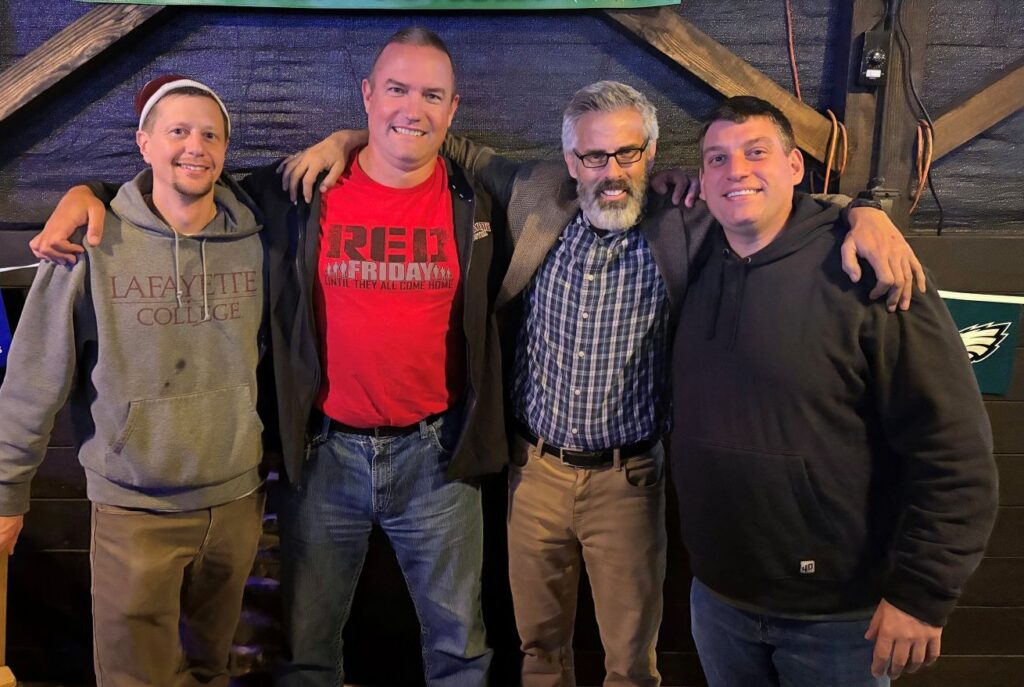
Annual Lafayette Steel Bridge pilgrimage, 2025, on the eve of the Lafayette-Lehigh football game. (L-R) Dan Kucz ’07, Craig Bloom ’07, Prof. Steve Kurtz, and Mike Lemken ’09. | Contributed photo
“That’s where he learns what I’m doing, and he’s always eager to catch up on my career progression,” Kucz says. “It’s always real with Kurtz. For so many of us, he made the Lafayette engineering experience meaningful, relevant, and personal, by welcoming you into this great tradition.”
“I have such gratitude for Lafayette and the connections made there,” Wright adds. “It’s community oriented. Professors like Kurtz care so much about the students and stay in touch long after graduation.”