March 10, 2026
History, memories, and transformation through rephotography
By Bryan Hay
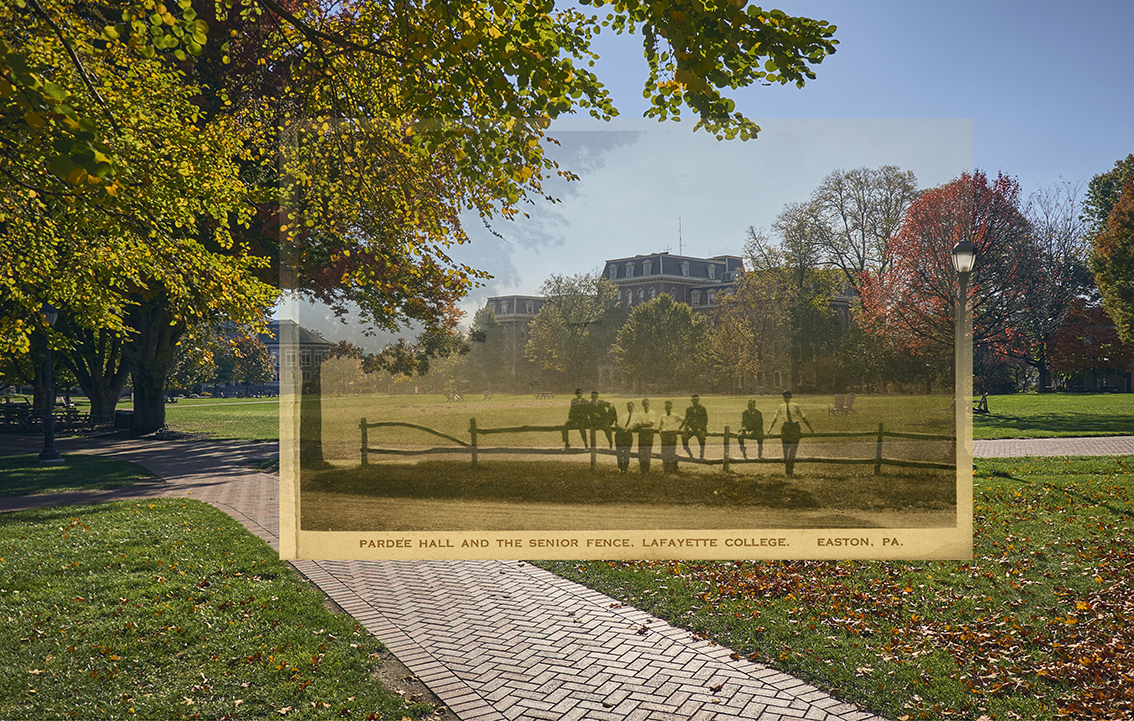
Rephotography by visiting visual artist Ricard Martínez
After months of exploration and reflection, students in Prof. Katie Stafford’s FYS 164: Adaptation (in the Humanities) have completed an insightful journey of Lafayette’s campus and traditions through rephotography, the process of photographing a subject in different moments in time.
Their final work is represented in Adaptations of College Hill: A Bicentennial Exploration Through Rephotography in Kirby Hall of Civil Rights Library. About a dozen panels are set up on the perimeter of the library, each depicting a variety of contemporary campus scenes melded with historic scenes and moments from the same vantage point, inviting conversations about the College’s 200-year history. QR codes take viewers to student essays, providing a window into their thought processes behind their works.
Free and open to the public and sponsored by Lafayette College’s Bicentennial Academic Fund, the exhibit will be on display through mid-April.
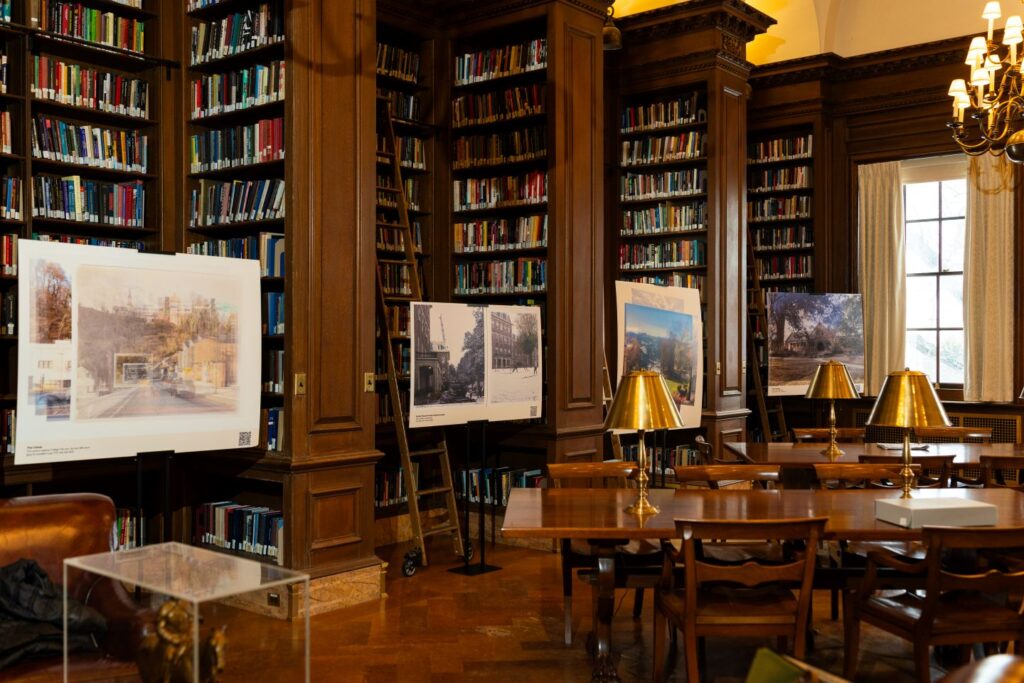
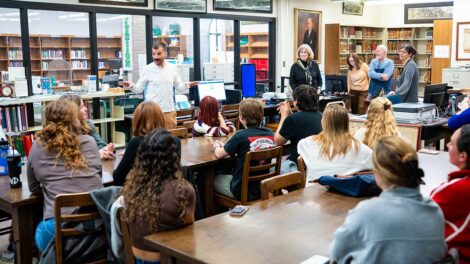
Visitors will see a range of Lafayette-inspired rephotography produced by students and their teachers. | Photo by JaQuan Alston
Supported by the College’s Special Collections staff and mentored by visiting visual artist Ricard Martínez, a photographer and historian from Barcelona who specializes in Spanish Civil War photography, Stafford’s students spent the fall semester exploring perspectives and composition techniques as they viewed campus buildings and landmarks, and imagined and reimagined the stories behind them.
“I think this is a very effective student-centered Bicentennial initiative,” says Stafford, associate professor of Spanish. “I’ve really enjoyed it because it involves the students, and these are first-year students who are making the campus their own by discovering its stories. It’s just a really cool opportunity to become part of a place, look at all the different kinds of people who have occupied our campus over the past 200 years, and think about them in different ways.”
Revisiting a historic image to take a new photograph from the same point of view—the technique known as rephotography—opens up new avenues for research and helps redefine our relationship with the past and the future, Martinez says.
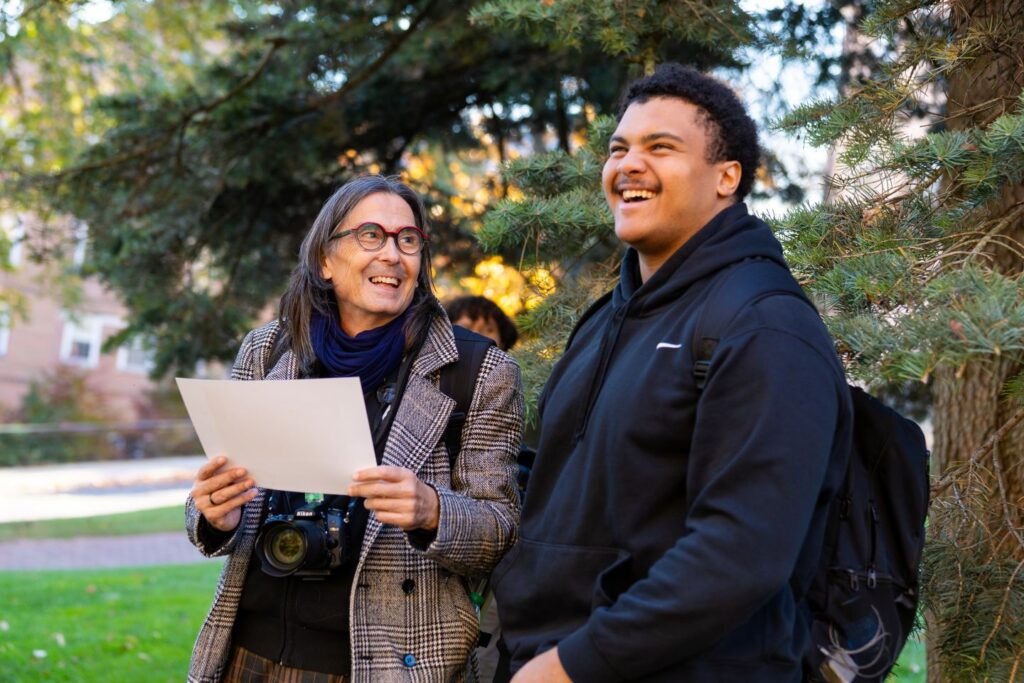
Visiting visual artist Ricard Martínez (left) guides Sean Kabengele ’29 during campus tour in fall 2025. | Photo by JaQuan Alston
“When we merge a current image with one from the past, it’s like a ghost coming back to take up the spot it occupied while alive,” he observes. “When you show an old picture and a new one together, it actually opens the door to a third position—the future.”
Often, rephotography is misinterpreted as a way to encounter the past, but Martinez thinks about the process as a gateway to the future as it involves taking a required physical step to visit an archive, a perpetual journey of discovery.
“It’s much more powerful if you think about the future,” he says. “These old pictures are preserved in the archive and are always waiting for us in the future.”
Visitors will see a range of Lafayette-inspired rephotography produced by students and their teachers. Among them include the entrance to Pardee Hall merged with a milky image of workers involved in an earlier maintenance project; South College shown in juxtaposition with 19th-century angles; football teams from 1902 to 2025; two winter views of Skillman Library stitched between a black tupelo and red maple. Stafford offers a view representing the changing seasons and changing moments of life between 2016 and 2026 from her office window on the fourth floor of Pardee Hall—the best view on campus, she says.
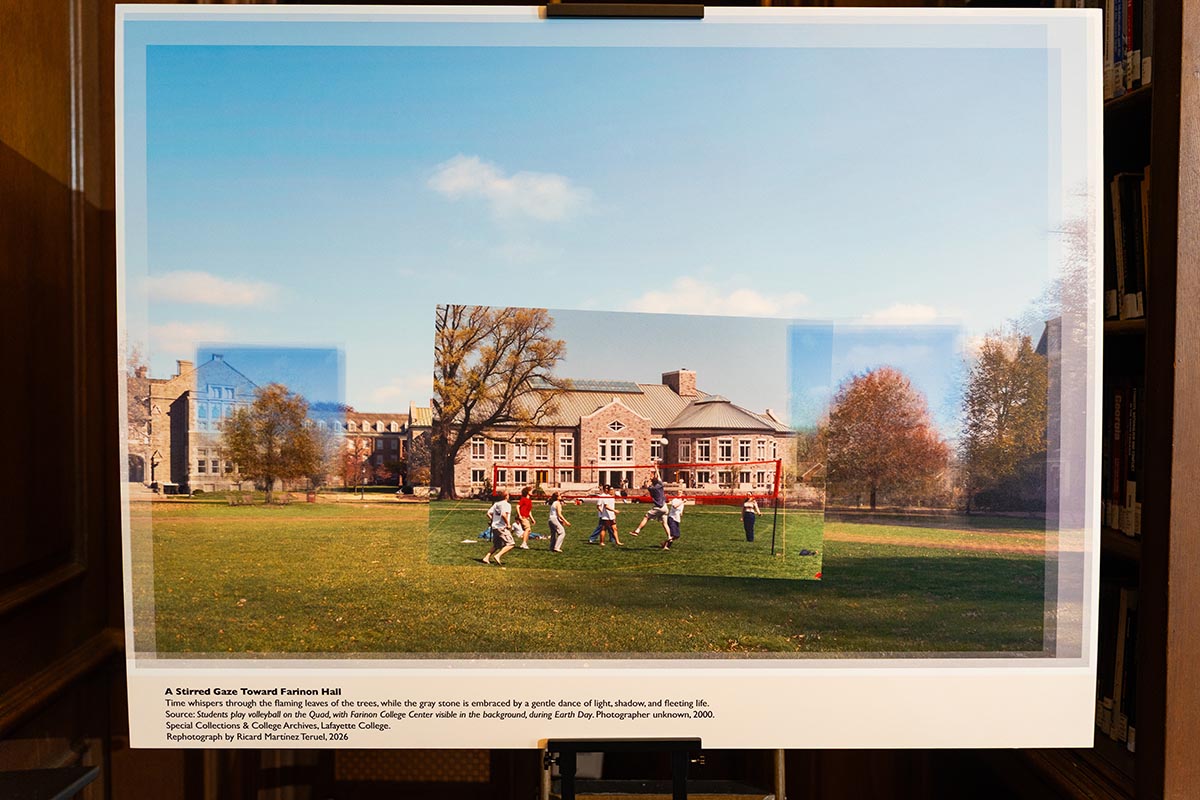
“A Stirred Gaze Toward Farinon Hall” by Ricard Martinez, featured in Adaptations of College Hill: A Bicentennial Exploration Through Rephotography | Photo by JaQuan Alston
Jesse Kronenfeld Casis ’29, who plans to major in government and law and anthropology and sociology, assisted Stafford and archives staff in assembling the exhibit in late February and was drawn to the conceptual, abstract nature of FYS 164. His reaction is reflected in his metaphorical panel showing the College Hill escarpment in multiple layers of imagery from the 1870s to the present.
“I put that hillside into my own life and my encounters with other students,” Casis says. It represents the whole process of a Lafayette student. Sometimes it’s harder for others to climb the hill, but we’re all going through the same journey, and we’ll get there together. It’s just different for everyone.”
Sean Kabengele ’29 found the project highly educational, aligning his rephotography with his role as a defensive tackle on the football team. Pouring over vintage rosters, he developed a composite of football teams from 1902 through 2025.
“It’s been interesting to visualize the history,” says Kabengele, adding that his FYS experience validated his decision to attend Lafayette. “Lafayette has been around a long time, and this project has offered a fascinating way to see the growth over the years.”
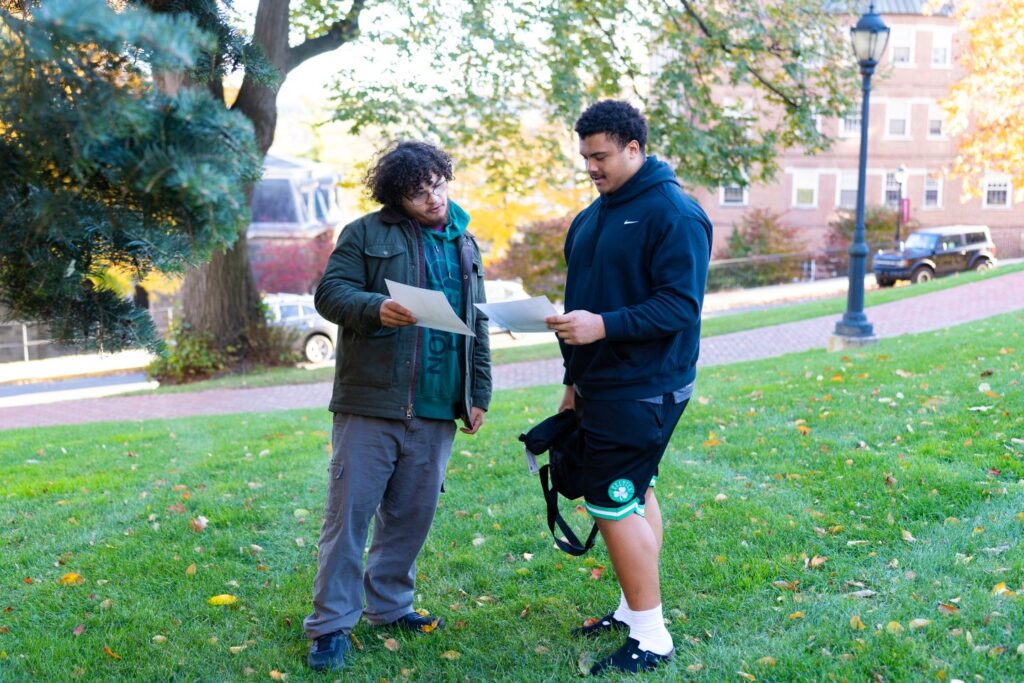
Jesse Kronenfeld Casis ’29 (left) and Sean Kabengele ’29 discuss their rephotography ideas as they survey the campus. | Photo by JaQuan Alston
Ana Ramirez Luhrs, co-director of Special Collections & College Archives, who along with her staff helped the students select original photographs, says she was impressed by seeing the final works and how the students paired their contemporary images with the images they carefully selected from the archives.
“I love the way they just superimposed the photographs and thought about the angle, lighting, and composition,” Luhrs says. “Our thanks to Ricard, who is really teaching them how to photograph and think deeply about how rephotography represents an evolving vantage point. Everyone did a beautiful job.”
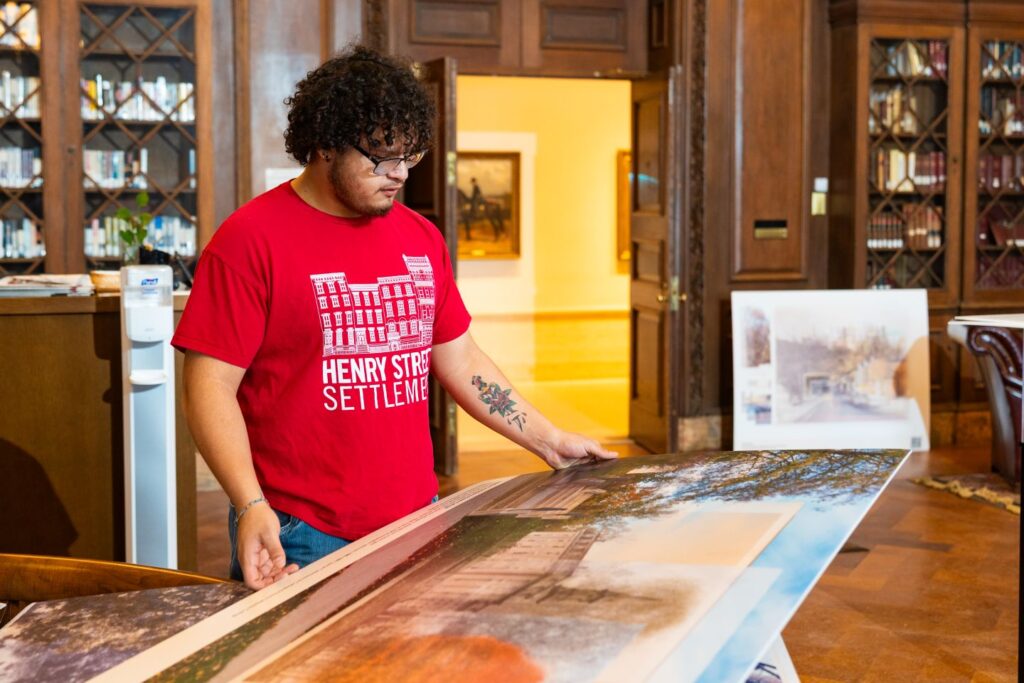
Jesse Kronenfeld Casis ’29 reviews final panels during installation of Adaptations of College Hill: A Bicentennial Exploration Through Rephotography in Kirby Hall of Civil Rights Library. | Photo by JaQuan Alston
As the exhibit took its final shape in Kirby Library, Stafford expressed pride in her students’ work.
“I’m just really happy and proud of what they’ve come up with, and how they each picked a project that was interesting to them,” she says. “I hope that visitors will read their essays, because that is very much a part of their visual voice.”
Stafford describes the exhibit as representing a true Bicentennial moment and exemplifying the liberal arts experience: a Spanish professor coming together with a visual artist and special collections, learning about archives and putting on an exhibit.
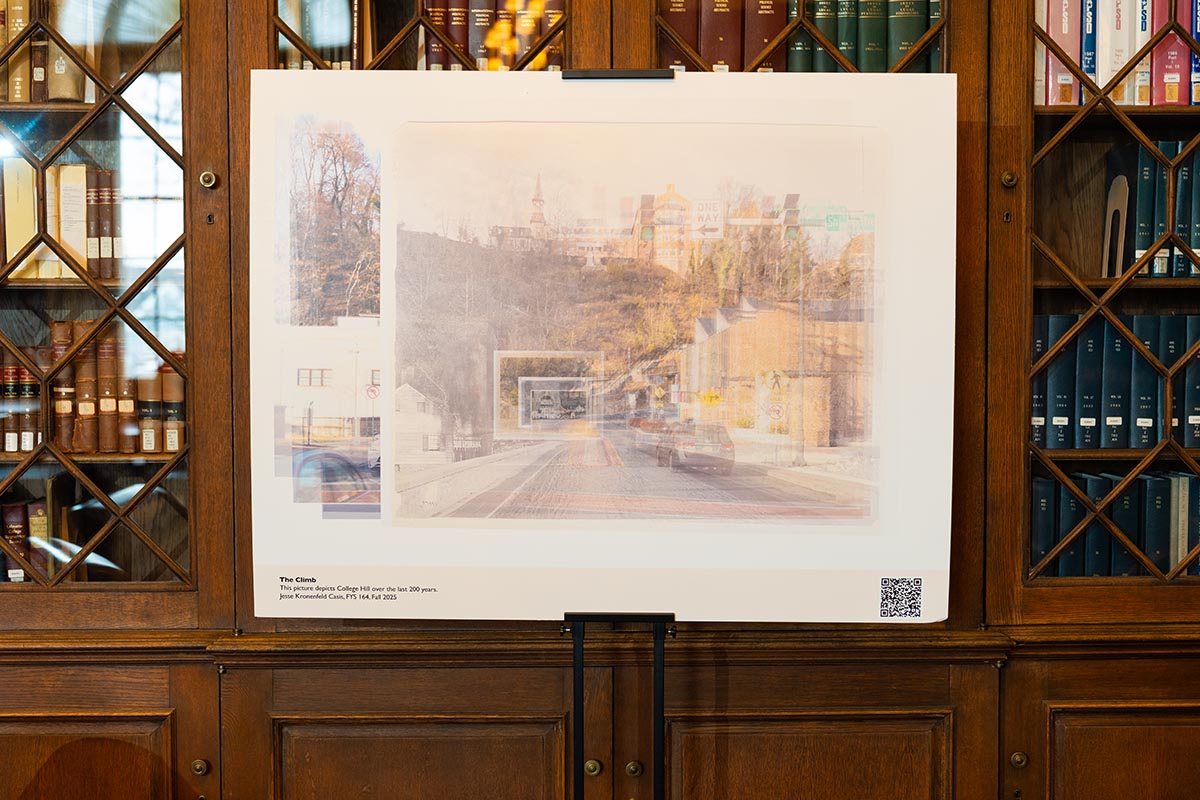
“The Climb” by Jesse Kronenfeld Casis ’29 featured in Adaptations of College Hill: A Bicentennial Exploration Through Rephotography | Photo by JaQuan Alston
“It all came together to show the kind of flexible thinkers who come to Lafayette College,” she says.
In addition to Lafayette’s Bicentennial Academic Fund and Special Collections, Adaptations of College Hill: A Bicentennial Exploration Through Rephotography received support from languages and literary studies, German studies, and the Max Kade Center for German Studies.
Categorized in: Academic News, Art, Bicentennial, Featured News, First-Year Seminar, German, Languages & Literary Studies, News and Features, Spanish