Board of Trustees approved new Climate Action Plan in May; campuswide celebration set for Sept. 23
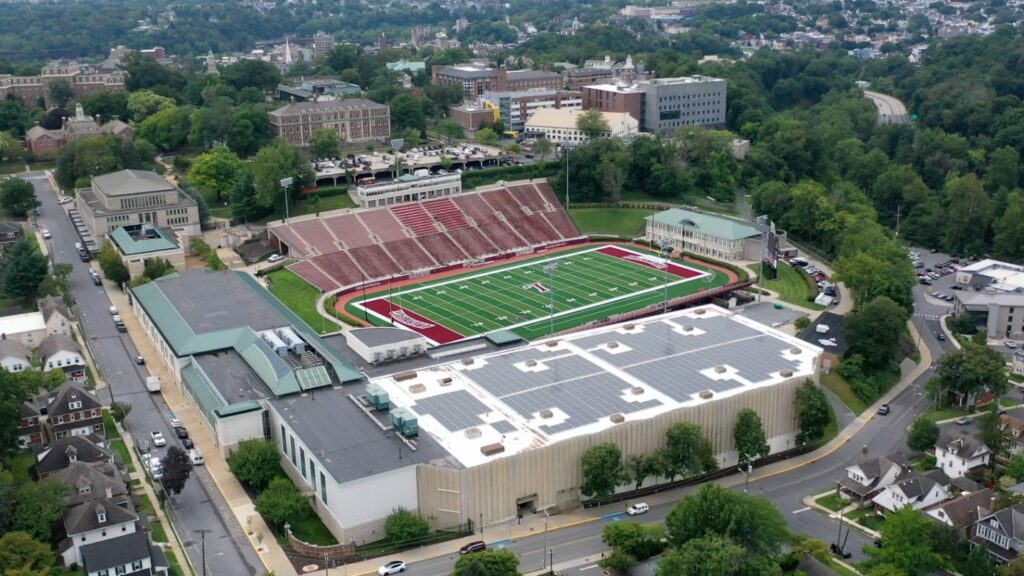
Since 2008, Lafayette has seen a substantial decrease in emissions related to fuels burned on campus or purchased for electricity, largely due to an increase in efficiency, electric vehicles, and renewable energy sources. In 2021, a 0.5-megawatt solar array was installed on the roof of Kirby Sports Center.
By Kelly Huth
Lafayette’s mission to achieve carbon neutrality by 2035 is coming into view thanks to an approved update of Lafayette’s Climate Action Plan (CAP) with specific strategies to guide the College to its goal.
The Board of Trustees renewed Lafayette’s commitment to carbon neutrality by approving CAP 3.0 on May 22. The updated plan incorporates feedback from hundreds of students, faculty, staff, parents, and alumni who participated in sessions hosted throughout 2025-26 by the Office of Sustainability and the CAP Steering Committee, which simultaneously celebrates its 10-year anniversary this year.
“I am so grateful for the leadership and commitment that is embodied in CAP 3.0,” President Nicole Hurd says. “This work represents what is best about Lafayette—students, faculty, staff, alumni, and community members coming together to make our values visible.”
CAP 3.0, now available on the Office of Sustainability’s website, acts as a road map for the College to achieve its goals. The College’s CAP is reevaluated every five years and focuses on identifying greenhouse gas reduction and resiliency strategies, decarbonization, adaptation measures, and integrating sustainability into academics and campus life, while taking into account the impacts of a changing climate.
Since 2008, Lafayette has seen a substantial decrease in emissions related to fuels burned on campus or purchased for electricity, largely due to an increase in efficiency, electric vehicles, and renewable energy sources. The College also has been collecting more data on emissions types along its supply chain, helping to gain a better picture of the broader impact decisions can make.
In 2024, the College announced 20,000 megawatts of energy would be offset by a Power Purchase Agreement for Renewable Energy Credits from an off-site solar array in Kentucky, built in collaboration with other colleges and universities. In 2021, a 0.5-megawatt solar array was installed on Kirby Sports Center. The latter will offset 9,625 metric tons of carbon dioxide in 30 years.
CAP 3.0 takes that work even further, laying out six key focus areas:
- Decarbonizing heating, cooling, and hot water
- Electricity solutions
- Transportation
- Waste and procurement
- Metzgar net zero plan
- Resiliency and adaptation measures
“Taking action to adapt to climate change while reducing our emissions is what keeps Lafayette at the forefront of climate leadership,” says Delicia Nahman, director of sustainability. “What sets us apart is the opportunity to connect our academic work with how we operate as a campus—and to turn that connection into real-world solutions.”
Join the CAP 3.0 celebration!
Remarks from President Hurd • light refreshments | 2-3:30 p.m. Wed., Sept. 23 • Marlo Room, Farinon • MORE