September 29, 2026
Putting a spin on cricket ball aerodynamics research
By Stella Katsipoutis-Varkanis
Video by Olivia Giralico
Compared to some of the more widely followed sports around the globe, like soccer and baseball, the sport of cricket hasn’t been explored nearly as much from a scientific standpoint. This summer, mechanical engineering major and EXCEL Scholar Tendai Ankude ’28 has devoted himself to filling that research gap. With the guidance of his adviser, Tobias Rossmann, Ankude has been conducting his own independent research on the motion of cricket balls to gain a deeper understanding of their aerodynamic qualities.
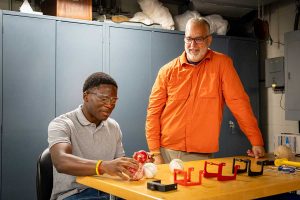
With the help of Prof. Tobias Rossmann (right), Tendai Ankude ’28 (left) hopes to shed some light on the science behind the sport of cricket through his research.
One of the main goals of Tendai’s student-led research is to learn more about fundamental fluid mechanics that impact everyday life.
“People know of aerodynamics through things like airplanes but aren’t really sure how it all works,” says Rossmann, associate professor of mechanical engineering. “If you can reach millions of people around the world who watch cricket and explain a little bit about the science behind what’s happening in the game, it makes science digestible and understandable.”
Ankude is having a go at the research topic by combining computational work with hands-on experimentation using the subsonic wind tunnel in Lafayette’s Thermal/Fluids Lab. “We have a data collection system that Prof. Rossmann set up that tells us the lift force, drag force, angle of attack, and rotations per minute of the cricket ball,” says Ankude, who hopes to ultimately base his senior thesis on the study. “I’ve been passionate about aerodynamics since I was young, and I’m a passionate Formula 1 fan, so doing this work myself—working with a computer, different simulation parameters and conditions, and seeing that mirrored in the wind tunnel—has merged all of my interests.”
Having the unique opportunity to use the subsonic wind tunnel—which can reach a top wind speed of up to 40 meters per second—to simulate the spinning of a cricket ball during a real-life match, Ankude says, is one of the most interesting and rewarding aspects of the project.
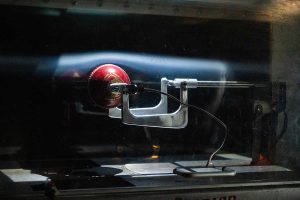
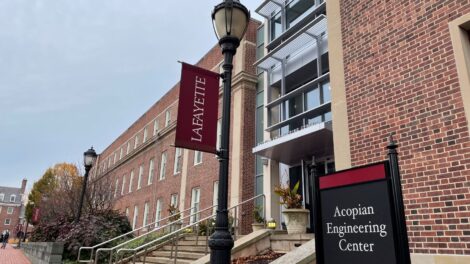
Lafayette’s subsonic wind tunnel is one of the major pieces of specialized laboratory equipment featured in the the mechanical engineering facilities in Acopian Engineering Center.
“I’ve read about wind tunnels since I was very young in terms of aircraft manufacturing and F1 testing, and being able to work with one so independently has been a gift, especially as someone [who started using it] in their second year of college,” he explains. “It’s something very rare at the college level, and the experience has been invaluable to me.”
Rossmann adds that giving students access to such state-of-the-art lab equipment and facilities to help them develop their skills as researchers is a hallmark of the engineering division at Lafayette. “We pride ourselves on undergraduate research and allowing students to be as hands-on as they want to be,” he says. “When a first-year student comes to me and says they want to use our equipment, I can say let’s do it.”
So went the story of how Ankude linked up with Rossmann to launch the project. “I was interested in doing research with Prof. Rossmann before I actually came to campus,” Ankude says, explaining that he sent Rossmann an email during his first year to express his interest in aerodynamics research opportunities after hearing Rossmann speak at an American Society of Mechanical Engineers (ASME) talk. After the two discussed Ankude’s interests, Ankude was selected for an EXCEL Scholarship and began his project in the fall of his sophomore year.
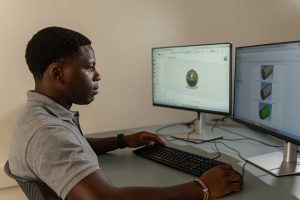
Ankude uses a data collection system created by Rossmann to analyze the lift force, drag force, angle of attack, and rotations per minute of a cricket ball.
“That open-door policy we have at Lafayette—where we’re able to speak to professors even outside of our discipline on topics that we’re interested in, and where professors can connect you to the resources you need—is something really special,” Ankude says. “Prof. Rossmann and I have formed a strong mentor-mentee bond.”
Rossmann says assisting Ankude with his research endeavor has helped him get even better at helping to produce great students. “Knowing how students work on problems that are a bit beyond the undergraduate curriculum really does help inform my teaching,” Rossmann says. “It also helps me become a better research adviser to have quality students like Tendai and guide them through the process.”
Working with Rossmann has also solidified Ankude’s aspiration to pursue graduate school and a career in an aerodynamics research-related field. Ankude hopes to continue working on his project through his junior and senior years.
“Before this, I didn’t know if I had enough prior knowledge to get involved with research, or if I was prepared enough,” Ankude says. “But when you reach out and speak to a professor at Lafayette, there’s always a path forward for you as long as you’re curious and driven in what you want to do. Never let what you perceive as your current knowledge limit you from opportunities.”