Associate professor of geology and environmental geosciences explores the young volcanoes that lie beneath retreating ice in southeastern Iceland
Tamara Carley, who studies Icelandic volcanoes to better understand our dynamic planet, will take her audience on a virtual field trip to the Vatnajökull ice cap for this year’s Jones Faculty Lecture at 7:30 p.m. March 10 in 104 Kirby Hall of Civil Rights.
“It is a true honor to be selected for the Jones Faculty Lecture, a program that celebrates the consequential scholarship conducted by faculty in our campus community,” says Carley. “I have learned so much from my colleagues through the years by attending Jones Faculty Lectures. I hope people leave this experience with a better understanding of dynamic, hazardous, Icelandic volcanoes in the context of a rapidly changing climate.”
Carley, associate professor of geology and environmental geosciences, received a National Science Foundation grant in 2022 to support her and her students’ research on subglacial silicic magma systems. Carley has conducted three fieldwork expeditions supported by this award, accompanied by six Lafayette students.
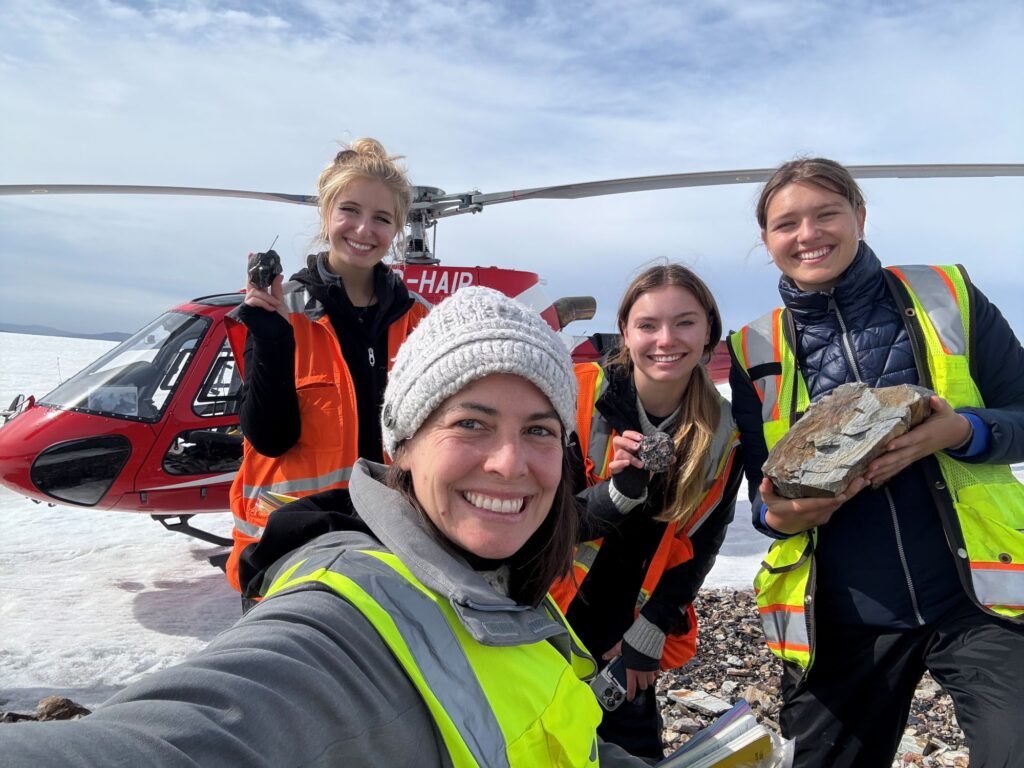
July 2025 at Þórðarhyrna, one of the volcanoes to be featured in the March 10 talk by Prof. Cawley, front center. Behind her (L-R): Gabby Montano ’25, Illinois State University, and Lafayette College geology majors Victoria Andreo ’27 and Maggie Pearce ’27. Students are holding rocks that show the diversity of samples collected at this outcrop. | Photo by Tamara Carley
Carley notes that Iceland is at the intersection of an active mid-ocean ridge, a mantle plume, and the periphery of the Arctic Circle. This unique position results in globally significant magma production and complicated interactions between erupting volcanoes and glacial ice.
Vatnajökull—an icecap that covers 10% of Iceland’s land area—sits on top of the junction of the ridge and plume, and with it, some of the island’s most active and hazardous volcanoes.
Carley explains that ice coverage has long presented challenges to investigating the history of these volcanoes, which in turn makes it difficult to anticipate their future behavior. Vatnajökull is rapidly shrinking due to climate change and ice loss. This is cause for alarm, as rapid and significant ice loss can destabilize shallow magma bodies and trigger volcanic eruptions. It also presents a rare opportunity to investigate a dynamic and enigmatic region of Iceland that has been hidden from view for the entirety of its human habitation.
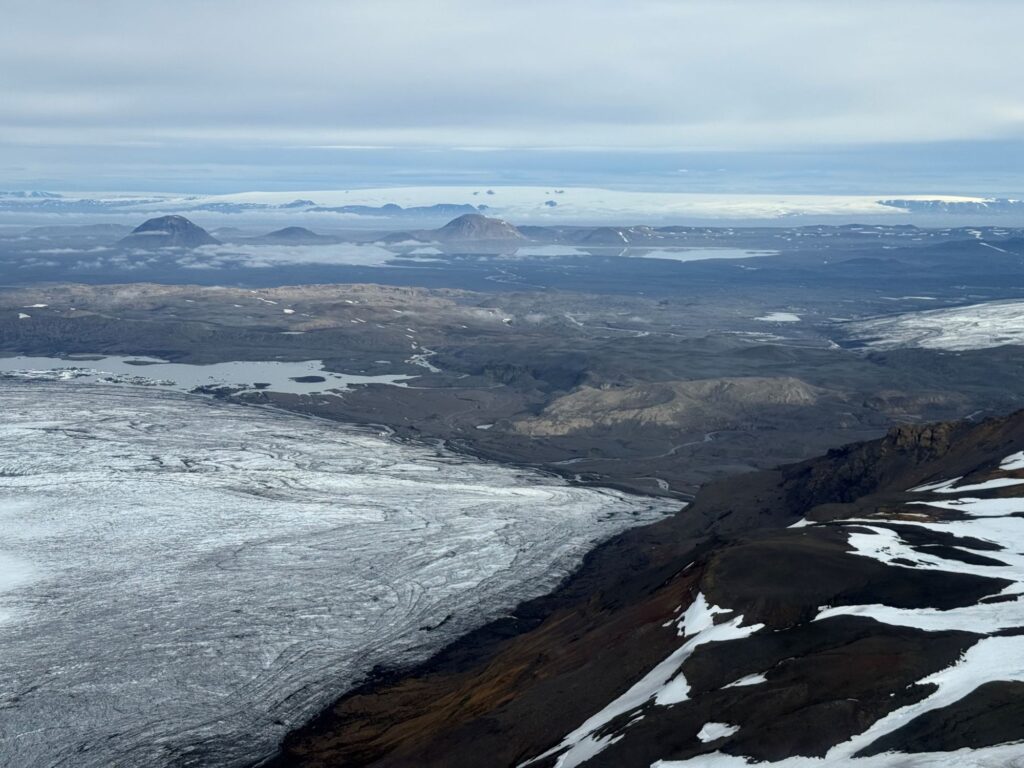
July 2025 at the western margin of Vatnajökull, about to land at a volcano named Hamarinn, looking west across to Hofsjökull, a neighboring ice cap. | Photo by Tamara Carley
Small, isolated protrusions of rock, called nunataks, that rise above the thinning ice are the peaks of large, subglacial volcanoes. Diverse piles of jumbled rocks called moraines form along the margins of retreating outlet glaciers; each rock was ripped from a young volcano or older bedrock and transported to its resting place by flowing ice. Together, these nunataks and moraines provide Carley and her students with the physical, chemical, and chronological evidence necessary to probe the magmatic history of southeastern Iceland.
“Geologists are guided by the notion that the present is the key to the past, and the past is the key to the future,” she says. “The recent past of subglacial volcanoes beneath Vatnajökull, interpreted in the context of today’s rapidly changing climate, impresses upon us the need to better prepare for a potentially hazardous future in the land of fire and ice.”