August 17, 2026
Navigating airfare turbulence
By Brianna Miron ’26
Anyone who’s ever booked a flight knows how tricky predicting ticket prices can be. Between any two cities, travelers might be shown dozens of different price points, depending on factors like how far in advance they book, the airline they’re flying with, and the day of the week they’re departing. Assistant professor of economics Michael Carter and EXCEL Scholar Michael Byrd ’28 are analyzing data from the seven largest airlines in the U.S. to identify patterns in these fare fluctuations.

Prof. Michael Carter and Michael Byrd ’28 are spending the summer researching disparities in airline pricing. | Photo by JaQuan Alston
Carter, who previously worked setting prices at an airline, explains, “What we’re really trying to do is look under the hood and say, what are the lines that the airlines are drawing, or what are the gates that they’re putting up?” For example, “If you are thinking of buying a ticket eight days from departure versus six days from departure, what we’re going to be able to see is how much you might have to pay as you go over the seven-day fence.”
To find where exactly those fences lie, Carter and Byrd have been spending the summer dissecting data at a scale best reflected in their research paper’s title, “What Can Two Million Prices Teach Us About Airline Competition?”
“Even if I look at one relatively small market—let’s say, Omaha to Pittsburgh—there are over 1,300 price points, filed by six different carriers,” Carter says. For each market, Carter and Byrd compare flights with similar restrictions, like flights on the same date, in order to isolate the factors leading to consistent shifts in prices. They compare fares both within individual airlines and between competitors. “Once you match all of those travel restrictions, you can see—are there patterns?” Byrd says.
By uncovering these trends, Carter and Byrd hope to help travelers find ways to save money when booking their next trip. “Something we see kind of early in our results is that if you’re willing to fly on a Tuesday, Wednesday, or Saturday, airlines will usually give you a lower price,” Carter says.
The analytical skill and quantitative rigor this kind of research requires is precisely what drew Byrd, an economics and math double major, to the project. “It’s very data intensive, and I like data,” Byrd says. “And the problem-solving aspect—having to consider what the problem is and how to think through the solutions—that’s what I enjoy most.”
Byrd was initially motivated to pursue research after reading about another Lafayette student’s research for an economics thesis. “I remember reading his story and thinking, wow, I want to be someone like him,” he says. “Seeing that was really, really inspiring for me.”
Working with Carter this summer as an EXCEL Scholar has given him the opportunity to play an active role in research and gain hands-on experience with data. “There are just things you can’t learn in the classroom but you can learn by doing research,” Byrd says. “Getting such close interaction with my professor has been very helpful—to see his own methodology and think of how I would consider these problems.”
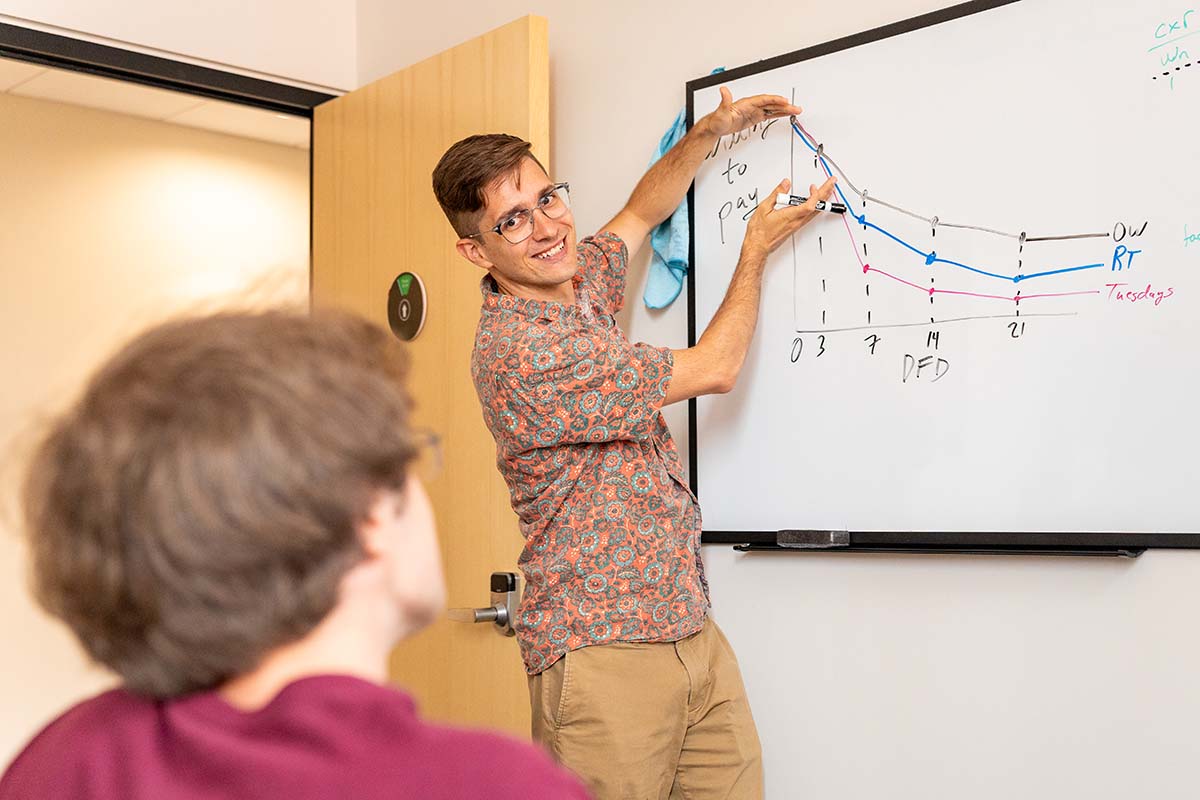
By uncovering airline pricing trends, Carter and Byrd hope to help travelers find ways to save money when booking their next trip. | Photo by JaQuan Alston
Carter recognizes this impact, describing the EXCEL program as an invaluable way for students to develop research practices and gain exposure to the type of work they’ll do after graduation. “You learn a very different set of skills working with messy data no one has ever seen before. You have to be a lot more creative in how you’re answering and asking questions.”
This is a challenge students like Byrd are eager to take on. “An upside of working with Lafayette students is they are very driven to ask big questions,” Carter says. “So when I ask Michael or any of my other research students to look into something, I don’t have to hold their hands. I can say, go explore and write down your questions for me, and we’ll figure this out together.”


Categorized in: Academic News, Economics, Faculty Research, Featured News, News and Features, Students