October 27, 2026
Prof. Megan Fernandes to deliver Jones Faculty Lecture
Megan Fernandes, associate professor of English, will discuss writing from loss, drawing on the late Lauren Berlant’s idea of a poetics of dissociation and a sonnet by Diane Seuss, for this year’s Jones Faculty Lecture at 7:30 p.m. Nov. 11 in 104 Kirby Hall of Civil Rights. The event is free and open to the public.

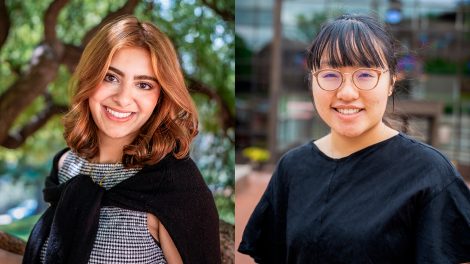
Megan Fernandes, associate professor of English (Photo by Rivkah Gevinson)
Megan Fernandes is the author of three books of poetry. Her third book of poems, I Do Everything I’m Told (Tin House, 2023), was named a Best Book of 2023 by The New Yorker, Time Magazine, Vogue, The Boston Globe, ElectricLit, LitHub, Autostraddle, etc. Her work has appeared in The New Yorker, Poetry, The American Poetry Review, and The Kenyon Review, among others. Fernandes also has had solo multi-media work shown at the Tate Modern and collaborative work shown at the 2022 Venice Biennale, the ICA London, and the Soy Capitán gallery in Berlin. Her fourth book of poetry, Fernandes & I, is forthcoming with Graywolf Press in 2028.
Here’s a preview of her Jones lecture, what inspired it, and her reaction to being selected for this year’s Jones Faculty Lecture.
What inspired your talk and how does it resonate in this time we’re all experiencing?
Some months ago, I had a student who wrote a very funny, swaggy poem for class and then, in the middle of the poem, casually mentioned a passing fear about a school shooting. It wasn’t meant as a dramatic turn. The ‘intrusive thought’ wasn’t intrusive to her, it had simply become embedded in her thinking, her cognitive structure, since high school. It reflected the reality she was living in, her everyday life in America. To consider the violence amidst the mundane didn’t feel exceptional. It was not even the volta (emotional turn) of the poem.
See, I’m interested in these moments. These moments where humor meets a paranoia that is not a paranoia at all; it is simply the active entertaining of a possibility. We are constantly entertaining these possibilities, these thoughts of our own annihilation, even our species’ annihilation. And my god, there is a cost to that imagining. Just the other day I read an article saying something to the effect that there is a 10%-33% chance AI might kill us all in the next decade. I’m not really sure what to make of this information except to do what the great poet Frank O’Hara said … which is to continue. As he says: ‘the Seine continues, the Louvre stays open it continues it hardly closes at all.’ So, the talk is about, I suppose, the how of how we continue, not in a space of false optimism, but thinking through models of dissociation explored by scholars and poets such as Lauren Berlant, yes, but also Frantz Fanon, Judith Butler, David Eng and Shinhee Han, Diane Seuss, Hala Alyan, Aga Shahid Ali. We won’t get to everyone in a single talk, maybe this is a book project in the making, but the lecture is part of a larger argument about how to write without reality or in a new reality or a surreality. And it is not simply just about the poetics of dissociation, but the politics of it as well, what it teaches us about our attachments and detachments under various political regimes.
What draws you to the poetry of Lauren Berlant and Diane Seuss?
I love poetry. I love theory. I love a theorist who reads poetry as Lauren Berlant did and did quite seriously. The poetics of dissociation is about, amongst other things, the work of Claudia Rankine and her radical punctuation. At the end of their life, Berlant was also working on comedy and humor. I did not know Berlant personally, but Berlant (alongside folks such as Sara Ahmed, Avgi Saketopoulou, Sianne Ngai, Jack Halberstam) are important thinkers for me. As for Diane Seuss, well, I think she is a genius. She writes from the bottom, I mean, I find her absolutely gutting. Her syntax is a wilderness, she spits out her interiority, her flow, the way she punctuates a line, the rhythm she creates internally? It’s inimitable. Diane Seuss and Lucille Clifton and Frank Bidart, for syntax, can’t be beat. I’ll be close-reading one of her sonnets from her book frank: sonnets. It’s a sonnet that begins with the line, ‘Who wants to be soft? I don’t.’ But of course, softness is a gift and a political position.
What does it mean to you to have been selected for this prestigious lecture series?
It is moving to be asked, and in particular, I hope to do my department proud. I feel lucky to be working in a department of committed teachers and thinkers. We are actively discussing what makes the discipline a discipline, and we are full-on nerds. I think everyone should be a literature and writing major, though, of course, I’m a bit biased.
The talk is also about pedagogy, it draws on a few experiences in the classroom that have been particularly meaningful to me. I’m constantly astounded by our students, their impressions and takes on writing, their ways of approaching a poem. A few weeks ago, I gave a talk at Yale, and afterward, at a dinner with faculty, I shared an analysis that two of my current students (Matthew VanWright and Christos Patterson) had said in regard to Robert Creeley, a Black Mountain poet we have been reading in ENG 151: Introduction to Creative Writing. The Distinguished Writer-in-Residence at the table put down his fork and turned to me and said, ‘Wow, those observations are just brilliant! And in an intro class?’ And I felt very moved by his reaction and also grateful to be in conversation every week with these minds. Their analysis was about line breaks as reflecting a disruptive emotional processing in a speaker, and it was largely intuitive. So much of learning is naming the relationship between a student’s intuition and a technical, historical, or aesthetic principle. What I’m saying is that yes, it is an honor to give the Jones lecture, but it is always a dream to get up in front of a group of smart people and talk about ideas, books, poems, hurt, belonging, humor, etc. I love how a room thinks together.
Fernandes’ talk is sponsored by the Thomas Roy and Lura Forrest Jones Faculty Lecture and Awards Fund, established in 1966 to recognize superior teaching and scholarship at Lafayette. Registration is not required.