October 20, 2026
Prof. Xu Ma earns competitive grant to help students explore Chinese religious culture through music and movement
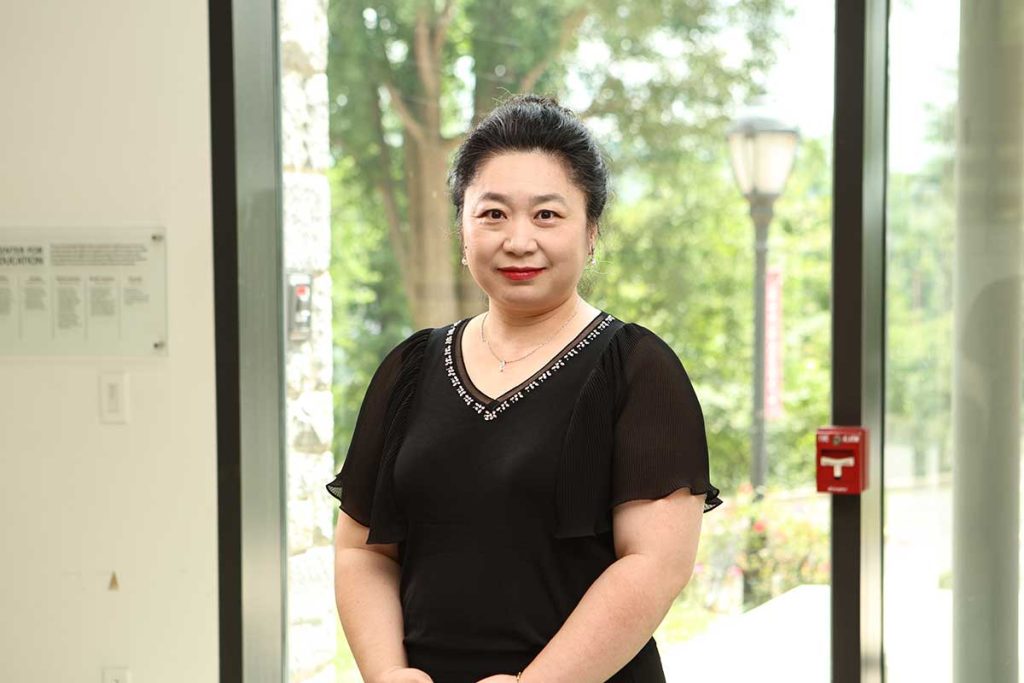
Xu Ma, assistant professor of religious studies | Photo by Rick Smith
By Stella Katsipoutis-Varkanis
What can a breathing exercise teach students about Chinese religious life? How can listening to a string instrument become a lesson in moral cultivation? For Xu Ma, assistant professor of religious studies at Lafayette College, these questions bring the study of religion into the body and the senses. Recently awarded a grant from ASIANetwork’s Embodied Learning About Asia program, she brought practitioners and scholars of traditional Chinese healing arts and music to campus for immersive and innovative educational experiences.
The competitive grant—which was awarded to Ma and her co-recipient Wandi Wang, assistant professor of Chinese at Lehigh University—enabled Ma and Wang to host two scholars-in-residence at Lafayette and Lehigh during the fall semester: Seng Kan Cheung, a Chinese American immigrant healer specializing in traditional Chinese practices, including qigong, taiji, and acupuncture; and Meimei Zhang, associate professor of Asian studies at Occidental College, traditional Chinese music scholar, and accomplished player of the zither, a traditional Chinese string instrument. Through demonstrations, performances, classroom visits, and public presentations, the guests invited students to explore Chinese religious and cultural traditions through hands-on experiences in sounds and bodily movements.
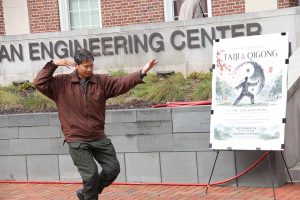
This fall, scholar in Residence Seng Kan Cheung, Chinese American immigrant healer, led a public demonstration of taiji, qigong, and acupuncture in Lafayette’s Anderson Courtyard. His residency and that of Meimei Zhang, associate professor of Asian studies at Occidental College, at Lafayette was made possible by Ma’s ASIANetwork grant. | Photo provided by Xu Ma
“I was very excited when I found out I was awarded the grant,” says Ma, who also recently released her new book, Boundaries and Bodhisattvas: Women, Lay Buddhism, and Religious Spaces in Late Imperial China. “The grant gave me an opportunity to introduce substantial embodied experiential learning into my classroom and our campus. I wanted students to think about how their senses could reshape their learning and intellectual work. A musical performance or a breathing exercise can open questions they can then take back to a text.”
ASIANetwork’s Embodied Learning About Asia program encourages teaching methods that go beyond conventional classroom instruction, and supports residencies and pedagogical resources to help students engage with Asian cultures through physical, sensory, and participatory learning. For Ma, the grant presented an opportunity to experiment with new approaches to teaching and meaningfully connect with students at a time when technology and artificial intelligence are increasingly impacting the educational landscape.
“It not only motivated me to rethink my teaching and the design of my courses, but it will also benefit the larger curriculum of the Department of Religious Studies,” Ma says. “It allows us to see how we can design courses and activities through multiple experiential layers to teach students about different civilizations, cultures, and religious traditions, and make our teaching more appealing to the younger generations.”
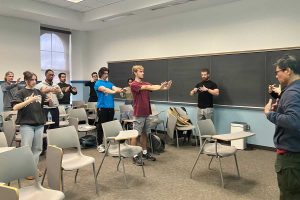
Cheung introduced Ma’s students to the traditional Chinese practices of qigong and taiji through in-class demonstrations. | Photo provided by Xu Ma
During his weeklong residency in September, Cheung introduced students to qigong and taiji, practices involving breath, movement, and body-mind-environment alignment. His demonstrations also explored acupuncture as a traditional healing practice, inviting students to consider how Chinese religious and philosophical traditions understand relationships between the body and its surroundings. “In the Chinese Daoist tradition, physical health and the human body are an integral part of the cosmological rhythm, and you can attune your body, mind, and heart to that larger cosmological dynamic to cultivate good health,” Ma says.
The activities were integrated into Ma’s REL 209: Sacred and Scared: Strange Tales and Popular Religions in East Asia course, and her REL 218: Confucianism: Self and Society course, where students observed traditional practices, participated in movement exercises, and observed and directly engaged with Cheung to connect religious ideas with lived experiences.
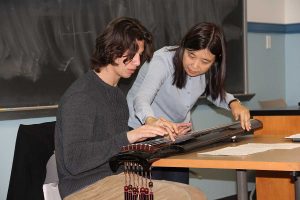
Zhang introduced Ma’s students to the guqin and pipa, two traditional Chinese musical instruments. | Photo provided by Xu Ma
Zhang’s October residency offered another perspective on embodied learning through traditional Chinese music. She introduced students to the guqin, a seven-string zither, and the pipa, another traditional Chinese string instrument. Attention to sound, silence, posture, and gesture offered a way to explore why musical discipline became associated with ethical cultivation. “Music can play such an important role in moral and emotional cultivation,” Ma says. “Rituals and music go hand in hand in Confucianism, which is all about becoming a better human in society.”
Zhang also met with students during office hours and presented a public talk. Ma incorporated additional cultural resources—including traditional Chinese paintings, musical instruments, books, films, and documentaries to deepen students’ understanding. For Ma, experiential learning is most valuable when sensory encounters and academic inquiry strengthen one another. “A brief qigong session can open questions about the body, self-cultivation, and religious life; but without historical and textual context, it risks reducing a complex tradition to an exotic experience,” she says. “Guided reflection helps students examine their assumptions, recognize the limits of brief participation, and develop more attentive ways of interpreting what they encounter with intellectual rigor.”
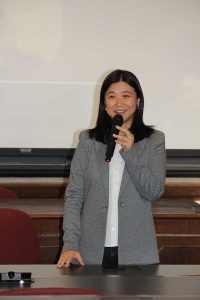
Zheng delivering a public lecture to the Lafayette community. | Photo provided by Xu Ma
The grant also supported a public demonstration of taiji, qigong, and acupuncture in Anderson Courtyard, as well as a pedagogical workshop at Lehigh University. The workshop brought together the visiting scholars and educators from nearby institutions to discuss the benefits and limitations of embodied learning, and how it could be more effectively integrated into college teaching.
For Ma, these moments exemplify what makes Lafayette’s learning community unique. “I really enjoy teaching at Lafayette because our students are talented, motivated, and thoughtful,” she says. “They are eager to learn and explore something new and different. I want them to have more opportunities to incorporate their own skills, like singing and painting, into their academic work. At the beginning of Zhang’s public lecture, a student in REL 218 gave a beautiful vocal performance of a traditional Chinese song set to a poem from a Confucian canon. Seeing students bring their talents into conversation with what we study is one of the most rewarding and meaningful parts of teaching for me.”
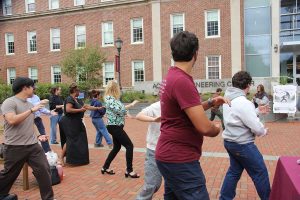
Lafayette community members participating in the public demonstration led by Cheung. | Photo provided by Xu Ma
Ma plans to reflect on and share the lessons she learned from the grant-backed initiatives through scholarly articles, conferences, and workshops. She also sees the experience informing departmental curriculum innovation and contributing to wider conversations about teaching in a digital age.
She is especially grateful to Meghan Masto, associate provost of scholarship, research, and academic initiatives; Mary Ellen Jackson, director of sponsored research; Robin Rinehart, Richard H. Jr., ’60 and Joan K. Sell Chair in the Humanities and professor of religious studies; and Brett Hendrickson, professor and head of the Department of Religious Studies, for their generous support throughout the grant application process and the residencies.
The project also has brought a new question to her scholarship: How might learning to perceive wisely and differently change the way people understand themselves and their relationships with the world? “In the future, I’d like to explore how our sensory perceptions can cultivate us into better perceivers and teach us about the relationship between ourselves and the world, and move toward a better understanding of selfhood and self-definition,” Ma says.