November 11, 2025
Testing the waters
By Bryan Hay
Undeterred by a swift current in the Bushkill Creek and its chilly 60° F water, even on a midsummer day, Prof. Christa Kelleher ’08 and her intrepid research students pulled on hip waders and stepped gingerly into the creek bed.
As joggers, dog walkers, and others out for a morning stroll on Karl Stirner Arts Trail passed by unaware of the activity, the importance of the Lafayette team’s quiet work became instantly clear as small waterproof temperature sensors were methodically tucked among rocks and under tree roots in the water.
The data they’re collecting will eventually reveal much about the health of the creek and the larger Delaware River watershed, a resource that’s treasured by recreation seekers, anglers, hydrologists, biologists and others.
This summer, work began in earnest on Kelleher’s five-year, $489,451 National Science Foundation Faculty Early Career Development Program (CAREER) award, the agency’s most prestigious recognition of early-career faculty.
The research, involving installing temperature sensors in the Delaware River basin, will have important implications for aquatic and riverine habitat, hydrology, and human recreation, all affected by water temperatures.
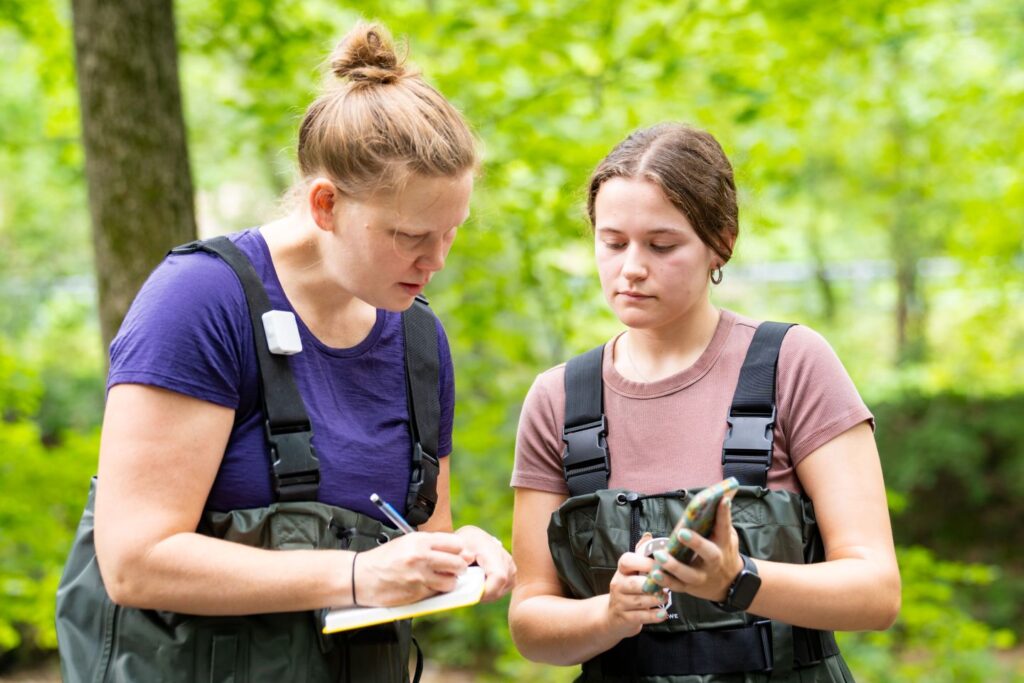
Prof. Christa Kelleher ’08 (left) and Ashley McElroy ’27 compare notes while placing sensors in the Bushkill Creek. | Photo by JaQuan Alston
“It tells you so much about what’s happening in a stream. It tells you about the health of the stream and health of the ecosystem that resides in the stream,” says Kelleher, a hydrologist and assistant professor of civil and environmental engineering and Kate and Walter A. Scott ’59 Scholar in Engineering.
“It tells you about atmospheric exchange. So, it’s going to tell us a little bit about what rising air temperatures mean,” she adds. “It tells us about hydrological processes. So, if it’s really cool in a stream, that’s telling you there’s very healthy riparian vegetation cover and you might have groundwater contributions. It also tells you about exchanges between groundwater and surface water.”
As civil engineers, Kelleher and her students are particularly interested in what water temperatures say about human activity.
“Where we have stormwater inputs, we’ll sometimes get these massive spikes in stream temperature, and we have a couple sites where we expect that if you have a really exposed stream, it’s going to be warmer, with wider daily variations,” she says. “We’re using that pulse of stream temperature to understand what is happening in streams and how stream water quality varies.”
There’s an abundance of publicly available water temperature data from the U.S. Geological Survey but little from the Lehigh Valley area. This research aims to correct that.
“We want continuous data, and we want it for a year or more, because it’s really what we need to understand what is happening in a stream in the Delaware watershed,” she says, adding that the first focus is the Bushkill Creek, a popular waterway for recreation and known for its rich habitat, then moving to other tributaries over the next five years, possibly longer.
“Our hope is to share this data with organizations and individuals to give them a fuller picture of what is happening at the stream in their neighborhood, or the stream where they go fishing,” Kelleher says. “We have some nice partnerships to ensure this work is shared widely, including with the Nurture Nature Center in Easton. We’ll be eager to share some of what we’re finding with the broader community in the coming years.”
As a Lafayette alumna, Kelleher enjoys being with students as she relives good memories of conducting similar research when she was a student here.
“I benefited from the opportunity to do research with multiple faculty members, which made the classroom come alive,” she says. “Being able to have summer student researchers with me makes it so much more fun.”
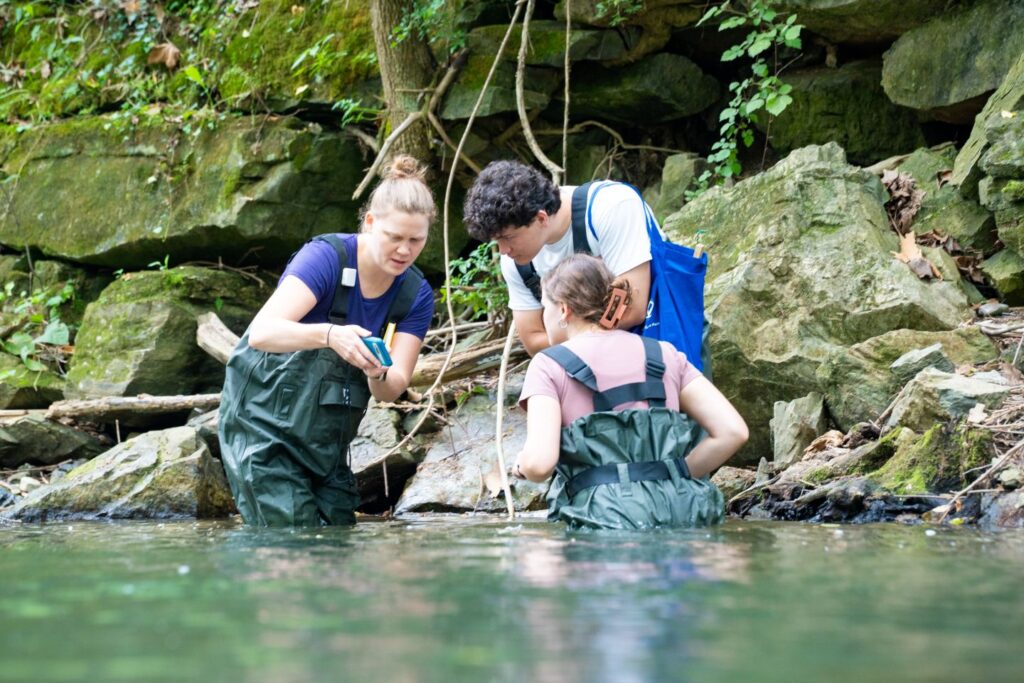
Water temperatures reveal much about the health of the stream and health of the ecosystem that resides in the stream, explains Prof. Christa Kelleher ’08, shown here with Ashley McElroy ’27 and Robbie Snyders ’26 placing small sensors among the rocks in the Bushkill Creek. | Photo by JaQuan Alston
As she prepared to enter the creek, Ashley McElroy ’27, a civil and environmental engineering major and Clare Boothe Luce Scholar, shared that the experience working on such consequential research has enhanced her classroom experience by applying concepts to real-life situations.
“Even just going in the stream and being outside for a little bit in the summer has really been helpful,” she says. “Learning how to program a stream sensor is really awesome because they do that in real life. And I’ve been learning how to use a field book and the importance of taking really good notes.
“Getting outside and learning more about the environment in general, seeing how stream temperature can really affect the earth and what we could do for the world through collecting stream temperatures, has been revealing,” she adds.
It’s been a classic Lafayette experience all around.
“It’s a really individual experience,” she observes. “At Lafayette, you have opportunities to work directly with an experienced professor in small groups, and that’s something you may not get at big schools.”
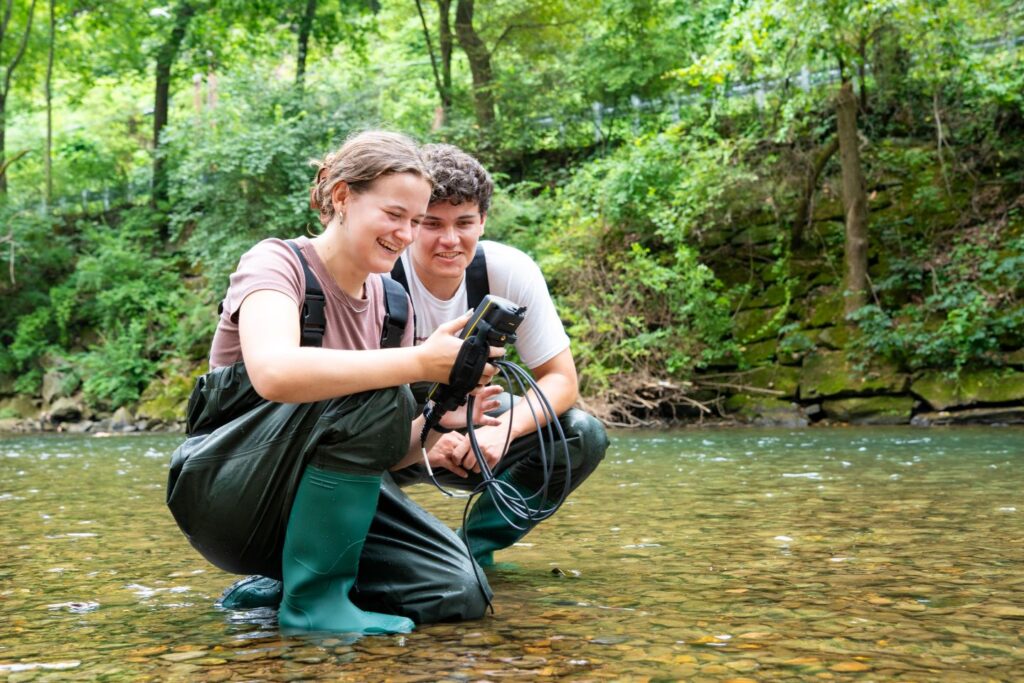
Ashley McElroy ’27 and Robbie Snyders ’26 shared a common observation about how working alongside an expert faculty member reflects the quality of a Lafayette education. | Photo by JaQuan Alston
At a larger research university, the kind of research being conducted by Kelleher would likely be led by a graduate student and involve many undergrads, adds Robbie Snyders ’26, a civil and environmental engineering major and EXCEL Scholar.
“At Lafayette, Prof. Kelleher always makes the time to focus on helping us become better engineers and helping this project succeed,” he says. “I never had the opportunity to be part of a research experience like this before. It’s been great to learn about how critical water temperatures are to the environment and to be outdoors working together in a small group.”
The material in this article is based upon work supported by the National Science Foundation under Award No. 2440131.

Categorized in: Civil and Environmental Engineering, Faculty Research, Featured News, News and Features, Research, Sustainability