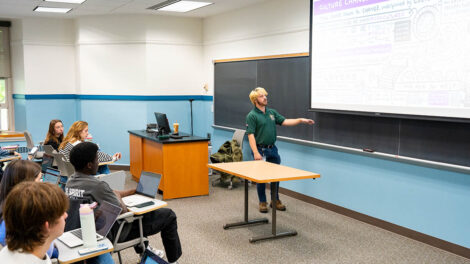
Mary Wilford-Hunt’s Introduction to Architectural Engineering course turns local alumni-led construction projects into immersive learning experiences
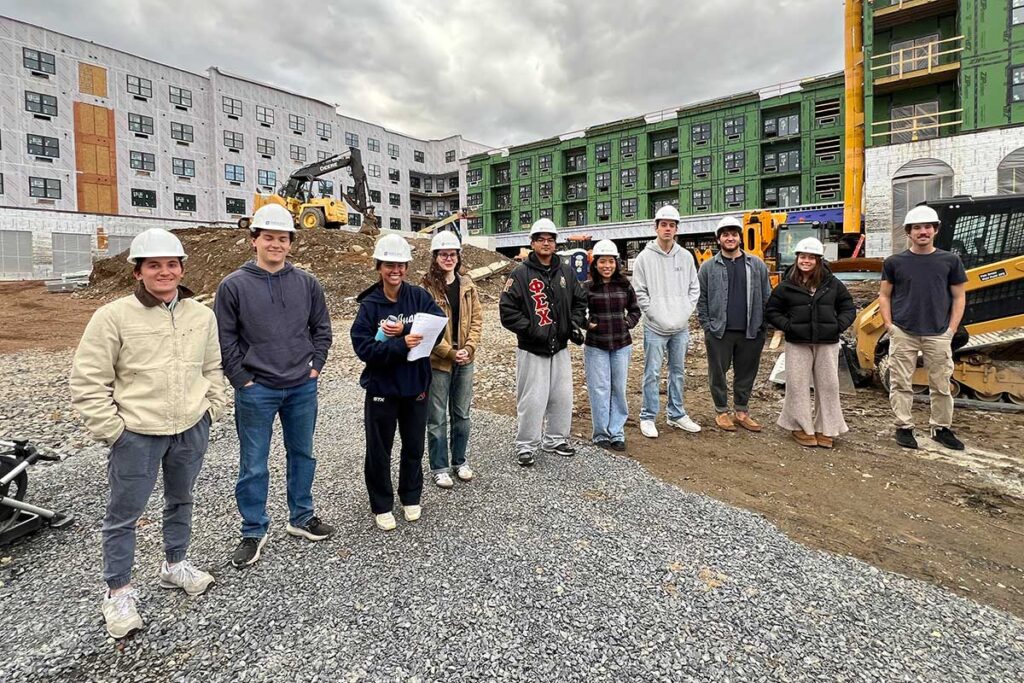
Students in Prof. Mary Wilford-Hunt‘s Introduction to Structural Engineering course got an insider’s look at the construction of The Confluence, a five-story apartment building at the gateway of Downtown Easton. | Photos provided by Mary Wilford-Hunt
By Stella Katsipoutis-Varkanis
This fall, students in Mary Wilford-Hunt’s Introduction to Architectural Engineering course didn’t just study how buildings are made—they watched them come to life in their own backyard.
Offered within Lafayette’s Engineering Studies program, EGRS 271 introduces students to how various architectural systems—like foundations, building enclosure systems, electrical, plumbing, heating and cooling, and more—work together to create a major construction project. Students’ learning, however, goes far beyond the technical.
Through site walks and guest lectures from influential alumni in the industry, students learned how various architectural systems—like foundations, electrical, plumbing, heating and cooling, and more—work together to create a major construction project.
“The course aims to broaden students’ understanding of the world and the built environment, and how they can play a role in it,” says Wilford-Hunt, licensed architect and senior associate director of corporate, foundation, and government relations at Lafayette, who has been teaching the course since 2010.
To do this, students undertake a case study of a project in construction either on or near campus. “It has a lot more meaning for them than just reading about a case study project with which they have no connection,” says Wilford-Hunt, who retired in December but will continue as an adjunct faculty member. “This immediately connects them to the community where they live, work, and study.” On-campus buildings like Rockwell Integrated Sciences Center, Simon Center for Economics and Business, and McCartney II have been the focal points of past case studies. This year’s study centered on The Confluence, a modern five-story apartment building at the gateway of Downtown Easton.
Designed to increase Easton’s housing inventory, the 273-unit building holds significance for the College community: The project is led by real estate entrepreneur and Lafayette alum J.B. Reilly ’83, P’16,18. As founder and CEO of prominent real estate development firm City Center Group, Reilly has headed up a multitude of revitalization initiatives in Allentown and Easton—including The Marquis luxury apartments, which sit mere steps away from The Confluence. Also working alongside Reilly on his latest venture is Andrew Miller ’04, executive vice president of North Star Construction Management Inc.
Throughout the fall semester, EGRS 271 students had the opportunity to attend guest lectures from key players in the development of The Confluence—including Miller, Reilly’s son Jack Reilly ’18, and representatives from USA Architects and City Center Group. The class heard firsthand about each individual’s role in the project as well as challenges they faced, while alumni also shared how their Lafayette education set the foundation for their careers. Miller led in-person construction site tours for the students, where students watched what they were learning about in the classroom take shape before their very eyes.
A project led by real estate entrepreneur and Lafayette alum J.B. Reilly ’83, P’16,18, The Confluence features 273 units and was designed to address Easton’s housing deficit.
“I’m very proud of Lafayette and how much it’s grown in education, athletics, and presence. And to have this bustling city nearby and for kids to be able to walk a site and talk to the people involved in the project, it’s very exciting,” says Miller, whose construction firm also worked on Lafayette’s McCartney II and Wallach Sports Performance and Lacrosse Center.
Miller’s hope is that students learn to question and challenge design: “There are too many projects in the world that are designed but just don’t happen,” he says. “But with creative thought, and collaboration between teams and your client, you can make it happen—that’s the key takeaway I wanted them to walk away with.”
William Blair ’26, a civil engineering major who took Introduction to Architectural Engineering in the fall, says the experience gave him a new perspective on how the various elements of a project come together to create something impactful. “After Lafayette, I plan to work in the transportation industry at a consulting firm in New Jersey,” he says. “And seeing The Confluence come together firsthand allowed me to get the full behind-the-scenes picture of a project, not just be limited to one side of the story.”
Taking part in case studies like this one and engaging with influential local alumni, Wilford-Hunt adds, could also potentially inspire students to live in—and perhaps leave their own mark on—the Lehigh Valley area after they graduate. Wilford-Hunt also often coordinates with Rexford Ahene, professor emeritus of economics, to invite each other’s students to their class sessions and events, giving students further opportunities to deepen their connections with alumni.
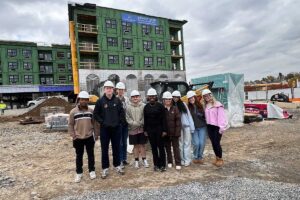
Wilford-Hunt’s students gather at the southeast corner of The Confluence site, which is designed as an open space for recreation and events.
“Hearing from people who have gone through the same educational journey and understanding the various paths they can take following graduation is important to students, whether they want to follow a career in development, architecture, construction, engineering, real estate, or something else,” Wilford-Hunt says. “Several guest lecturers have even invited students to consider internships or employment with their organizations.”
Miller, who has guest-lectured for EGRS 271 over the last four years, says having the opportunity to give back to his alma mater as an alumnus is equally rewarding for him: “I remember a number of speakers from my time at the College, and how they helped me make that connection to the real world—and that’s what I want to do,” he says. “I loved my time at Lafayette, and everything there set me up to be the best I can be. And if I can impact even just a couple of kids, it’s well worth it.”