June 26, 2026
Inside the classroom: Exploring global connections through African pastoralism
Inside the Classroom is a series offering a glimpse into classes at Lafayette, the talented professors who teach them, and how they impact and define a student’s experience.
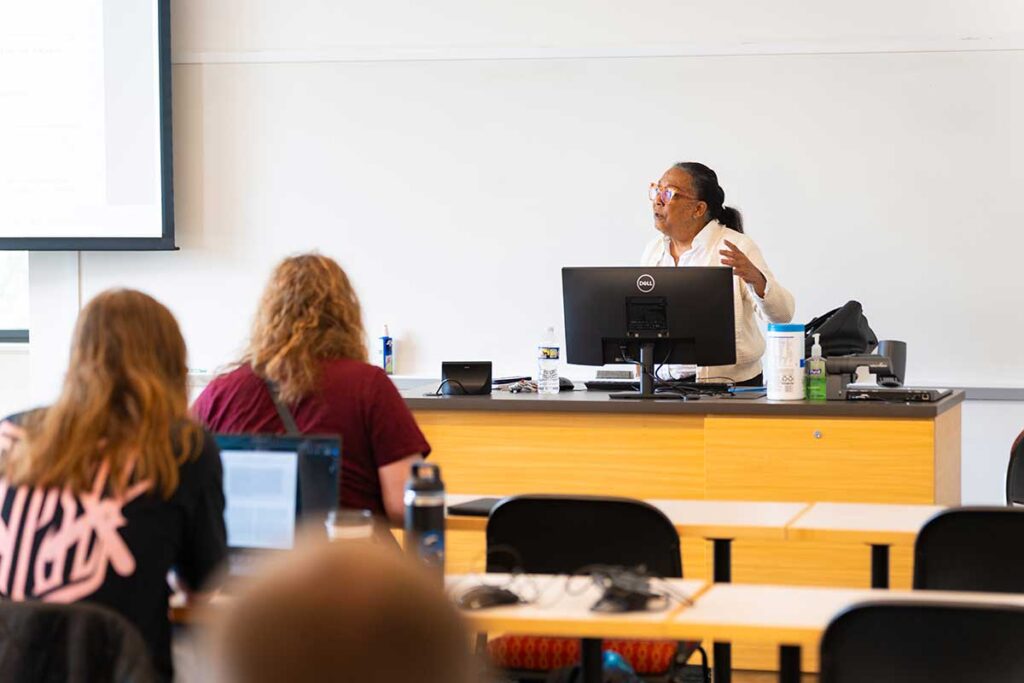
In her AFS 330: Cowboys in Africa course, Prof. Wendy Wilson-Fall draws on her decades of research on West Africa to give her students a new perspective on the global market, economics, and day-to-day life around the globe. | Photos by JaQuan Alston
By Stella Katsipoutis-Varkanis
For Prof. Wendy Wilson-Fall, Cowboys in Africa is no ordinary course. It’s the culmination of all the research she’s done throughout her career. “I spent my whole life working on this,” says the professor and chair of Africana studies, whose research and publications have primarily centered on mobile livestock producers in West Africa. “It allows me to share my experience and accumulated knowledge with others, which is so satisfying.”
Taught every spring, and taught online for the first time this summer, AFS 330 looks at beef consumption in the United States as a comparative point to examine the impact of factors like climate change, terrorism, environmental protection and policy, human rights, and more on pastoralists (or livestock producers) in West and East Africa, the economy, and ultimately the world.
“About 40% of the world is covered in pasture,” Wilson-Fall says. “Many think of pastoralism as an old-fashioned, quaint lifestyle and don’t understand the economic impact of livestock producers.” Pasture lands are almost as biodiverse as forests and provide important ground covering for stabilizing climate, she adds. “I’ve witnessed some of the terrible challenges pastoralists have had to go through over the last eight years, some of which are completely out of their control. I firmly believe young Americans benefit from knowing about the world and what some of the big issues are for their generation.”
Students delve into the course content through class readings, discussions, videos, guest lectures, and even artifacts collected by Wilson-Fall during her travels.
Over the course of the semester, students engage in readings and discussions, watch videos, and use resources like the World Bank Regional Sahel Pastoralism Support Project and other scholarly sources to delve into the course content. They also hear guest lectures given by subject matter experts from Lafayette and beyond, including faculty members from the College’s Africana Studies program. “We also do map exercises where students have to identify the major ecological zones in Africa, and we learn about rain level measures,” Wilson-Fall adds. “I even sometimes bring in artifacts I’ve collected on my travels from two of the major herder populations in West Africa, so students can pick them up, look at them, and ask me questions about them.”
Lonan Jennings ’27, who has a major in English and minor in German and took the course in the spring, says Wilson-Fall expertly strikes a balance between using visual, physical, and reading materials to help students understand complex concepts. “I’ve learned more about the global market and economy than ever before, which gave me a better understanding of my own country,” he says. “But what I gained from the course went far beyond that. Prof. Wilson-Fall is absolutely brilliant. Having her as a professor expanded me as a person, how I approach problems and thinking. I admire how she incorporates her own knowledge and her life’s work to make learning feel so much more real.”
Taking the course, Jennings adds—which draws students from across disciplines, including environmental studies, economics, engineering, government and law, and more—even helped enhance his studies in his own major. “Taking this course taught me I’m multifaceted, and learning and interacting with different cultural contexts makes me a better writer and student, and a stronger applicant for grad school,” says Jennings, who hopes to one day pursue a Ph.D. in English.
For Milan Hood ’28, an economics major with a minor in data science who plans to work in finance, AFS 330 helped her sharpen critical thinking skills that will continue to benefit her long after her time at Lafayette. “This course perfectly demonstrates Lafayette’s Cur Non motto because it exposes students to African societies and cultures often overlooked by traditional Western-centered education,” she says.
Through the course, Wilson-Fall aims to sharpen students critical thinking and expand their perspective on what it means to be a global citizen.
Ultimately, by teaching students about rural economics in Africa in a more global context, Wilson-Fall aims to demonstrate to students how everyone is connected to the topic in some way. “I really enjoy helping students see this big picture, the interplay of things that seem very separate but are actually very related,” she says. “It’s important for students to be aware citizens and challenge themselves to think beyond the easily available. If they understand how different people are experiencing citizenship in terms of civic responsibility, governance, protection of the environment, and the like, it gives them an opportunity to reflect on their own citizenship.”
“Something Prof. Wilson-Fall said that stuck with me is, ‘If you’re not curious about life, you’ll live a dull life,’” Hood adds. “It’s something I always think about now, because it’s important to always be willing to ask questions and learn.”
Categorized in: Academic News, Africana Studies, Faculty and Staff, Featured News, News and Features
Tagged with: Inside the classroom