August 5, 2026
Seeking a better understanding of molecular activity in yeast and its link to improving human health
By Bryan Hay
It smells like a bakery in Justin Hines’ chemistry lab, with a faint smell of sweet, toasty yeast wafting through the second-floor hallway in Hugel Science Center.
Using common baker’s yeast, Hines, David M. ’70 and Linda Roth Professor of Chemistry, and his students are seeking a better understanding of the molecular activity helps proteins to fold correctly, and how protein misfolding leads to a variety of human diseases, most notably neurodegenerative diseases like Alzheimer’s and Parkinson’s disease, and even cataracts and diabetes.
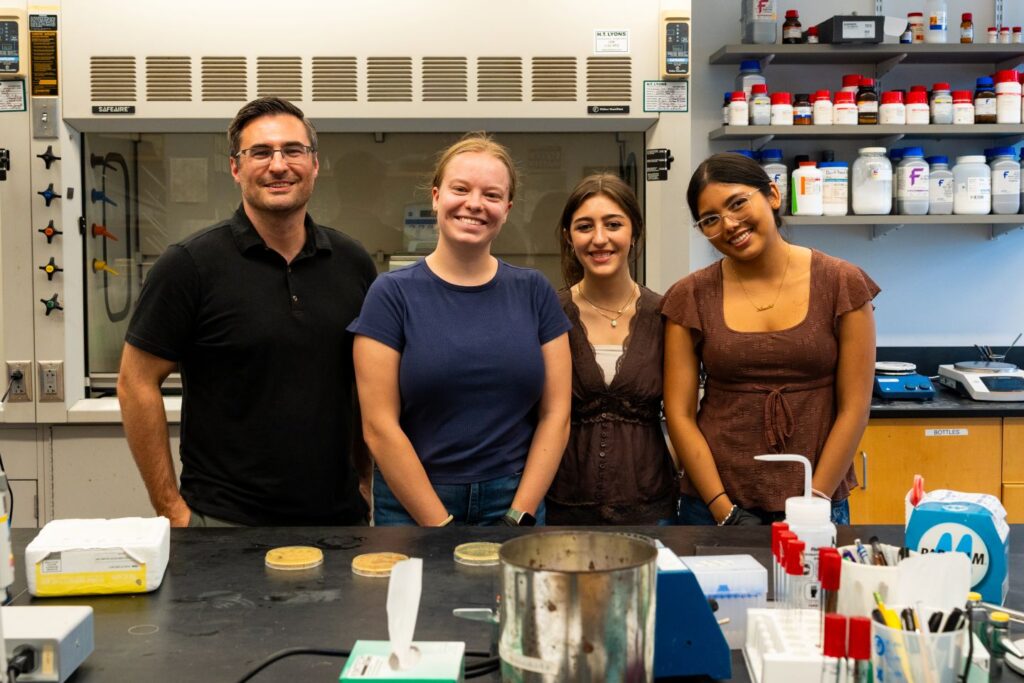
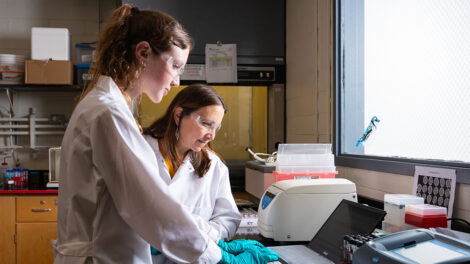
Justin Hines, David M. ’70 and Linda Roth Professor of Chemistry, with his 2026 summer research students: Lauren Davidson ’27, Melanie Audelo-Riaño ’28, and Christina Vella ’29. National Institutes of Health grant has supported undergraduate research opportunities for many students through the years. (Photo | JaQuan Alston)
Sometimes linear strings of amino acids in proteins twist and change shape, folding themselves into a distorted form and sticking together. This is called aggregating, and it prevents them from functioning properly and plays a big role in neurodegenerative diseases, which are increasing as humans live longer.
A group of proteins called “chaperones” work to prevent protein aggregation and can ensure other proteins fold correctly, preventing proteins from becoming tangled in inappropriate ways. Human cells share the same characteristics of misfolding, which is what inspired Hines to pursue this research focus and gain a better understanding of how proteins function.
Hines developed an interest in protein misfolding in 2007 during his postdoctoral training at University of Wisconsin. A recently renewed National Institutes of Health grant for $553,785, now in its fourth cycle, has supported undergraduate research opportunities for many students through the years, each group enlightening Hines’ research with their own unique perspectives and approaches to their learning and offering opportunities to attend scientific conferences and participate in summer research.
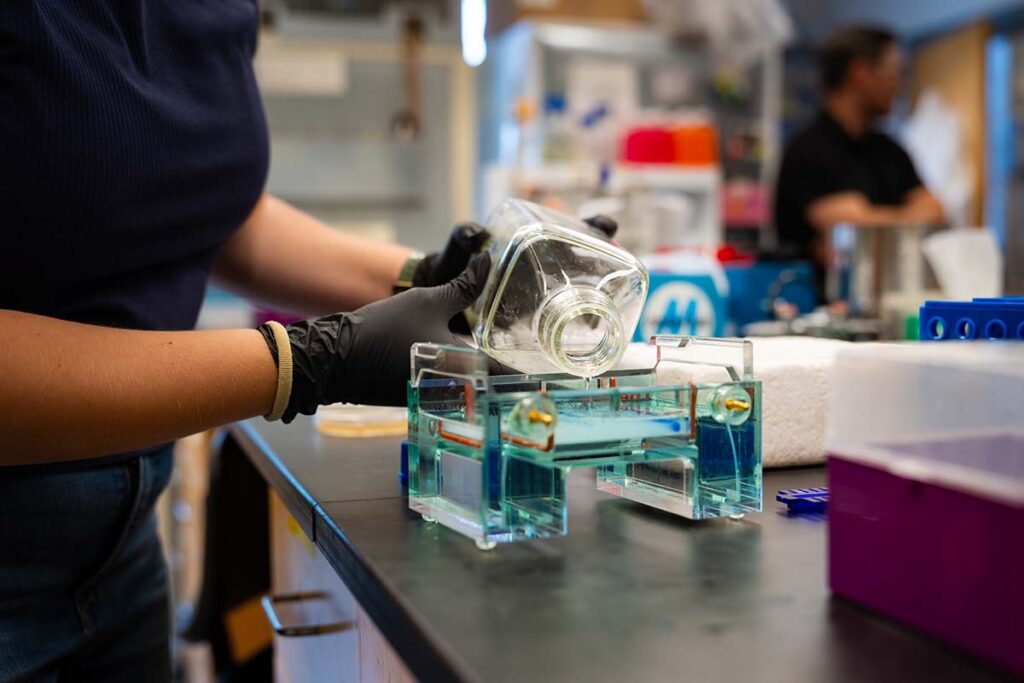
Students are seeking a better understanding of the molecular activity helps proteins to fold correctly. | Photo by JaQuan Alston
“It allows me to have more students than I might otherwise have and provides what are called indirect funds to the College that fund other EXCEL students over the summer,” he says. “The external grants acquired by faculty members actually help to support the whole research community here, because the money is used broadly by the College to support other students.”
Studying yeast genetics is a perfect fit for the Lafayette undergraduate experience.
“Working with baker’s yeast allows you to study these proteins in a tractable model organism,” Hines says. “Yeast cells grow very quickly, generating large quantities and providing a wonderful genetic model organism. It makes this kind of work doable by undergraduates in a timely fashion, so the students can learn from the experiments, and then iterate and conduct more experiments in the time frame they’re here at Lafayette.”
Like many other Lafayette students before them, biochemistry majors and EXCEL scholars Lauren Davidson ’27, Melanie Audelo-Riaño ’28, and Christina Vella ’29 are enjoying a classic Lafayette undergraduate experience, working alongside a tenured professor with a deep knowledge of his subject area.
On a quiet summer day in Hines’ lab, Davidson and her lab mates express proteins, injecting them in a gel-filled dish, which allows for better observation of the chaperone proteins.
“This is so interesting,” says Davidson as she displays a plastic dish holding the gel. “An electric current pushes the proteins down, and as they go down, the bigger proteins get caught toward the top, and then the smaller proteins get caught toward the bottom. We see our protein aggregates, the really big ones, clumped together. They’re the misfolded proteins that we’re looking for.”
Her interest in biochemistry and neurodegenerative diseases is personal as her grandfather had Alzheimer’s. She did research in high school on fruit flies, which share many human disease-associated genes and help scientists understand Alzheimer’s disease.
“Then, when I came to Lafayette, I was really interested in Prof. Hines’ research because of the connection to neurodegenerative diseases,” says Davidson, who’s planning on grad school and a career in pharmaceutical research and development.
“The protein misfolding aspect is really interesting to me,” she adds. “It’s worked out in a very nice flow that I’ve been able to continue my study of protein misfolding, protein interaction, and neurodegenerative disease research for a lot of my college life, which has been really interesting.”
Davidson chose Lafayette because of the opportunity to do hands-on research.
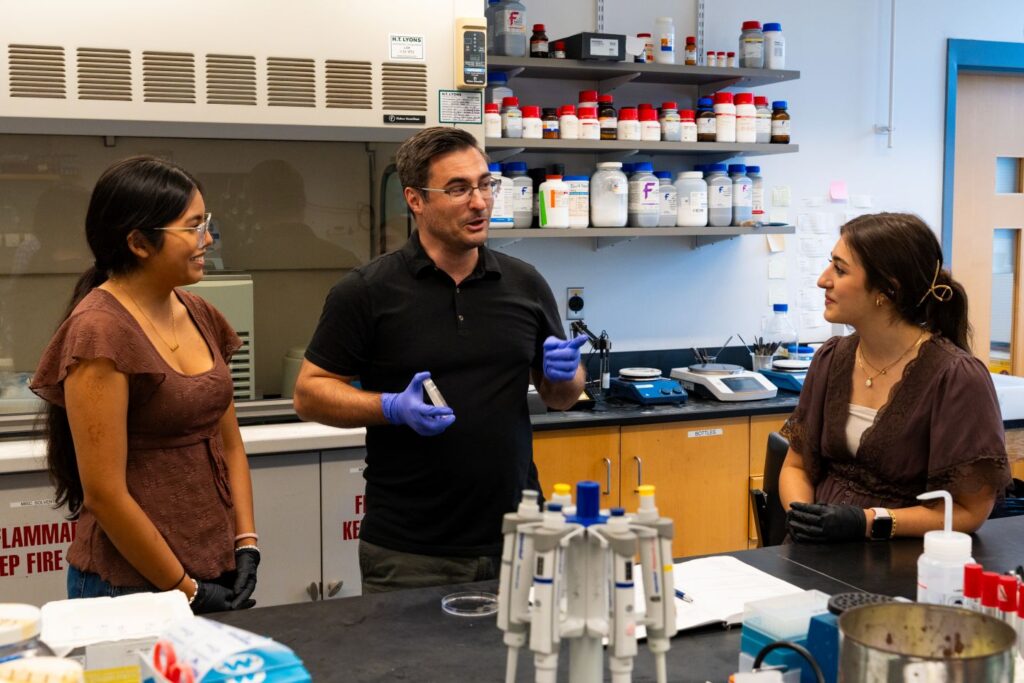
Prof. Justin Hines explains yeast physiology to Melanie Audelo-Riaño ’28, and Christina Vella ’29. (Photo | JaQuan Alston)
“I knew I wanted to be able to kind of have some hands-on experience in a lab and be able to really participate in those experiments, and that’s not necessarily something you can do at a larger institution with graduate students and postdoctoral students teaching you,” she says. “Here, you get to work directly with someone like Prof. Hines. And with Melanie and Christina, it all comes together to make a really rewarding collaborative environment.”
Audelo-Riaño, a Bergh Family Fellow, says she values the opportunities to present on the yeast genetics work at high-level scientific gatherings and the collaborative spirit working in the lab with Hines and her student colleagues.
“My experience at Lafayette has provided me with a graduate experience as an undergraduate,” says Audelo-Riaño, who plans to eventually attend medical school. “To have access to someone like Prof. Hines and be able to work alongside him is incredible.”
Working alongside Davidson and Audelo-Riaño has been a thrill for Vella, also a Bergh Family Fellow.
“We’ve gotten pretty close, and I couldn’t ask for better labmates,” says Vella, who plans on grad school and a career in a STEM-related field. “I have some friends at larger universities, and they have not been able to get the same experience. The Lafayette undergrad experience is something I really value.”
For Hines, he finds satisfaction in observing the moments when his students discover the relevance of the research in their own lives.
“By the end of the research experience in my lab, students are often very involved in designing experiments and describing results, in a way that’s very similar to what a graduate student would be doing,” he says. “They end up being very well prepared for the next phase of their careers, whether it’s going into industry or moving on to graduate or professional school.”
Lafayette alums from the Chemistry Department include professors, dentists, physicians, veterinarians, optometrists, and researchers in industry.
“We give students the benefit of the doubt that they are capable of doing more, because we know they are, and sometimes getting this to happen begins with allowing it to happen,” Hines says. “It starts with removing the presumption that an undergraduate can’t do a particular thing. Students are given a lot more autonomy here. This is true across Lafayette, but it’s particularly true in the Chemistry Department .”
Categorized in: Academic News, Biochemistry, Chemistry, Faculty Research, Featured News, News and Features, Research