August 20, 2026
From birch bark to bio-based polymers
By Bryan Hay
A bundle of split white birch logs, a box of dry, curly white birch bark. It looks like the makings of a classic campfire.
But these pieces of white birch are the raw ingredients in a process to extract betulin, a natural compound found in the bark, the precursor for making bio-based polymers. Betulin is found in abundance in white birch bark, a waste product in the lumber and paper industry.
Extracting betulin from the bark using more environmentally friendly switchable solvents is the focus of summer research between Lindsay Soh, professor of chemical and biomolecular engineering and department head, and EXCEL Scholar John Oramas ’27, who’s majoring in chemical engineering with a minor in Spanish. Betulin has potential uses in the pharmaceutical, cosmetics, and polymers industries but current ways to harvest betulin are limited and wasteful.
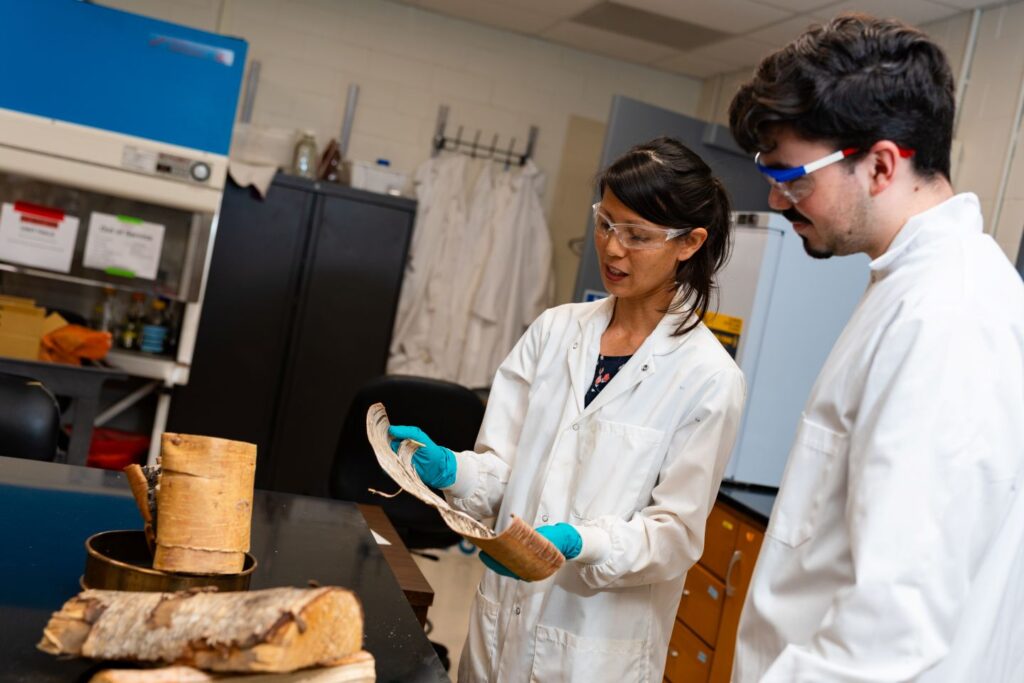
Lindsay Soh, professor of chemical and biomolecular engineering and department head, and EXCEL Scholar John Oramas ’27, prepare to harvest betulin from birch bark. (Photo | JaQuan Alston)
Soh and Oramas are using a novel class of solvents, to try and harvest betulin in a more sustainable manner. Specifically, they are using switchable solvents that change properties with the addition of an external trigger in order to extract and recover the betulin. Their work focuses on using carboxylic acid-based switchable solvents, which can be derived from biological systems and are benign compared to more common amine-based switchable solvents.
Their lab resembles a test kitchen as Oramas prepares the process of extracting betulin. First, he pulverizes the bark in a commercial blender and dries it in a laboratory oven. Once the milled bark is dried, the extraction begins by heating the bark to 80 degrees Fahrenheit and adding the solvent. Then the magic begins: Oramas adds the trigger (a base in water) and the solvent changes properties allowing betulin to precipitate out and easily be recovered as a solvent via filtration. The result is a fine white powder comprising a high-quality betulin extract.
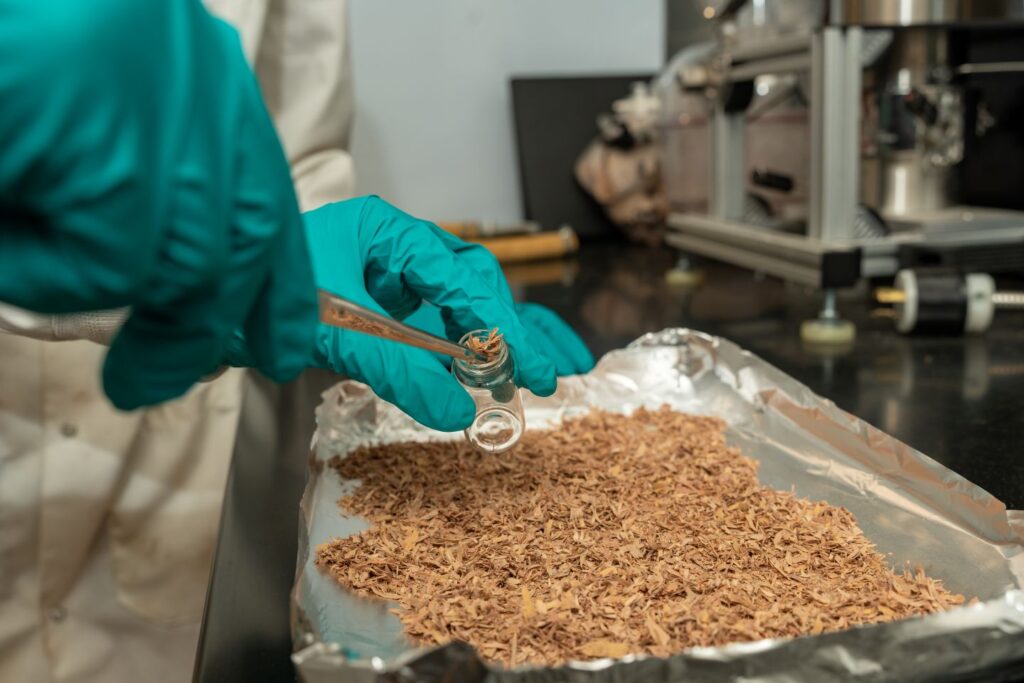
Betulin is extracted from pulverized white birch bark. (Photo | JaQuan Alston)
In their current collaboration, this extract is being used directly by Melissa Gordon, associate professor of chemical and biomolecular engineering, to create a range of biobased thermoset polyesters.
“Comparing the extract to those from traditional organic solvents, we were able to get comparable purities or maybe even better,” Soh explains. “Our polymer collaborators are saying this extract is really high quality. They’re making great polymers with it already, which is very exciting progress for our overall collaboration.”
The progress, along with the recyclability of the switchable solvent and an economic and sustainability analysis of the system, are all being documented as part of Oramas’ thesis, which they hope to publish next summer.
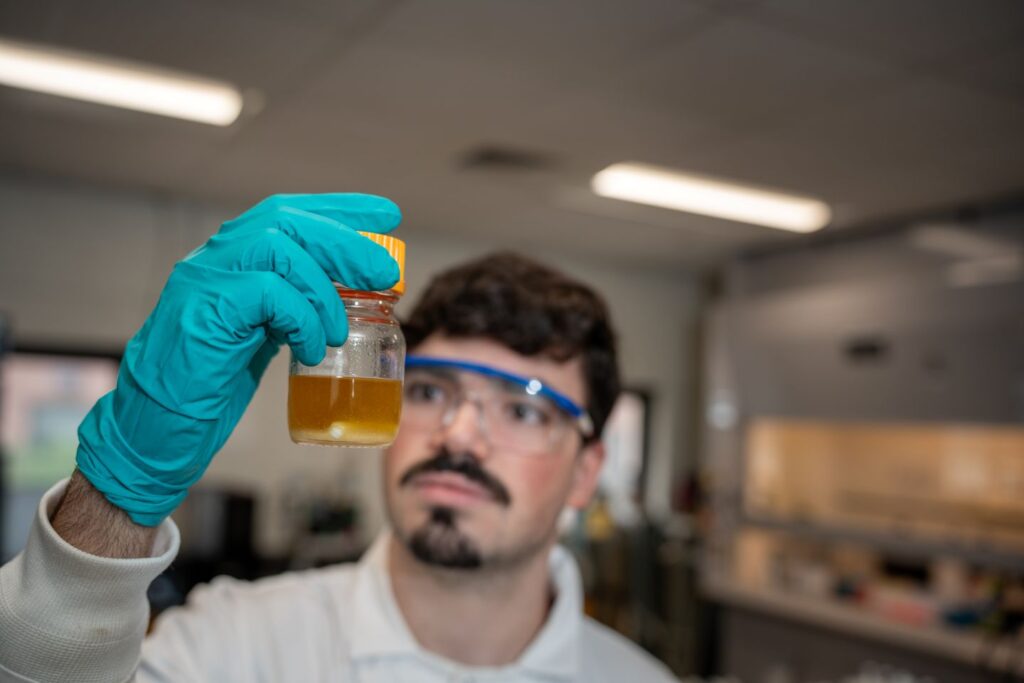
Solvent allows betulin to precipitate out of the bark. (Photo | JaQuan Alston)
Oramas says he has gained much from working with Soh over the last three summers.
“The biggest thing you learn while doing research is that it enhances your critical thinking skills. You learn how to really dive deep into a topic and apply knowledge,” he says. “You apply knowledge from your courses to your research, and then you also are able to apply the skills you’ve learned through research, such as data analysis or experimental design, to your other classes.”
Among the many benefits of Lafayette College is the opportunity to work directly with professors who are experts in their fields.
“It’s very rewarding. I’ve learned a lot,” says Oramas, who’s planning on furthering his education and working in the chemical engineering industry.
“You just have another resource to rely on—someone you know who truly cares and wants to help you learn more,” he adds. “That’s also a neat part about Lafayette because if I did go to a large research university, I probably wouldn’t have as deep of a connection with my professors, like I do with Prof. Soh. I probably wouldn’t have as hands-on of a role in the research either. I’m able to actually do a lot of the experimental design myself and help figure out where the project’s going to go. At a larger institution, you would be more in the back seat, and you wouldn’t have as much influence on what you’re doing.”
Each student who comes through Soh’s lab and classroom brings unique perspectives and style to her research.
“I mentor students very differently depending on their strengths,” she says. “For instance, John is very independent and an amazing troubleshooter, even in his first year working with me. At first we were more hands-on and talked through problems from the start. Now I’m much more hands-off, asking John to think through problems first before we work out a solution. That’s a strategy I try to use for all my students. I’m hoping to help them become independent thinkers and problem solvers.”
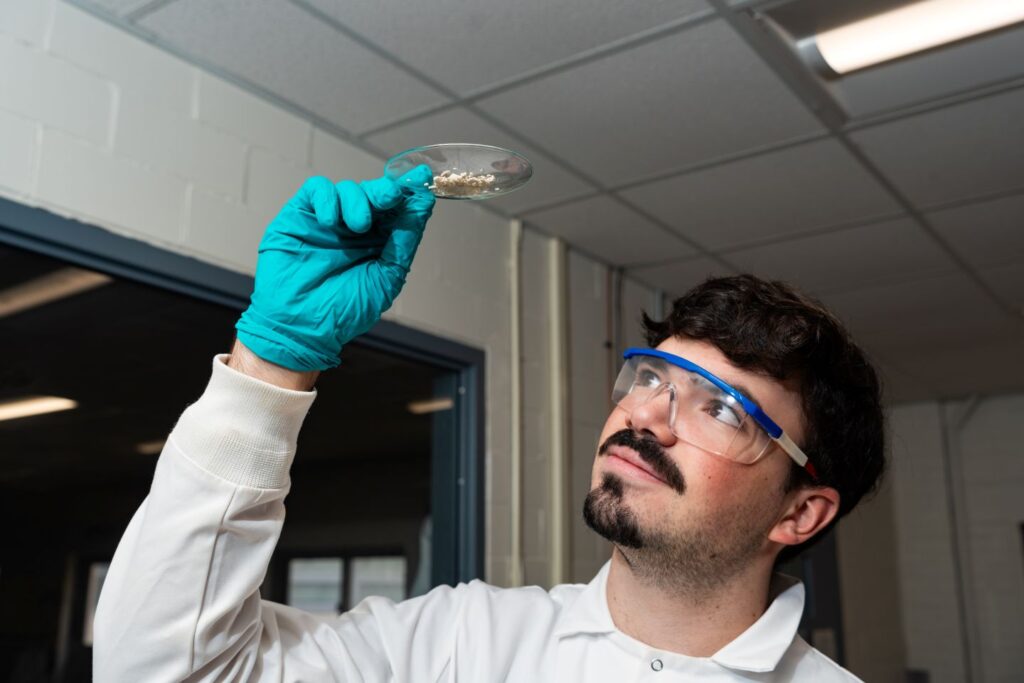
John Oramas ’27 inspects a high-quality betulin extract. (Photo | JaQuan Alston)
Summer’s slower pace provides the space and time to focus on research.
“There’s a million commitments during the semester, and it’s harder to make progress on research,” Soh observes. “My philosophy with the summer is to get students fully immersed and thinking about the project. We’re not limited by time constraints, and we can work out all of the experimental procedures and make real progress.”
In addition to summer research, Oramas also values the intersections of engineering and the liberal arts, and how they inform each other.
“It’s just a really cool experience, a nice dichotomy to be able to go from math- and science-focused courses and then experience the humanities, in my case Spanish classes,” he says. “It’s been a nice way to advance my other skills that aren’t just math and science. My writing and conversational skills and my confidence in public speaking have all been enhanced. Over the summer and during the semester, Lafayette’s liberal arts and engineering tradition has been very informative and helped me grow more than I would have if I were just doing chemical engineering.”
Categorized in: Chemical and Biomolecular Engineering, Faculty Research, Featured News, News and Features, Research, Students