November 13, 2026
Inside the classroom: What is art?
Inside the Classroom is a series offering a glimpse into classes at Lafayette, the talented professors who teach them, and how they impact and define a student’s experience.
By Briana Miron ’26
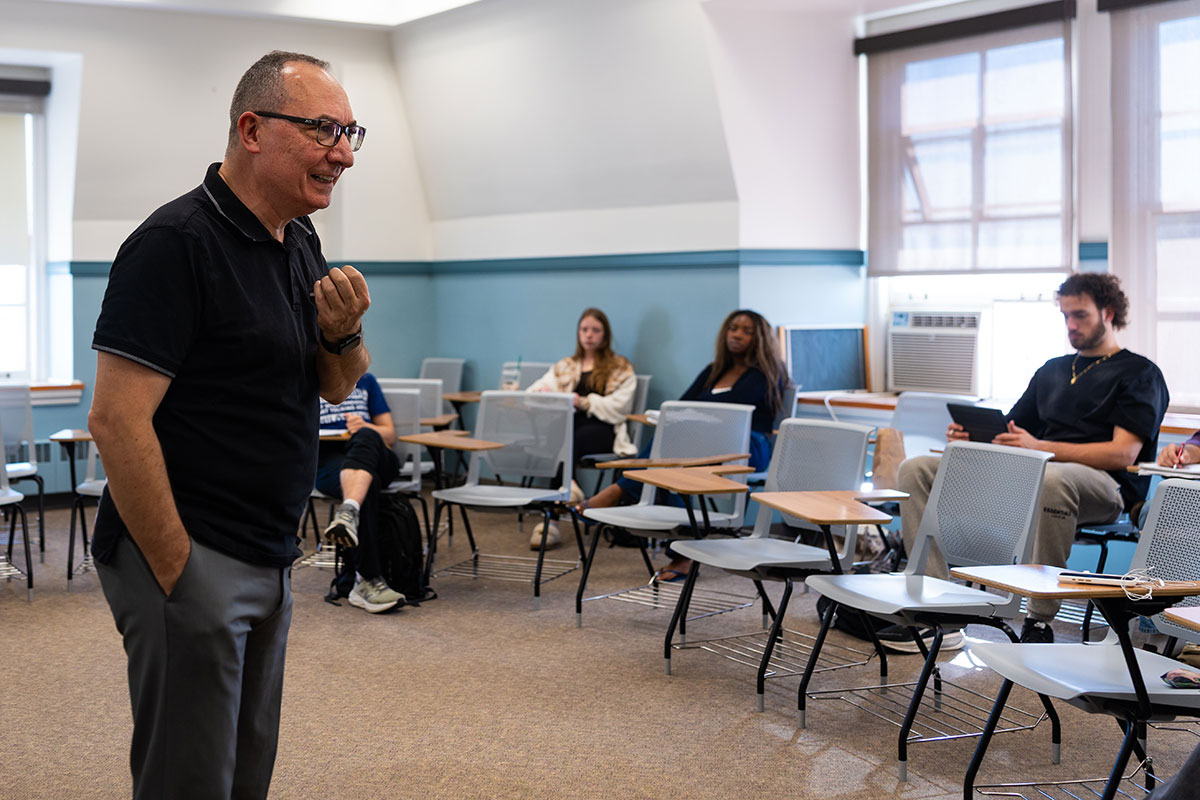
“What is art?” is the question at the center of Prof. Alessandro Giovannelli’s Philosophy of Art course.
Whether they realize it or not, the average person encounters this question on a daily basis. The pieces they gravitate toward in a museum, the photograph they linger on a few seconds longer while scrolling through Instagram, or the movie they recommend to a friend all reflect judgments about what works they consider worthy of time and attention.
The philosophy of art, or aesthetics, examines these judgments. But in typical philosophical fashion, attempts to define “art” only lead to more questions.
Is an objective definition attainable? Does the responsibility for making this distinction fall on the viewer or the artist? Must art convey or evoke emotion? Should these judgments take into consideration the context in which a work was made?
As students investigate what role, if any, these factors play in defining “art,” readings from classical and contemporary philosophers serve as the foundation for lectures, argumentative papers, and class discussions.
Giovannelli, a professor of philosophy at Lafayette, notes that some of the liveliest discussions occur when the class considers works challenging conventional definitions of art. Modernist paintings by Jackson Pollock and avant-garde works like Marcel Duchamp’s Fountain (1917) force students to ask at what point splatters of paint across a canvas, or an ordinary object submitted to a gallery, become art. Through these discussions, Giovannelli encourages students to move beyond their immediate responses and instead “go deeper into what may justify a more sustained attention and reflection upon that item.”
“I think it’s a course in many ways that opens the students’ eyes and minds to how art is way more pervasive than one might have assumed,” Giovannelli says. “We appeal to works of art, to poems, theatrical plays, movies, or a book we read some years ago for insights they may give us on how to lead our lives and how to better understand people in situations different from ours.”
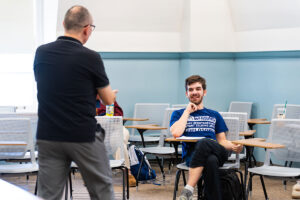
Matthew Simpson ’27 engages in a lively discussion with Prof. Alessandro Giovanneli.
As a self-contained course, the only prerequisite is an open mind. That means for many students, the course functions as an introduction to philosophy itself. Because the field of aesthetics ties in elements of perception, ethics, and language, “it ends up exposing students to the variety of types of questions that occur in philosophy,” Giovannelli says. He finds this breadth gives students “an appreciation of the openness of philosophy.”
And while it may be some students’ first philosophy course at Lafayette, it certainly isn’t the last for many. “Professor Giovannelli inspired my love for the philosophy of aesthetics through his unbridled passion and enthusiasm,” says Bay Malone ’27. Malone took Giovannelli’s Philosophy of Art, Philosophy of Literature, and Philosophy of Film all in the same semester. She also enrolled in philosophy capstone courses while conducting research with Giovannelli as an EXCEL Scholar. She says this course in particular was “an incredible introduction to the world of aesthetics” and Giovannelli’s teaching of Aristotle helped her to “cultivate a deep fascination for the ethics of art.”
While Malone holds dual majors in philosophy and classical civilizations, Giovannelli has seen the course attract and benefit students from a variety of backgrounds. Art students have expressed how exploring the course’s central question has influenced their creative processes in the studio, with some wishing they had taken the course sooner. Even engineering students have made room in their schedules for additional philosophy courses or taken on philosophy as a minor following their time in his class.
Beyond the material, one of the course’s greatest benefits is its format. The small class size allows for a true Socratic seminar, in which students dissect and critique the arguments of earlier philosophers while exchanging their own ideas with classmates. Instead of being told what to think, students are being taught how to think.
“With the classical theories, none of them are exactly right, but each one of them ends up being inspiring, and that’s part of the goal of the course,” Giovannelli says. “It prompts self-reflection and the modification of one’s own view, not on the grounds of authority, but in contrast, on the grounds of reasoning and reflection.”