November 16, 2026
Inside the Classroom: Decoding data

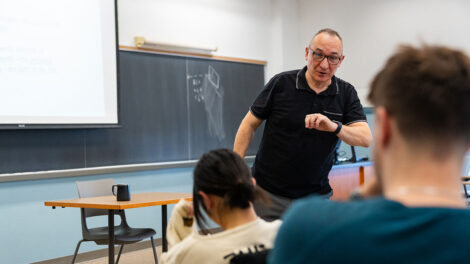
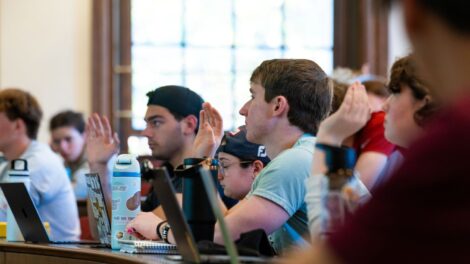
Students in Prof. Abby Lau‘s Applied Statistics course learn how to use R, an open-source programming language used for statistical computing, among other software. | Photos by JaQuan Alston
By Stella Katsipoutis-Varkanis
Data is everywhere. From smartwatches tracking steps, to smartphones auto-filling texts, to algorithms shaping social media feeds, numbers are increasingly influencing how people experience and navigate the world. In her Applied Statistics course, Prof. Abby Lau has one goal: To impart to her students the technical and critical thinking skills they need to better understand the statistics driving the world, their significance, and the mathematical science behind them.
“Whether it’s for personal or professional purposes, having data literacy—understanding how it was collected, what it means, and what conclusions can be drawn from it—is so important,” says Lau, assistant professor of mathematical sciences. “It helps you make sense of the information surrounding you each day.”
MATH 186 brings together students from academic backgrounds both inside and outside of the Department of Mathematical Sciences—including policy studies, economics, government and law, and others—as it is a required course for majors in various disciplines. But students leave the course with something more than a requirement checked off their list: They gain a keener ability to manipulate, interpret, and evaluate data.
Lau’s course meets three times a week, with one day dedicated to hands-on learning in a computer lab.
Lau’s section of the course meets three times a week, with Mondays dedicated to hands-on computer labs, and remaining class sessions centered on lectures and group exercises. Lau starts off the semester by covering simple statistical concepts (e.g., averages, percentiles, and graphs) and moves on to more complex material (e.g., probability and inferential statistics) as the course progresses. A defining feature of Applied Statistics is its use of R, an open-source programming language used for statistical computing. Rather than relying on calculators or spreadsheet programs like Excel, students are taught how to manipulate data, make calculations, and create visuals from scratch by coding.
“Intro stats courses don’t typically have this software component,” Lau says. “For students who perhaps want to do research in the future or be competitive candidates for jobs after they graduate, having the skill to manipulate data using software is a huge bonus.”
For Allison Giebutowski ’29, a policy studies major, learning R has been one of the course’s most valuable takeaways. “I’m very interested in studying forecasting models, economic and education policy, language models, and the ethics and conversations around artificial intelligence,” Giebutowski says. “Learning how to use certain tools like R to do that has been fascinating.” Lau’s students also learn how to use Quarto, an open-source publishing system that combines programming code, results, and written explanations in a single document—helping students clearly and efficiently communicate their findings.
Throughout the semester, students put their coding and statistical skills to practice by working independently and in groups on projects that involve exploring datasets with R, creating data visuals, sharing their findings, and incorporating probability and inferential statistics. Sumeya Sufian ’29, a double major in economics and government and law, says these exercises have made statistics feel more approachable. “While I’m still unsure of what I want to do after Lafayette, I know being able to interpret information on my own rather than relying on others to do it for me will be valuable, no matter what career I follow,” she says.
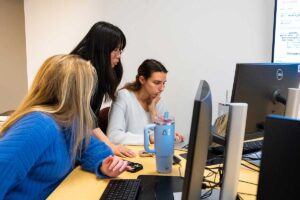
The course’s emphasis on collaboration allows students to gain a deeper understanding of complex learning material.
The course’s emphasis on collaboration, Sufian says, gave her confidence in approaching the subject matter: “During our group discussions, the students rely on each other and work together to figure out solutions to questions or problems we might be coming across in our code.” Lau, she adds, has a generous open-door policy and is very receptive to questions. “I love Prof. Lau’s enthusiasm and excitement for what she’s teaching. And because of Lafayette’s smaller student-to-faculty ratio, you can build more personal connections with classmates and professors, which I’ve found to be extremely helpful.”
Beyond technical knowledge, Lau wants students to develop the judgment necessary to evaluate information they encounter in everyday life—from how studies collect data, whether samples are in fact representative of the populations they claim to represent, and whether visuals accurately reflect results. Lau believes having a firm grasp on these underlying concepts is important now more than ever, especially as AI gains more traction. “I want students to get better at asking questions when they’re presented with data,” she says.
Lau adds that she loves teaching Lafayette students because of their creativity, curiosity, and eagerness to try new and complex things. “This might be an intro course, but the material is challenging. And in the end, students walk away with technique, statistical thinking, and programming skills,” she says. “This course really sets them up for success.”