November 19, 2026
Cur Non: A story of circuits, code, and winning on rival turf
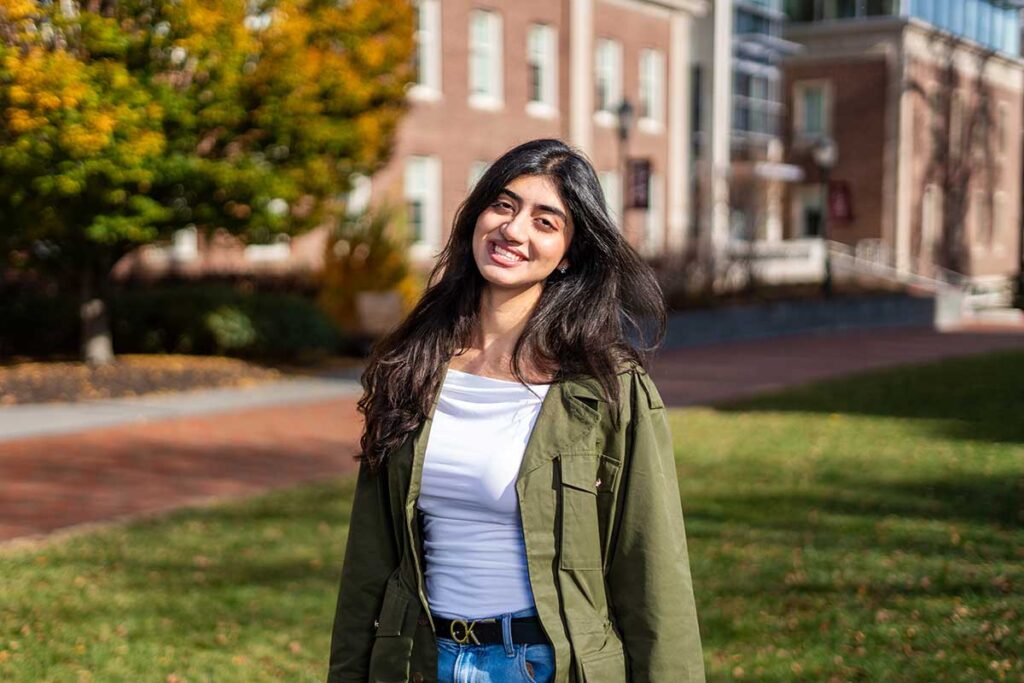
A budding engineer, Fatima Tanveer ’29 has a goal that’s close to her heart: Using her passion for robotics to improve people’s lives. | Photo by JaQuan Alston
By Stella Katsipoutis-Varkanis
This past summer, Fatima Tanveer ’29 had a defining Rivalry moment—not on a field, but in a science lab.
The electrical and computer engineering major walked onto the home turf of Lafayette’s archrival ready to go head-to-head with 75 student-researchers in Lehigh University’s STEM Summer Institute (STEM-SI), the institution’s largest cross-college research program. A first-year at the time, Tanveer had spent the summer developing a system that used machine learning to control the movement of water droplets for potential applications in laboratory automation. She found herself up against undergraduate students of every level whose research presentations spanned robotics, artificial intelligence, chemistry, biology, and more. And in true Lafayette fashion, Tanveer squashed the competition.
“I was kind of scared because it was my first time doing research at that level,” Tanveer says. “I wasn’t expecting to hear my name when they announced the winners.” Then came the announcement. The presenter, co-director of STEM-SI Chad Kusko, acknowledged a Lafayette student had earned an award before naming Tanveer as the first-place winner of the competition’s Advanced AI and Machine Learning category.
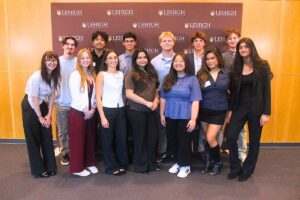
This summer, Tanveer won first place in the Advanced AI and Machine Learning category of Lehigh University’s STEM-SI competition. Here, she poses with fellow winners. | Photo provided by Fatima Tanveer ’29
For Tanveer, the moment didn’t just reinforce that her research mattered. It reminded her when you follow what interests you, you can make your mark on the world—even when you don’t have the homefield advantage. “I realized if you’re passionate about something, you can do it,” she says.
And this has become central to Tanveer’s Lafayette experience. In just her first year and a half at the College, the budding engineer (who also has a minor in mechanical engineering) has built robots, conducted research, founded a campus organization, and thought up technologies that could make life better for others. For Tanveer, engineering is a means for helping people.
Originally from Pakistan, Tanveer attended 11 schools by the time she reached 11th grade, moving frequently as her father, an army officer, was stationed in different locations. She once envisioned becoming a doctor—so vividly, in fact, that her family affectionately called her “Dr. Fatima.” But by high school, she discovered she had a deep passion for computer science and mathematics. At the encouragement of a high school teacher, Tanveer made the switch to engineering. “I realized I can go into robotics to help people in the same way I would have helped them if I were a physician,” she says.
Her goal to improve the lives of others is quite personal: “My grandmother is quite elderly and has had several falls, one of which happened while I was with her at a library in Pakistan,” Tanveer says. “That moment stayed with me, and it’s a big reason I want to work on robotics that support people’s mobility and independence.”
At Lafayette, she found a space where she could pursue her ambitions while also exploring interests beyond engineering. “The fact that Lafayette is a liberal arts college allows me to explore the breadth of my personality,” Tanveer says. The opportunities Lafayette offers students to take courses across disciplines, interact with students with different perspectives, and develop communication skills she believes are essential for engineers working with the broader community, Tanveer says, were a huge draw. “I also liked how the class sizes are so small here that you can make a memorable impact on your professors, and vice versa,” she adds. “The chance to build connections is what brought me to Lafayette.”
When she arrived at the College, Tanveer noticed something was missing: a robotics club. With Lafayette’s Cur Non motto as her inspiration, she founded one herself, giving students another pathway to combine classroom concepts with hands-on projects, explore the broad applications of engineering, and have fun. “The purpose of the club is to give students even more space to do what excites them,” Tanveer says.
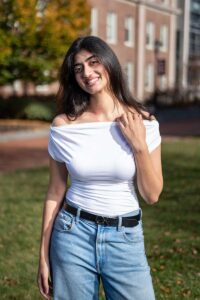
Tanveer is the founder of Lafayette’s Robotics Club, communications chair of Lafayette’s chapter of Engineers Without Borders, and an EXCEL Scholar. | Photo by JaQuan Alston
The club has already launched three projects: a four-wheeled rover, a miniature four-legged robot inspired by robotic dogs, and a self-playing musical instrument. The Robotics Club is also developing opportunities to introduce younger students to engineering through workshops for first-year students and community outreach with Girl Scouts. Tanveer hopes to one day collaborate with local schools and bring the club to international competitions.
For her, the organization represents what Lafayette is all about: creating a community where students can experiment, collaborate, and discover what they are capable of, and encouraging and empowering them to act on their ideas. “The biggest lesson I’ve learned at Lafayette, I think, is the spirit of Cur Non applies to a lot of what I’ve done,” she says. “If I want to practice robotics and there’s no club, why not start a new one? If I want to take a history class and a differential equations course at the same time, why not do it? If I want to work on my own research project, why not go for it?”
Tanveer has carried that curiosity into her work as an EXCEL Scholar as well, conducting research with Yih-Choung Yu, professor and department head of electrical and computer engineering. Her current project involves developing a small social robot that identifies different types of candy, sorts them into separate compartments, and offers selections to people it encounters in Acopian Engineering Center. By observing whether someone responds positively or negatively, the robot can adjust its next interaction. Tanveer says the concept allows her to investigate complex engineering concepts, including robot navigation, camera performance, and social robot design.
Through her coursework, Tanveer also pursues her interest in better understanding not only how machines function, but also how humans interact with and respond to tech. For her Building the High-Tech Startup course, Tanveer personally went into the Easton community to interview people and learn firsthand what kind of technological innovations could potentially benefit people with physical disabilities. The experience ultimately sparked her idea to create a clothing fastener that could allow someone with limited mobility to open a shirt with a simple tap. “I hope to work on the project over the next two to three years,” Tanveer says.
She’s also made it a point to explore other disciplines through her course selections. Tanveer’s First-Year Seminar, “Global Justice,” for example, challenged her to consider international issues and various global perspectives. “It’s really cool to me that you can take whatever class you want at Lafayette,” she says. Tanveer even took a data science course at Lehigh through the Lehigh Valley Association of Independent Colleges (LVAIC) cross-registration program, which also broadened her own perspective as a student and gave her an even greater appreciation for Lafayette’s smaller, close-knit campus community. “When you have a lot of students in a larger university, it becomes really difficult to be able to cater to each student and provide resources for all of them in a manner they need,” Tanveer says.
Lafayette’s proximity to Philadelphia and New York City presented Tanveer with the opportunity to compete in hackathons at Yale and Columbia, “opportunities that are well within reach for Lafayette students,” she says. She also serves as the communications chair for Lafayette’s chapter of Engineers Without Borders and has worked as a fitness assistant on campus. “All of these roles helped me immerse myself in American campus culture as an international student,” Tanveer says.
Next semester, she will be taking her studies abroad through Lafayette’s Engineering in Bonn program in Germany, where she plans to complete required engineering coursework while soaking in a different academic and cultural environment. Tanveer will also be conducting research in Prof. Maren Bennewitz’s Humanoid Robots Lab at University of Bonn. “Finding a research home abroad was possible because of Lafayette’s connections and encouragement,” Tanveer says.
She credits several members of the Lafayette community with helping her pursue these opportunities, including Jenn Rossmann, dean of Engineering; Priyank Kalgaonkar, assistant professor of electrical and computer engineering, Tanveer’s adviser, and Robotics Club adviser; Yu, her EXCEL research mentor; and Matt Bednarsky, Dyer Center program manager, who has helped Tanveer connect her engineering ideas with entrepreneurship. Their encouragement, she says, has made it possible to turn her ideas into action.
In the future, Tanveer hopes to earn a Ph.D. in robotics and pursue a career in industry, eventually starting her own company focused on assistive technology. Whatever direction her career takes, Tanveer says, Lafayette is where she is excited to develop the expertise to make those dreams possible.
“Lafayette has been very kind to me,” she says. “The College has helped me bloom with grace in the way I want to bloom. You don’t just build your life at Lafayette; you enjoy building it here.”
Categorized in: Class of 2029, Electrical and Computer Engineering, Engineering, Featured News, News and Features, STEM, Student Profiles, Students