October 6, 2026
Leisure after the last shift
By Brianna Miron ’26
People spend decades saving up for retirement, but give far less thought to what they’ll actually do with it.
Beyond income, work can provide individuals with a sense of purpose, structure, and community. Without a job to fill their hours or a career to define themselves by, retirees must find fulfillment through other outlets. Prof. Chu Chu and Julia Mudry ’27 have been working to identify those outlets by researching how the aging population engages in leisure activities.
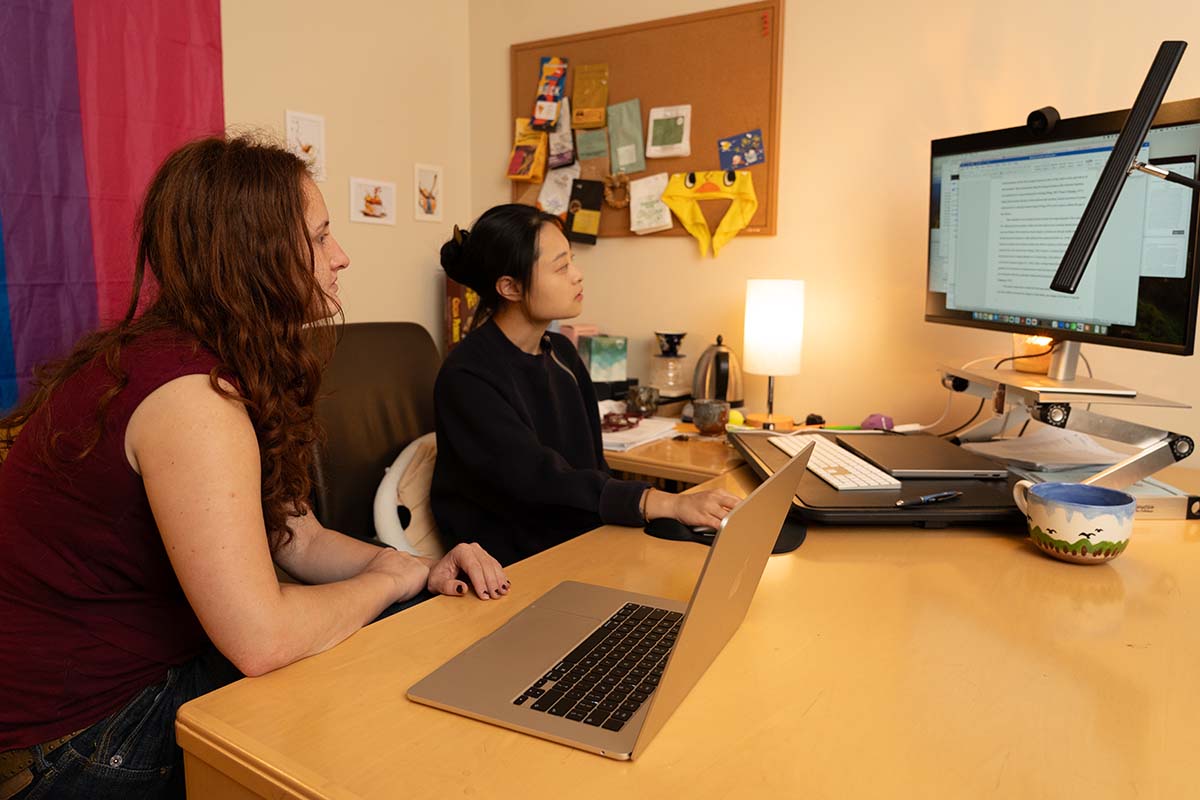
“We want to assess three common themes—social, well-being, and active—on a continuum, to make it clear what someone really emphasizes about why they like a certain activity,” says EXCEL scholar Julia Mudry ’27. | Photo by JaQuan Alston
Chu, assistant professor of psychology, has witnessed this transition firsthand in her own pottery-making and Japanese tea ceremony classes, which are made up almost entirely of retirees.
“A lot of them treat their hobby almost as a second career, especially folks who don’t have grandkids or a big family,” Chu says. “It seems to have filled part of the identity they lost after retirement. It also gives them a community space to share something.”
To study this phenomenon empirically, Chu and Mudry have spent months developing and fine-tuning a new measure to analyze recreational behaviors. The MELI, or Modern Engagement in Leisure Interest measure, is designed to characterize what kind of leisure activities an individual engages in and how they do so.
“We want to assess three common themes—social, well-being, and active—on a continuum, to make it clear what someone really emphasizes about why they like a certain activity,” Mudry says. “Some people say, ‘I like to take walks,’ and some people say, ‘I like to take walks with my dog and partner,’ and for those two people, what they like about that leisure activity might be different.”
This summer, Mudry also has been drafting protocol for in-person, qualitative interviews with retirees. Along with MELI, these in-depth conversations will help Mudry and Chu evaluate how seriously someone participates in an activity, and whether there’s a connection between their leisure and vocational interests.
This mixed-methods study could provide insight into the types of leisure activities people could most benefit from in retirement. “Previous studies on the aging population find that having a serious leisure hobby, pursued with a career-like effort, is very beneficial for mental health,” Chu explains. “With our new measure, we can assess which hobbies tend to be pursued seriously, and which ones are the most beneficial for retired folks to find meaning in and form this alternative self-identity around.”
When she arrived at Lafayette, Chu found herself as one of the youngest members of her pottery and ceremonial tea classes. Chu realized how often these sorts of hobbies appeal to those who are retired or later in their careers. “Finding additional purposes outside of work prior to retirement can really help with that transition,” she says.
Mudry views her own grandmother as proof of this. “She was always doing something, and now that she’s 85 and still going at it, I’m realizing the value of that for life,” she says.
Both Chu and Mudry describe the research process as its own exercise in exploration. Designing a study and developing methods for data collection has given them ample opportunities to collaborate and learn from one another.
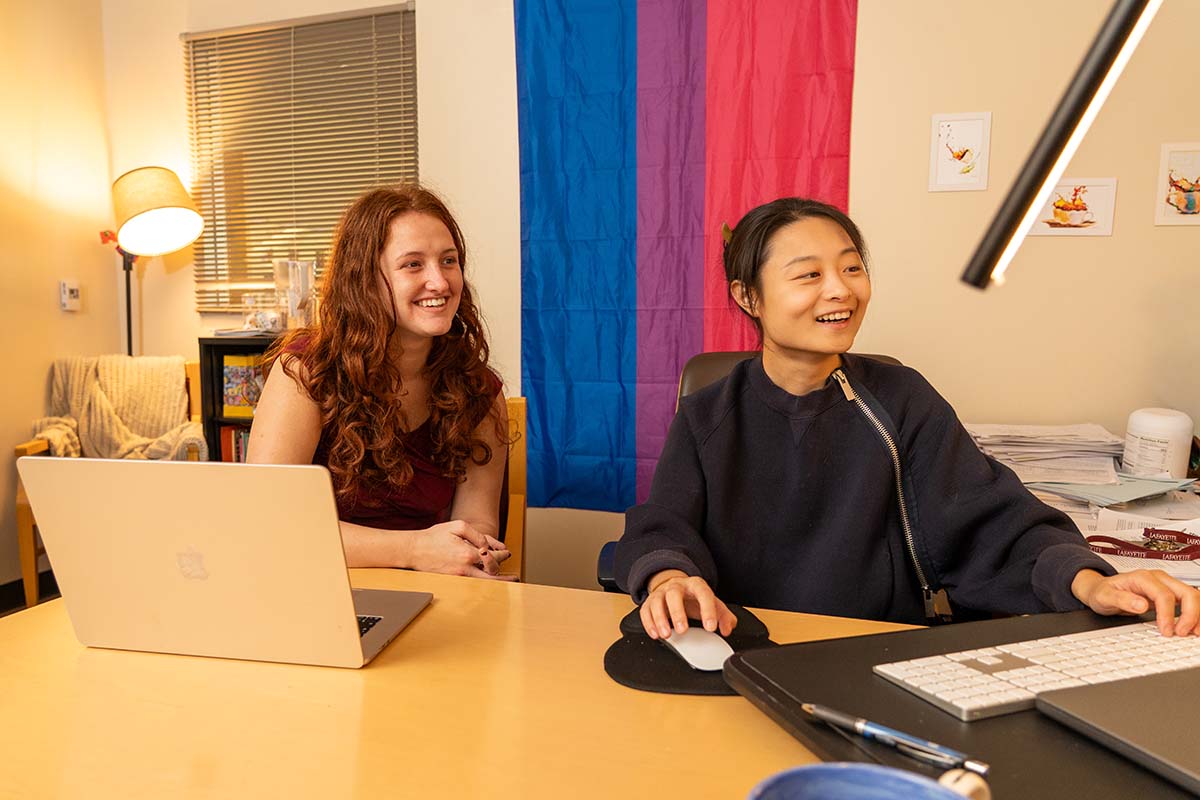
Mudry and Chu took a new step into qualitative research with this summer research project. | Photo by JaQuan Alston
“Developing a relationship with a professor is really valuable. It teaches you new ways to think,” Mudry says. “And now I feel comfortable asking questions, which was definitely something that was nerve-wracking for me at the beginning of college. But everyone has questions.”
Chu seems to be learning just as much from EXCEL Scholars like Julia, whom she describes as “mini graduate students.” Mudry’s findings on “serious leisure interests” during the literature review phase helped inform the final study.
“I’ve never done qualitative research before, so this is all very exciting for me,” Chu says. “At Lafayette, working with undergraduate students who are also exploring allows me to face the fear a little bit. It’s OK that I don’t know perfectly how this is going to go.”
Categorized in: Academic News, Faculty Research, Featured News, News and Features, Psychology, Research